
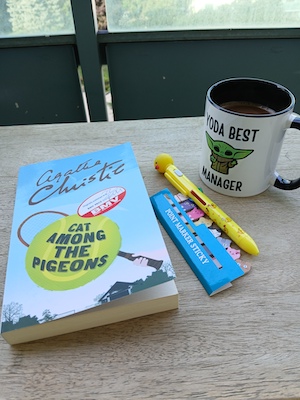
I Try to Solve an Agatha Christie Mystery | Cat Among the Pigeons (Hercule Poirot)

The prince of Ramat, a fictional Middle Eastern country, dies in a revolution. Before he does, he asks his English pilot to find a way to get his jewels, worth three quarters of a million pounds, out of the country and safely out of his enemy’s hands. The pilot spends a mysterious twenty minutes alone in the hotel room of his sister and teenage niece, and when his and the king’s bodies are later found, the jewels aren’t with them.

The story then moves to an exclusive all-girls boarding school in England, Meadowbank. Among its pupils are the pilot’s niece Jennifer, her best friend and the daughter of a former intelligence agent, Julia, and the dead king’s cousin, Princess Shaista. The faculty and staff include school co-founder and formidable headmistress, Miss Bulstrode; her co-founder and reliable right-hand, Miss Chadwick; her presumed successor, Miss Vansittart; the new secretary, Ann Shapland; an unlikeable games mistress with a history of uncovering people’s secrets, Miss Springer; a smart English and Geography teacher, Miss Rich; a snobby French teacher, Mademoiselle Blanche; and a handsome young gardener, Adam, who’s actually a British intelligence officer undercover to ferret out anyone who may be after the king’s jewels. All lovely and idyllic, until one late night when Miss Springer is found dead in the new Sports Pavilion.

Cat Among the Pigeons is a bit of a mixed bag for me. I LOVE boarding school mysteries, and as someone who grew up in an all-girls Catholic school, stories that take place in that kind of environment are among my favourite kinds. But I’m also not fond of mysteries involving international espionage. Nothing against them, they’re just not my thing. And even though, at its heart, this mystery is about missing diamonds, there’s a lot of international intrigue flavouring the crimes.

As a mystery I’m trying to solve, this case unfortunately falls a bit flat for me. The location of the diamonds is obvious really early on. They’re clearly at the centre of the whole thing, so the motive behind the murders also seems easy enough to guess. The methods are also fairly straightforward: Miss Springer is shot from four feet away, and the blunt object used to kill the second murder victim is mentioned within the same chapter. All that’s left to figure out is whodunnit.

This isn’t to say that the murderer’s identity is easy to suss out. I’m actually at the point right before the big reveal, and I don’t know who the murderer is. I have my suspicions, of course, but I don’t feel particularly strongly about them. The trouble is, what I usually LOVE in Agatha Christie mysteries is the psychology aspect. Give me ALL the drama! Give me ALL the overwhelming emotions and personality clashes! If money is involved, then let the suspects be all shady and scheming and trying to appear perfectly innocent. With the whole espionage angle and GBP750,000 at stake, there’s a bit of professional detachment to this crime, and that in turn makes it not quite as gripping for me as her other works.

That being said, this is still a good book, and an enjoyable read. I loved reading about the school and all the personalities in it. There’s a chapter composed of characters’ letters to home that I found really interesting. I also really enjoyed the subplots about characters’ lives, like Miss Bulstrode choosing her successor, Miss Chadwick worried about upcoming changes to her beloved school, Ann Shapland being a restless sort with a series of different jobs and not wanting to settle down and marry her nice but dull boyfriend, and so on.

It’s just as a mystery where I’m trying to piece together the clues that this case isn’t quite as much fun for me as some of Christie’s others. I may have enjoyed it more if I’d simply read it as a story rather than tried to solve it, but even then, I wish there had been a lot more focus on the boarding school intrigue and personality clashes amongst students and staff, and a lot less on the whole hidden diamonds thing.

Did I Get It Right?

30% yes? Which in this case is pretty much a no, LOL. I did figure out one of the murders, and I actually did suss out quite a number of details about other characters. I even guessed the ultimate big reveal at one point. Unfortunately, I then dismissed that guess as a red herring, and deemed the actual big reveal villain to be innocent. Oops.

The epilogue, about the ultimate recipient of the prince’s diamonds, was a surprise to me, and also really sweet.

***SPOILERS BELOW***

Continue reading
I Try to Solve an Agatha Christie Mystery | Sad Cypress (Hercule Poirot)

Sad Cypress begins with a courtroom scene: Elinor Carlisle is accused of murdering Mary Gerrard. She had several reasons to dislike Mary: first and most hurtful, the man Elinor loves, Roddy, is in love with Mary instead. Then, shortly before her aunt, Mrs. Welman’s, death, Elinor receives an anonymous letter, warning her that Mary, the daughter of Mrs. Welman’s tenants, is after her aunt’s fortune.

Sure enough, one night when Mrs. Welman is seriously ill, she asks Elinor to call her solicitor; she wants to make provisions for Mary in her will. Unfortunately, she dies before the solicitor can be called, and it turns out she never made a will at all. Having died intestate, her entire fortune goes to Elinor, who then honours her aunt’s wishes by giving Mary a generous sum from the estate.

Some weeks later, Elinor is cleaning out her aunt’s estate. She invites Mary and Mary’s friend, Nurse Hopkins, to join her for lunch. And Mary ends up dead, killed by morphine while Elinor and Nurse Hopkins were washing dishes. Elinor is arrested for the death, but fortunately, her aunt’s doctor, Peter Lord, is convinced of her innocence, and enlists the help of Hercule Poirot to prove it.

I loved reading this mystery! I had great fun parsing through the clues, and adding my little kitty sticky notes to pages with clues, ideas, or comments I wanted to mark. Whodunnit feels pretty straightforward; I had a bad guy in mind from the start, and now a few pages from the big reveal, I still think that person’s the most likely culprit.

I admit I was also tempted to let my mind spin out into wild alternative theories. Certainly, there are enough gossipy tidbits and long-ago scandals to throw suspicion on other individuals. But at my last attempt at solving an Agatha Christie mystery, the solution turned out to be simpler than I expected, so I’m going to go against the grain here, and stick with the simplest reveal. I’ll type it below, and then lock it in.

Did I Solve It?

Nope. My other strong suspect turned out to be the killer, but I ultimately ended up accusing someone else. To my credit, I did pick up on a lot of the important clues; I just figured there must have been another reason behind them. Bah, Dame Agatha, you’ve fooled me again!

***SPOILERS BELOW***

Continue reading

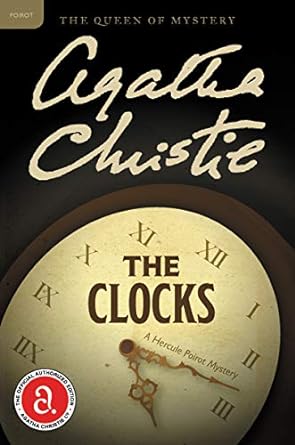
I Try to Solve an Agatha Christie Mystery | The Clocks (Hercule Poirot)

I admit, I didn’t enjoy The Clocks as much as I did Dumb Witness. Nothing against Dame Agatha’s writing; it’s just that this one has elements of espionage in it, and I much prefer domestic crimes rooted in family dramas.

I’m also afraid that my eagerness to try another Agatha Christie over the holidays, I may break my victorious end to the year. I honestly didn’t expect to get through it so quickly, and that may be because, unlike with Dumb Witness, I figured this one had a spy-related solution and so didn’t really bother trying to solve it. At least until just pages before the big reveal, when I realized that, spy elements or no, I simply can’t resist trying to outsmart the Queen of Crime at every turn.

Here’s the set-up: freelance typist Sheila Webb is called to No. 19 Wilbraham Crescent, the home of Miss Pebmarsh, for a last-minute job. The door is unlatched, so even if Miss Pebmarsh isn’t home when Sheila arrives, she should just let herself into the sitting room to the right of the entrance. Sheila does so, and stumbles onto a dead body. As she’s processing the fact, Miss Pebmarsh arrives home. It turns out Miss Pebmarsh is blind, so Sheila warns her about the dead body, and runs out of the house screaming into the arms of Colin Lamb, who happens to be passing by. Colin is “officially” a marine biologist, but is really a spy. He’s friends with Hercule Poirot, who’s retired and kinda depressed, so Colin takes him the case to cheer him up.

Some elements of curiosity:

  • Sheila’s boss says that Miss Pebmarsh asked for her specifically, but Sheila doesn’t know why as she hasn’t ever done work with Miss Pebmarsh before. More oddly, Miss Pebmarsh denies making the call in the first place.
  • Sheila enters the house at around.3 pm; Miss Pebmarsh’s cuckoo clock chimes the hour. But there are four clocks in the room that are turned to the time 4:13. Miss Pebmarsh denies having those clocks at all. Later, as Inspector Hardcastle is about to take the clocks into evidence, he finds only three.
  • Inspector Hardcastle finds a business card on the dead man, but when he investigates, both the man’s name and his company don’t seem to exist.
  • During the inquest, Sheila’s co-worker Edna says that something couldn’t have happened the way one of the witnesses says it did. Shortly after, she turns up dead.

Somewhat ancillary to this, but possibly related, Colin is in the area because he’s investigating a person of interest. His only clue is the number 61, the letter W, and a drawing of a crescent. Living at No. 61 Wilbraham Crescent is an engineer who seems shady in that he’s bad at his job, but not necessarily the kind of shady that Colin is looking for.

Through both Colin and Inspector Hardcastle’s investigations, we meet a whole cast of characters in the neighbourhood, including an overworked mom whose husband is away for long stretches of time, a woman with 14 or 19 cats (different characters have different counts), and a few more. Poirot plays armchair detective in this one, literally, relying on Colin to share all possible clues while Poirot’s little grey cells do their work.

And while I didn’t quite put as much effort into solving this case as I usually do with other Agatha Christie cases, I’m somewhat (arrogantly) confident I know what happened. So I’m locking in my guess, with equal confidence that I will be wrong and my lack of interest in spy fiction kept me from picking up most of the relevant clues.

Did I Solve It?

LOL, no not at all. And even when I thought through a significant clue with a 50/50 chance of getting it right, I chose the wrong answer. Ironically, my proposed solution did somewhat touch on the answer to the espionage case Colin was working on, so I guess in this particular story, I turned out to be a better spy than detective!

*** SPOILERS BELOW ***

Continue reading