
Review | I Hunt Killers, Barry Lyga

7766027As the teenage son of Billy Dent, the most notorious serial killer of the 21st century, Jazz feels constantly under scrutiny. It’s only a matter of time, he imagines people thinking, before Jazz turns out just like his father. It doesn’t help that before Billy was imprisoned, he trained Jazz to join him in killing. As Jazz observes, “For Dear Old Dad, Take Your Son to Work Day was year-round.” [p.11] Jazz likes to believe that even if his father hadn’t been imprisoned, he would have been able to shake off his father’s influence anyway, but a part of him can’t help but notice how easy it would be to knock a cop unconscious. A part of him understands that a killer had removed his victim’s fingers not just for trophies, but to symbolically give the finger to the police. Despite his best efforts, Jazz had indeed absorbed his father’s lessons, and would make a great serial killer.

Barry Lyga’s I Hunt Killers has an incredibly audacious premise. As a mystery and thriller aficionado, I’ve read quite a few serial killer stories, and the Dexter Morgan character is utterly compelling. But to explore the potential of a teenage boy to be a serial killer — and more importantly, to have that boy not be a psychopath, but rather someone who is fighting desperately to avoid what he fears is his destiny.

In his quest not to be his father, Jazz is determined to use his father’s training to hunt down a serial killer currently terrorizing his neighbourhood. In doing so, he is faced with how much he really has learned about being a successful serial killer. This is dark and twisty territory, the kind that in an Ian Rankin, Stuart MacBride or Val McDermid novel would probably have the hero drinking or doping heavily. Lyga keeps it PG-13, with Jazz being more like a tortured superhero than a truly broken man, but kudos to the author for not shrinking back from the darkness in Jazz’s psyche. The mystery itself is puzzling enough, but Jazz’s relationship with his father is just as complex and frightening as you might imagine it would be in real life. At times, Jazz seems much more mature than a teenager, but then with a childhood like his, it’s certainly understandable.

I Hunt Killers is a daring, complex, disturbing novel. Lyga pulls it off with well-paced plotting, fascinating characterization and pure guts. The ending felt a bit too superhero serial, dialling back a notch on the disturbing possibilities with a fairly standard promise of a new adventure. Still, after the rest of the story, I have no doubt Lyga will pull it off again with the next books in the series.
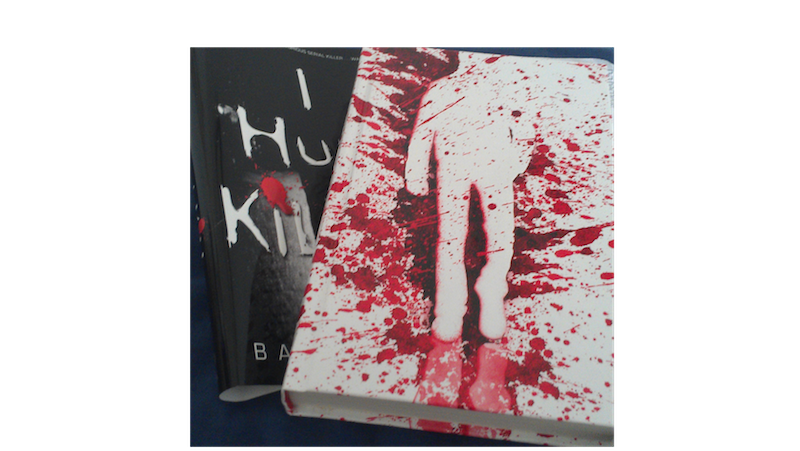
Finally, the hardcover edition has probably one of my favourite book designs from last year. Kudos to jacket and book designer Alison Impey. The experience of opening the dust jacket to realize what lay beneath is an apt introduction to the impact of the novel itself. Striking, horrific and memorable, with the rather audacious, almost defiant title I Hunt Killers, this book draws you in even before you turn the page, and it simply refuses to let go.

+

Thank you to Hachette Book Group Canada for a copy of this book in exchange for an honest review.
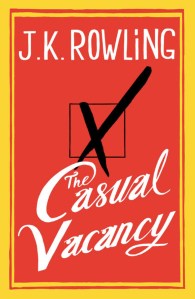
Review | The Casual Vacancy, J.K. Rowling

Britain JK RowlingI really, really wanted to like this book. I love the Harry Potter series, and here’s the thing: I also really like English village stories, social satire and political intrigue. I started reading J.K. Rowling’s The Casual Vacancy knowing it would be nothing like Harry Potter, and determined to read it on its own merits. Reviews of this book generally seem to fall into two categories: it sucks because it lacks the magic of Harry Potter, or it’s obviously not Harry Potter (duh!) and it’s absolutely amazing!

In my defence, I did give this book a fair chance — several, in fact. I started and stopped reading it several times over  the past couple of months, trying to see if I’d enjoy it more in a different mood. Unfortunately, about halfway through, I admitted defeat. I didn’t enjoy this book, and quite frankly, I didn’t want to waste any more of my time trying to get through it. This doesn’t mean it’s a bad book — opinions on it are fairly evenly split, which tells me you’ll either love the book or hate it, and it’s likely a matter of personal preference.

In the interest of fairness, whenever a publisher sends me a book, I make it a point to finish it before posting a review, just in case something happens in the last few pages that changes my opinion of the book. In this case, however, as I said, I didn’t want to keep trying anymore, and so, in case the book suddenly becomes much more to my taste at the halfway point, my apologies. Consider this a review of only the first half.

The reason I couldn’t get into Casual Vacancy is that it lacked the magic of Harry Potter. And by magic, I don’t mean wands and wizards, but rather narrative magic. Harry Potter cast a spell over the reader, and made me want to keep turning the page. It was compelling storytelling, with characters you cared about, and with a few exceptions, Casual Vacancy fell flat.

Rowling’s writing is as solid as ever, with a touch of Austen-like wry humour in her tone. Take the opening sentences for example:

Barry Fairbrother did not want to go out to dinner. […] However, his wife had been a little stiff and uncommunicative over lunch, and Barry deduced that his anniversary card had not mitigated the crime of shutting himself away in the study all morning. [p.3]

So far, so wordy, but the contrast between the formal “mitigation” and the trivial “anniversary card” is a bit of a convivial smirk at the reader, setting the tone of subtlety and irony that Rowling attempts throughout.

Rowling focuses on the mundane in this book. The tale of a small town political battle is told with endless minutiae of daily life. It’s as if Rowling wanted to prove how ordinary and un-magical she could write, and ends up being a bore.

I think part of the problem is that there’s a huge cast of characters, with little to differentiate them. They’re mostly greedy and power hungry, which could make for some wonderful gritty storytelling, or sharp, biting satire. Rowling’s writing lacks the edge to pull it off, and instead merely points them out to us, as though presenting a series of generic bad people one after another after another ad nauseum.

There are moments of brilliance. I love the scene where a woman decides to wear a sari to Barry Fairbrother’s funeral — even though her neighbours will disapprove, it’s like an inside joke between her and Barry. Great moment, touching, yet with a rousing touch of defiance against social conventions. My favourite, however, is Sukhvinder’s story. A teenage girl who unfortunately has facial hair, she is bullied in school (by a boy I actually loathed in the few chapters I’d read of him) and called a hermaphrodite, a hairy ape and so on. In probably the best scene from what I’ve read, Rowling writes how Sukhvinder hides in her room, with her mother and sisters talking in the background, and cuts herself. It’s taut, tense and powerful, and I wish the rest of the book had that same power.

Unfortunately, the story of the adult characters, which is the focus of the book, is much less compelling, much more meandering. I was bored; I couldn’t care less; I gave up.

+

Thank you to Hachette Book Group Canada for a copy of this book in exchange for an honest review.

Review | Where’d You Go, Bernadette?, Maria Semple

The email from Hachette Book Group Canada began: “Please let me know if you’re interested in receiving the book that Jonathan Franzen ‘tore through…with heedless pleasure,’” but it was Maria Semple’s book trailer (above) that hooked me. If she could make me laugh this hard with the trailer, I really wanted to see how much funnier the actual novel would be.

whered-you-goWhere’d You Go, Bernadette? is about fifteen year old Bee’s quest to find her mother, Bernadette, who has disappeared. At first, the story sounds like it would be depressing (a missing mother!) or at the very least, a literary award bait type coming of age/quest narrative (journey of a young girl, etc, cue violins). Fortunately, in Semple’s hands, the premise is comedic gold. This book had me laughing throughout — not subdued, ladylike giggles either, but rather chortling, falling off the bed in hysterics laughing.

It even has what is probably one of my favourite lines in a book, ever:

I attempted to pull Ms. Griffin off the teddy bear, which appeared to be causing her acute distress. [p. 176]

I love the format Semple chooses — instead of doing a straightforward narration of events, Semple tells her story through emails, newspaper clippings, and other pieces of research Bee uses in trying to find her mother.   Through this, we get to here Bernadette’s voice, which is hilarious, naive, and somehow also tragic. Bernadette is a compelling character, a talented architect whose work takes America by storm and yet who somehow ends up a homemaker in Seattle.

Seattle is hardly the middle of nowhere, but Bernadette is horribly displaced, and her snarky comments about Microsoft, the rain and five-way intersections are razor-sharp. She is so out of her element in fact that she outsources most of her day-to-day work, such as making travel arrangements or buying graduation presents, to a “virtual assistant from India” for 75 cents an hour. Her emails to Manjula, the virtual assistant, are chatty and free-wheeling, reminding me of Becky Bloomwood from the Shopaholic series, and just like Becky, Bernadette seems much too naive to realize when she’s over her head.

Bernadette also has to deal with “gnats,” what she calls the fussy, snobbish women in her neighbourhood. The biggest gnat of all is a woman named Audrey Griffin, who hires “a blackberry abatement specialist” to clear her yard, and who is constantly at odds with Bernadette. Without giving too much away, I had no idea something as simple as “abating” a yard of blackberries could escalate into one of the most epically comic neighbourhood battle of wills I’ve ever seen.

Given how hilarious this book is, it’s a lovely surprise, and a testament to Semple’s talent, that it never devolves into pure farce. Rather, there’s much heart in this novel. We end up really caring for Bernadette and her family. Take for example my Goodreads update on page 266:

this book has been hilarious so far, but this part might just make me cry. 😦 I really want Bee to find her mom. 😦 [Goodreads]

The book gets to you. I was muttering “gnat” whenever I saw Audrey’s name, and I was truly worried when I realized another woman had the hots for Bernadette’s adorably geeky husband. The reason Bernadette moved to Seattle in the first place is on one hand, utterly comic, yet on the other, rather heartbreaking. Bernadette is a believable, lovable figure from her very first email to Manjula, yet her pre-Seattle life adds so much more depth to her character.

The ending is a bit too neat, especially considering the utter wild abandon that characterized the comedy throughout the novel, but I was still happy with how things turned out. The narrative also slows down considerably when Semple abandons the madcap rush through bits of evidence and instead switches to straightforward narration from Bee’s perspective. The switch makes sense, story-wise, but the narrative momentum waned. Still, Where’d You Go, Bernadette? is comedic gold. If that book trailer makes you giggle, be warned: the book will make you laugh, will make you gasp, and every once in a while, may even make you shed a tear or two.

+

Thank you to Hachette Book Group Canada for a copy of this book in exchange for an honest review.