
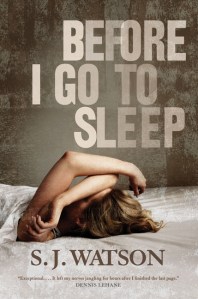
Before I Go to Sleep, S.J. Watson #50BookPledge

Oh. My. God. S.J. Watson’s Before I Go to Sleep is amazing. Read it, read it, read it. But first, and trust me on this one, make sure you have a few hours to spare. Sleep kept me awake till 2:30 am.

My tweets while reading:

May 18th, 4 pm: Engrossed in ARC of S.J. Watson’s Before I Go to Sleep. Out in June, watch for it. Incredible so far.

[I stopped reading for a few hours, then decided to read just a bit more when I went to bed around 11 pm…]

Midnight: OMG, the twists keep coming. S.J. Watson’s fault if I sleep super late tonight.

1 am: Literally gasped out loud while reading.

2 am: I knew it! I knew it!

2:05 am: Holy crap. I didn’t know anything after all. Chills.

That was when I realized I should just stop live tweeting my reading experience before I flooded my followers’ feeds with even more “Aha!” and “Oops.” moments.

How much do I love this book? And why do I love it so much? Check out my full review on Savvy Reader or read below.

S.J. Watson will be reading at Harbourfront Centre, Toronto, June 22nd.

Or check out this Vizme token to see an excerpt, a bit about the author and other cool stuff.

+

Full Review

[I just noticed that my review has been archived on the Savvy Reader site, so I’m republishing it here.]

Before I Go to Sleep is pure psychological thriller. Christine wakes up in a strange bedroom beside a middle aged married man she doesn’t recognize. It is only when she goes to the bathroom and sees her hand that she realizes that her skin is wrinkled, and that she too is wearing a wedding ring. She sees photos of herself, twenty years older than she thought she was, taped to the bathroom mirror. She also sees photos of the man from the bed, labelled “Ben, your husband.”

Ben explains that an accident eighteen years ago has destroyed her memory. While she can usually remember things that happen during the day, she will have forgotten them by the time she wakes up the next morning. She sometimes gets flashes of memories about her childhood, but most of her life is a complete blank. When Ben leaves for work, he says, “I love you, Christine. Never forget that.”

I thought Sleep was going to be an emotional, heart breaking tragedy, and in many ways it is. What if you lose your memories every time you went to sleep? There are events and people I remember vividly — sometimes, the most random of things, like riding the spinning teacup when I was three. Then there are events I remember, but am not too clear on the details. Memories are notoriously unreliable, and I love the security of looking at photos and knowing that that moment, at least, was real. To lose even the most tenuous hold on memory, to look at photos and have them evoke no sense of recognition, to have lost the last two decades of your life — I don’t even want to imagine how that would be like. In one scene, Christine is angered by Ben’s seeming indifference to a past event. Then she realizes that, for Ben, the emotions have already scabbed over, years before. Yet for her, emotions will always be raw, because she will always, every day, be experiencing them for the first time. So Christine’s condition is tragic; the last sentence in the book almost made me cry.

But Sleep isn’t just a beautifully crafted drama. Christine receives a call from Dr. Nash, who tells her she’s been his patient for a while now. He returns to her a journal she’s written, from which Christine reads about her past, but as disconnected from it as if the journal were a work of fiction. How much can we trust this journal, when Christine herself can’t remember writing it? More importantly, why does she have snippets of memories that don’t agree with what Ben has told her about her past? Are these real memories, or has Christine created them herself? Is Ben lying to her, and if so, is it just because he wants to spare her pain? Who are these people she remembers, who seem so familiar and yet whom she can’t identify?

Watson takes us right into Christine’s mind, and I, at least, was just as confused as she was. I’d think I knew who to trust, and what the truth is, only to find out later that I was wrong. As readers, we have a bit of an advantage over Christine — unlike her, we don’t have to begin from scratch with every new day in her story. Yet, even with that advantage, I found myself frustrated, dying to know more, wishing I knew the truth. Watson depicts very vividly how much more frustrating it must be for Christine.

Before I Go to Sleep is a powerful, gripping, and yes, tragic, psychological thriller. I didn’t want to go to sleep when I was reading it; I just kept wanting to find out more. I also found myself getting caught up in Christine’s fear and paranoia; I certainly didn’t want to go to sleep with that kind of mindset.

More importantly, however, the title perfectly encapsulates Christine’s own, much more urgent, desire not to fall asleep yet. Each slumber is a kind of death. We expand our life by building on our memories; Christine must live as full a life as she can each day, because she starts completely from scratch again the next. And she must do this while dealing with potential half-truths and lies from people she has no choice but to trust.

Trust me: read this book.
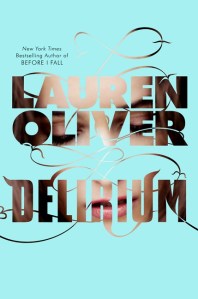
Delirium, Lauren Oliver #50BookPledge

In Lauren Oliver’s Delirium, love has been diagnosed as a disease, and everyone is required to undergo the cure when they turn eighteen. When I first heard the premise, my cynical brain immediately thought it was brilliant. No more Eponine-style romances for me! Thing is, the procedure doesn’t just kill off romantic love. My sister, who also read this book, called it practically a lobotomy, and that’s what it is: the doctors surgically remove every last bit of passion. You will never been heartbroken, but you will also view your friends and children with cold logic (you’ll give your baby milk because he’s hungry and needs food to live, not because you can’t stand to see him cry). You will no longer feel depressed, but you will also never enjoy your hobbies with as much fervour as before. Hana, the best friend of protagonist Lena, tells her early on, “You know you can’t be happy unless you’re unhappy sometimes, right?” And it’s true. Cliches aside, if you remove all violent emotion, you’ll have to remove the good with the bad.

Unlike Hana, however, Lena can’t wait for the procedure. When she was very young, her mother committed suicide because she was too infected by amor deliria nervosa to be cured. All Lena can remember is her mother laughing and dancing with her (then immediately checking to see if anyone had noticed; too much laughter after all is a symptom of delirium) and her mother fiercely telling her, “I love you. Remember. They cannot take it.” Lena is heartbroken by her mother’s death, and looks forward to being cured and freed from all that pain. I love that the heroine begins the novel looking forward to the procedure, and horrified whenever Hana makes negative comments about it. My natural reaction, once I found out the procedure destroyed all passion and not just romantic love, was to wonder how anyone could think that was a good idea. Lena’s desire to forget a completely different kind of pain made sense to me, and showed me how this procedure could be seen as a good thing, even by intelligent, non-brainwashed-drone individuals like Lena.

But Lena falls in love. Only three months before her procedure, she meets a boy named Alex, who has the scars of the cured, but whom Lena saw laughing when something messes up an evaluation interview. I love how she falls in love with him not just because of his good looks (though he is hot), but because of the tremor of laughter in his voice, and the constant look of amusement in his eyes. In a world where serenity is prized and passion is feared, happiness is enticing. Alex too, it turns out, first develops a crush on Lena when he sees her acting silly during a run — as Lena discovers during class picture day, even her ordinary looks are transformed into great beauty when she’s really happy. It’s wonderful seeing this tale from Lena’s perspective — I worry with her when Hana sneaks off to attend an underground party (with real music! Not the government regulated chipper tunes!), I feel for her whenever she remembers her mom, and I get just as giddy as she does whenever she meets up with Alex. She still worries about ending up like her mother, and I love what Alex tells her about the downside of the cure: “That’s when you really lose people, you know. When the pain passes.” I think of when my grandfather died, how my biggest fear is forgetting how he looks, or how he sounds. Pain sucks, but Alex is right; pain also keeps the past alive.

As you can probably tell, I love this book. It’s an emotional ride, which reminds me of how repressing emotions actually ends up making them burst out even more violently. I love how it goes beyond just a romance, and deals with the value of passion in so many things — friendship, family, music, hobbies, and yes, love.

I remember how violently I felt about things when I was younger, and how much more practical I am today. I remember how, when I was young, an older cousin told me never to fall in love, because it hurt too much, and I remember how I, fuelled by Disney movies mostly, vowed never ever to turn away from love, because I’d rather be hurt than block myself from feeling. I remember changing my mind later on, and chalking it up to maturity. Delirium is about a surgical procedure that removes strong emotions, but I wonder, though not as extreme, do we all subject ourselves to a similar procedure in the name of growing up?

This book will make you believe in love again. At the very least, it will make you realize why numbing yourself against pain, while tempting, can never work in the long term. Delirium ends with a bang, which actually reminded me of a Le Carre novel (I can’t say which, as that would totally be a spoiler). It’s a wonderful, exciting book that I hope will touch you like it has touched me.

By the way, if you plan on getting this book (as you should!), just to let you know, I found out on the Harper Collins Canada website that Delirium: The Special Edition will be published July 20, 2011. It’ll have new cover art, a Q&A with author Lauren Oliver and an exclusive excerpt from her next book! Pretty cool, eh? (Thanks to Harper Collins Canada’s Savvy Reader for letting me know details about Delirium: The Special Edition!)

Ten Thousand Saints, Eleanor Henderson #50BookPledge

Eleanor Henderson’s Ten Thousand Saints hooked me from the first line: “‘Is it dreamed?’ Jude asked Teddy. ‘Or dreamt?’” Not sure why I liked it so much, and I certainly don’t really care about the answer, but I do want to find out more about someone who would ask that question. I also love the way Henderson describes Teddy as wearing “opalescent, fat-tongued Air Jordans, both toes bandaged with duct tape” and Jude as “the one in Converse high-tops, the stars Magic Markered into pentagrams.” Character and time are established with such vivid, concrete detail, and there’s something endearing about the image of Magic Markered pentagrams and duct taped toes.

It’s no secret that Teddy’s about to die; the very first page situates the story “on the last morning of 1987 and the last morning of Teddy’s life.” By the second page, it probably isn’t much of a mystery either how he dies. Adopted by a pair of diehard hippies, Jude grew up taking drugs like other kids take pop, and the novel begins with Jude and Teddy  “celebrating Jude’s sixteenth birthday with the dregs from last night’s bowl.” So when Teddy dies of an overdose, how is a guilt-ridden Jude supposed to cope? He goes to live with his pot-dealing father in New York (he even names his bongs!), and that’s where the story really takes off.

Jude meets Teddy’s half-brother Johnny, who introduces him to straight edge, an underground youth culture that is vehemently against drugs, meat and sex. There’s quite a bit of irony in Jude’s parents shaking their heads and wondering where they’d gone wrong raising a son who now rejects drugs. There’s also quite a bit of wistfulness as Henderson explores the generational gap. Jude’s mother is a sweet, sympathetic character, whose decision at one point to be a part of the gang rather than a mother leads to hurt feelings. I also love how she wonders why her generation’s music about sex and drugs sounded so mellow and peaceful, while her son’s songs about morality and just saying no had to be so angry. Jude’s friend Eliza is such an intriguing character as well — she’s pregnant, and so is forced to grow up quickly (as are Jude and Johnny, who band with her and vow to help support the child), and at the same time, foreshadows a future generational gap that she will face with her own child. Her pregnancy both highlights the urgency of the trio figuring themselves and their lives out, and also expands the story of three teenagers into a bit of a family saga.

There is so much I can say about this book! It’s the kind of story that builds slowly, drawing you in closer and closer as you keep reading, until it ends and I, at least, was left with thinking, “Wow! What an ending.” I love the way Henderson develops her characters. I didn’t grow up in the 80s, and straight edge culture isn’t something I’m familiar with. But I was definitely drawn in by all these complex characters, who are all dealing in their own way with Teddy’s death and their potential role in it, and trying to figure out who they are and who they want to become. I just made the book sound incredibly cheesy, but it’s not; Henderson’s narration is subtle, humorous and heartfelt.

I love the way Henderson describes things: “he placed his finger under her chin and tilted her head slowly, slowly up until her eyes met his, the way a parent will prepare a child for a reprimand, or the way a man will prepare a woman for a kiss.” Tender, and what a spot-on image parallel! Or: “‘It’s a nice face,’ she said. Nice. It was so much more than nice, but she couldn’t think of a better word. You didn’t call a boy beautiful, not a boy who was your husband’s best friend, not a boy who didn’t like girls and who went around picking fights and who you really did think was beautiful.” Again: spot on, with the last phrase.

Saints goes beyond just wonderful characters and descriptions; it encapsulates an entire era — the reaction against the consequences of hippie lifestyles and the realization that, no matter how cool you may be, your children will always seek to differentiate themselves from you. Saints also deals with homosexuality and the advent of the AIDS crisis. I love the way Henderson reveals that a character is gay: “‘You want to know what it feels like? Bein’ with a girl?’ Rooster dropped his hand. ‘It feels like bein’ a fuckin’ coward.’” Bam.

Henderson’s characters feel very, very real, and so does their story. I don’t know if I’d call it a page-turner, but it does make you live in Jude, Eliza and Johnny’s world. To be honest, after the first page, I didn’t really get into it until Teddy died (which, because I glossed over that bit in the first page and didn’t bother to read the plot summary, came as a complete shock to me). But, like I said, it just kept building, and the ending is just wonderfully wistful. Beautiful, wonderful book. Highly recommended.