Review | Sanctus, Simon Toyne

I read Simon Toyne’s Sanctus because of the above trailer. [Note: If you like zero spoilers, ignore the above trailer. It convinced me to read the book, but it also made the first few chapters seem slow, because I already knew what was going to happen.] Promotion for Sanctus focused heavily on its similarities with Dan Brown’s Da Vinci Code. To be honest, while I’m a thriller fan, the deluge of “next Dan Brown” conspiracy thriller books that came after Brown’s success has made me cynical about that type of book.

Still, the trailer did intrigue me enough to check it out. There are definite plot similarities to Da Vinci Code, though the cinematic quality of Toyne’s writing, especially at the beginning of the novel, also reminded me of James Rollins. Unlike Brown and Rollins, however, who both rely heavily on research for their books, Toyne chooses to locate Sanctus in the fictional Citadel, a Vatican-like city-state in Turkey. As well, rather than the Catholic church, it is a fictional religious order of monks that guards the novel’s big secret. This detracts a bit from the impact of the novel, as it then becomes easier to believe the whole thing fiction and therefore Toyne’s revelations didn’t have as much impact on me as Brown’s. However, this decision also frees Toyne to imagine a secret and a conspiracy far beyond the realm of the ordinary.

I enjoyed Sanctus. The novel began a bit slow for me. From the trailer above, I already knew what the monk was going to do. Also, with so many characters in the first few chapters, it felt like a montage of scenes, and I couldn’t find a character to latch on to and care about. Still, once the story gets going, I really enjoyed reading about Inspector Arkadian and Liv Adamsen.

Sanctus is about how one monk’s actions endanger the secrecy surrounding the mysterious Sacrament hidden from the public for centuries by a group of monks. The monk’s sister, Liv, might be an integral part of a prophecy surrounding this Sacrament, and she is hunted by the monks trying to keep the secret and a group of people who want the secret to be revealed.

Toyne writes well, and Sanctus is an enjoyable read. For most of the book, however, it just didn’t grab me as much as I thought it would. I think that’s because it felt so much like The Da Vinci Code, except with the bad guys belonging to a fictional religious group and the clues pertaining to a religious document that doesn’t exist (or at least makes no claim to exist) in the real world. So while I was gasping at Brown’s observations about the Mona Lisa or alternate gospels, I viewed the document in Sanctus with detachment.

It wasn’t enough of a fictional world to completely transport me (as, for example, the world in Lord of the Rings, where I take a prophecy as significant because it feels significant within that world), nor did it have enough hooks in reality to completely grip me (as in the best James Rollins books). I did care enough about the characters to want to keep reading about them, but not enough to make real emotional investment (as I did with Spycatcher). Sanctus is a good book, a well-written, well-paced thriller, but nothing about it really struck me.

At least, that was true until the big reveal. When I found out what the Sacrament was, and why it was significant, I was completely, utterly blown away. I think I was still expecting a Da Vinci type reveal, so I figured that whatever the Sacrament was, it would have the same impact on me as the monks’ sacred document did. Well done, Mr. Toyne. I absolutely did not see that coming. Also, I realized why it was a good thing that Toyne stayed away from the extensively researched worlds of Brown and Rollins.

Sanctus is the first volume of the Ruin trilogy, and I’m curious about where Toyne will take his story for the next instalment. To be honest, I can’t imagine how he’ll take this story to a full trilogy. Then again, as my experience of reading Sanctus showed, Toyne’s imagination can certainly trump mine.

Author Encounter & Giveaway | Peter James

Now how could I resist an invitation like that? Meet an author, meet Harper Collins people I chat with on Twitter, and, most of all, eat snacks. Seriously, though, if you’ve caught my review of Peter James’ Dead Man’s Grip, you’d know that I’ve recently become a fan of his Roy Grace series. After meeting him last Wednesday, I must say I’ve become a major fan of the man as well.

Sometimes called the real-life Castle, Peter James researches his novels by going out with actual police officers on their beats. Once, he was with some police officers when they encountered a group of drunken men. Off to the sidelines taking notes for a book, Peter realized it was about to get violent and that he had to do something. “So,” he told all of us gathered at the Harper Collins Canada office, “I immediately looked for the smallest guy.” That brand of heroism explains the tiny handcuff pin he was wearing on his lapel, a joke gift from a police force because that was about the size of the criminals he was capable of arresting.

I don’t really know what I was expecting when I met Peter James, but it certainly wasn’t the super smiley, sweet and absolutely delightful man he turned out to be. After all, this was the man whose book turned me off salmon for weeks. (Interesting side note: I actually ate smoked salmon before meeting Peter, and regretted it when he mentioned the salmon scene in his talk.) Still, when he walked in with a glass of wine and a huge smile, he looked mostly like a kindly librarian, and you just can’t help but smile back.

I’m very nervous when meeting authors, so it helped that Peter was so friendly. It was so easy to chat with him that Cory from Harper Collins finally had to step in at around 9 pm and suggest that we ask our questions while getting our books signed.

Interesting things I learned about Peter James

  • He once had himself locked inside a coffin for half an hour, to see how it felt like, so he could write a scene authentically. “I wasn’t completely stupid,” he said. Before getting into the coffin, he’d asked someone how much air he’d have inside. Answer: 3 hours if he didn’t panic, 1 hour if he hyperventilated. So Peter went for 30 minutes. Still, as the funeral parlour man was walking off after sealing him in, Peter couldn’t help thinking about how old the funeral parlour man was. Plus, “What if he gets run over before coming back?”
  • He allowed himself to be locked in a van and submerged in Shoreham Harbour as a publicity stunt for Dead Man’s Grip. Why? Well, Jeffrey Deaver’s James Bond novel Carte Blanche was being released at about the same time. Peter wanted Roy Grace to give James Bond a bit of competition in publicity. Don’t believe me? Check out this video:

I asked Peter if he ever spoke to criminals for his research. I personally found Tooth (cold-blooded killer for hire in Dead Man’s Grip) a very well-developed character, without us getting too much of his back story, which is very rare for thrillers. Turns out, he does. He wanted to find out the motivations behind various crimes, so, for example, he once interviewed a career burglar. It also turns out that Peter intentionally shows all three perspectives in his books: victim, cop and killer. It’s an interesting choice, something I liked in Dead Man’s Grip, and definitely not an easy balancing act.

Win a signed copy of Dead Man’s Grip

It was a fun evening, and I especially love the way Harper Collins packaged our event swag. As I mentioned in my Dead Man’s Grip review, Shannon from Harper Collins had already kindly given me a copy a few weeks ago. Personally, I think he’s a fantastic writer, and if you haven’t read him before, I think Dead Man’s Grip is a great way to get into the series. (My review here) I’d love to introduce you all to this mystery series. (Or, if you’re already a major Peter James fan, I’d love to let you read his latest!)

So here’s the deal: leave me a comment on this post by October 15. Imagine you’re a novelist. What’s the wildest stunt you’d pull to research or publicize your book? (If you can’t think of anything, just leave whatever comment you want. I just think it’ll be fun to see what kind of stunts you’d come up with. 🙂 ) One of you, randomly picked, will win a signed copy of Dead Man’s Grip. (Sorry, I’m keeping the cool bookmark and ever cooler yellow crime scene tape for myself. 🙂 ) Canada only, please.

Vote Peter James

By the way, Peter is also in the running for ITV3 People’s BestsellerDagger Award. You can vote for him here till Oct 7th, 9 am. Whether you’re already a huge fan of the Roy Grace series, or you just want to give props to an author who’d actually lock himself in a coffin and risk drowning himself in a van, you can vote there up to 5 times. Bonus: If he wins, Cory from Harper Collins Canada has promised to throw an authentic English fish and chips party like the one Peter James promised his UK fans. Personally, I like Roy Grace, I think Peter locking himself in a coffin is insane but kinda cool, and I love fish and chips. So I voted.

EDIT: Yay! Peter James won the People’s Bestseller Dagger Award! Very well deserved, in my opinion.

Another Dagger winner is S.J. Watson, whose novel Before I Go to Sleep kept me up all night, literally. Loved it and blogged about it here.

Congratulations, Peter and S.J.!

Do leave a comment for your chance to win a signed Dead Man’s Grip. Trust me: you’ll love it.

Happy birthday, Jess! ~ Review roundup in honour of my sister

My sister Jessica is celebrating her birthday today. She’s introduced me to some of my favourite books and writers ever, including:

  • The Harry Potter series by J.K. Rowling
  • The Rebus series by Ian Rankin
  • The Spenser series by Robert B. Parker
  • The Guido Brunetti series by Donna Leon

… and lots, lots more. So, I figured, what better way to celebrate her birthday on my blog than by writing about some books and genres she loves?

The Hunger Games trilogy, by Suzanne Collins

I don’t have to tell you how awesome this series is, do I? It’s one of the most brilliant YA series I’ve read, possibly second in my mind only to Harry Potter. It took me months to convince Jess to read it, and she’s now an even bigger fan than I am. It just has everything: an inspiring heroine, self-sacrifice, politics, reality TV, family, kick ass action scenes, and yes, a love story.

If you’re one of a handful who hasn’t read the book yet, check out the website here to find out more about it. Better yet, read the books already. Trust me on this one.

Even better, there’s a movie out in 2012.

Love The Hunger Games and looking for your next read? May I suggest Moira Young’s Blood Red Road or Veronica Roth’s Divergent.

And, if you’re a nerd like me, check out The Girl Who Was on Fire, full of essays about the books.

View my review of The Girl Who Was on Fire 

To Kill a Mockingbird, by Harper Lee

One of Jess’ favourite books ever, and I’m sure a lot of you already agree about how awesome this book is.

Harper Lee’s To Kill a Mockingbird still feels as relevant today as it did when it was first published. Despite all the tense race relations Lee depicts in her story, Lee also offers us some of the most inspiring characters in literature. How often do we watch the news and wish we had lawyers or politicians with as much integrity and passion for justice as Atticus Finch? How much do we wish we had the same staunch beliefs in right and wrong that Scout has? In Lee’s tale of a white lawyer defending a black man in a racist town, we simply fall in love with her characters, and cheer them on, whole-heartedly, in their battle, which is a battle for justice, but more importantly, a battle against hate.

The Sigma Force series, by James Rollins

Actually, any book by James Rollins is guaranteed to have two things: insane thrills and science that seems too weird to be true, but is actually based on extensive research. The Sigma Force series, which Jess introduced me to and we both love, has the added bonus of starring a team of kick-ass nerds. Seriously, imagine Sheldon Cooper with a black belt in karate and Iron Man type gadgets.

Reading Rollins is always like watching a good movie: you’re riveted by the action, and freaked out by the knowledge that there’s a kernel of truth in the story. His latest, Devil Colony, isn’t my favourite of his books, but it’s still pretty damn good.

View my review of Devil Colony

For Rollins fans: he’s a very active tweeter, and chats often with fans.

Follow James Rollins on Twitter

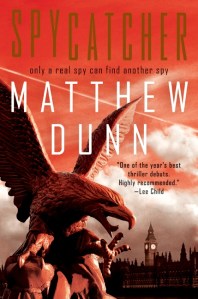
Spycatcher by Matthew Dunn

Jess is a huge fan of spy novels, especially those that feel “close to the ground.” John Le Carre, Alan Furst and Len Deighton, rather than Ian Fleming. Matthew Dunn’s Spycatcher caught my eye as something she’d enjoy. To my delight, I absolutely fell in love with this book myself, and I’m not even much of a spy fiction fan.

Dunn is a former MI6 agent, and like Le Carre, his field experience is almost palpable in his writing. (Unlike Le Carre, Dunn doesn’t use a pseudonym, which I find interesting.) Spycatcher follows Will Cochrane as he tries to stop an Iranian terrorist. It’s a thrilling story, and while Cochrane and his team appear almost superhuman at times in their strategies, Spycatcher works so well because we see Cochrane’s vulnerability, his humanity. We feel his pain at not having seen his sister in eight years, and we long as much as he does for him to be able to settle down with the woman he loves. Incredible book, and I can only hope Dunn writes even more.

View my review of Spycatcher

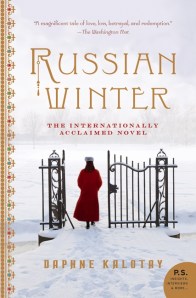
Russian Winter by Daphne Kalotay

Jess loves books about Russia, especially books written bySolzhenitsyn, Dostoevsky and Chekhov. I haven’t blogged about any of their books (I’ve also never read Solzhenitsyn, though Jess assures me he’s really good), so here’s the next best thing: Kalotay’s Russian Winter is about Nina Revskaya, a former ballet dancer now living in Boston and auctioning off her jewelry. A mysterious link between her and a man who appears to own a necklace that belongs to one of her sets leads Nina to remember her past in Russia under Stalin. The present-day scenes were okay, but I just love the scenes in Russia. The descriptions of ballet are just beautiful, and Kalotay makes us feel both the fear of Stalin and the characters’ desire to escape this fear through art.

View my review of Russian Winter