Are You My Mother? A Comic Drama, Alison Bechdel

I’ve heard great things about Alison Bechdel’s graphic memoir Fun Home, about her relationship with her father. While I haven’t had a chance to read it myself, when I heard about her upcoming Are You My Mother? I decided to check it out.

Thomas Allen (Canadian distributor for Bechdel’s publisher HMH Books) was kind enough to send me the advanced uncorrected proof of Are You My Mother? to review. It contained only the first chapter of the book, and so while I cannot give a full review, I can certainly tell you my reaction to that excerpt. Here it is: I want to read more.

I looked up the book online, and saw this article that says HMH has planned a first printing of 100,000 copies for Mother, which is “a pretty daring number for a sophomore literary writer, and one of the biggest ever for a [graphic novel].” Great news, especially if you loved Fun Home and can’t wait to read more. Mother is on sale today!

From the blurb: Mother takes a look at the life of Bechdel’s mother,

voracious reader; music lover; passionate amateur actor. Also a woman, unhappily married to a closeted gay man […] [Mother] leads readers from the life and work of iconic 20th-century psychoanalyst Donald Winnicott, to one explosively illuminating Dr. Seuss illustration, to Bechdel’s own (serially monogamous) adult love life.

Personally, I can’t wait to see the “explosively illuminating Dr. Seuss illustration.” In the first chapter alone, Bechdel begins by wondering how best to tell her mother about Fun Home to reflecting on Virginia Woolf, symbolic dreams and psychotherapy. There is a touching glimpse of Bechdel as a child, dictating the events of her day to her mother who wrote them in a journal. Bechdel’s recitation was, she admits, “obsessive-compulsive” in the amount of mundane details, yet still her mother “was listening to me. Whatever I said, she wrote down.” In stark contrast to this is her confession to her therapist that she is drawn to the work of Donald Winnicott because “I want him to be my mother.”

Bechdel’s mother as she appears in the first chapter is a complex figure — loving yet critical, eager to give constructive criticism on Mother yet at other points also seeming to distance herself from the work. I am already fascinated by this woman, and am eager to read more about her. The excerpt ends with a powerful montage, a cluster of photographs Bechdel discovers and arranges “according to my own narrative.” Apparently taken as a continuous series of shots, the images of Bechdel as a baby in her mother’s arms reveal the mom making funny faces and the baby getting progressively more delighted. In the second to the last photo, the baby is practically screaming with laughter, only to end with the baby’s wary glance at the man behind the camera in the last photo. So much is said in two pages. The juxtaposition of her mother’s chatter about Lady Gaga in the present day (in jagged boxes) with Bechdel’s narration about the photographs (in regular rectangles) heightens the poignancy of the moment. You can almost feel the past and the present merging, and you are pulled right into this family’s tale.

Bonus: the proof I received also included a peek at Alison Bechdel’s process of creating this memoir. I had no idea how much work went into creating a graphic memoir. I always just assumed the cartoonist drew the page by hand and then scanned it onto the computer and then somehow ink and colour it digitally. Okay, to be honest, I was more than a little blurry on the details after the drawing by hand part.

For Bechdel, I learned it is a twelve-step process using practically the entire Adobe Creative Suite. I was most fascinated by the fact that her first step is writing the story on Adobe Illustrator: “even though I’m on the computer and not holding a pencil, I’m conceiving of the page in terms of images and design at the same time that I’m writing the narration and dialogue.” Confession, in case you haven’t figured it out by now – my only experience in cartooning is doodling comic strips, usually when bored at school. My process consists of drawing stick figures (or if I’m especially creative, peanut figures) and then having talk bubbles beside their heads. So I find it utterly fascinating that Bechdel (and, for all I know, perhaps lots of other graphic novel writers) designs the layout of the panels first, before drawing anything.

I don’t know if that glimpse into Bechdel’s creative process will be in the published book, but I certainly hope so. I’ve always respected writers and artists of graphic novels. Seeing Mother under step-by-step construction fascinated me, and made me respect them even more.

Great news, by the way, for Bechdel fans — she’ll be at the Toronto Comic Arts Festival on Saturday, May 5th! Tip: show up early. She’ll be at TCAF for only a day, and I bet there’ll be a huge line.

UPDATE: I’ve just received a review copy of the entire book from Thomas Allen Ltd. Thanks Thomas Allen! My review of the finished book will be posted later this month.
Review | Ichiro, Ryan Inzana

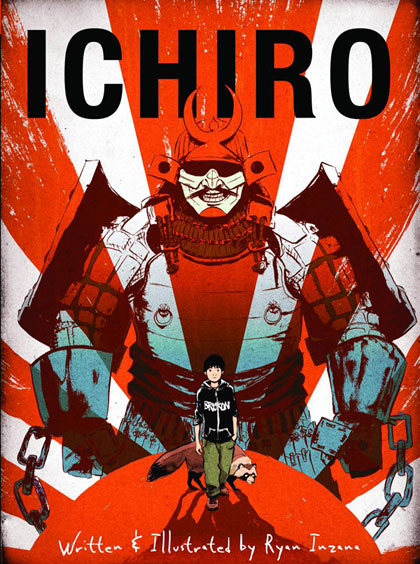
Raised by his mother in New York City and knowing very little about his Japanese heritage, Ichiro doesn’t feel like he fits in anywhere. He idolizes his father, a soldier killed during a war, and in his honour wears a shirt saying “Kill ’em all. Let God sort ’em out,” which his Grandpa Benny tells him is an army slogan. Grandpa Benny is racist, adding to Ichiro’s conflicted sense of self, being himself half-Japanese yet seeing his grandfather’s anger towards other immigrants. When Ichiro’s mother arranges a business trip to Japan and leaves Ichiro in the care of his Grandfather Sato, Ichiro learns a lot about that part of his heritage. More importantly, he learns that there is much more to war than a strict divide between a good side and an evil side. Ryan Inzana‘s Ichiro is an imaginative, textured graphic novel about the nature of war, and about the need for tolerance and open-mindedness.

I love that Ichiro explored the horrors of World War II from the point of view of the Japanese. Ichiro’s grandfather explains the historical context behind Japan’s belief in the emperor’s divinity, and tells Ichiro stories about victims of the atomic bomb. Inzana contrasts the horrific effects of the atomic bomb with a scene of teenage boys playing a war video game. “Waste that guy!” a boy exclaims, his friend happily pumping more virtual bullets into a soldier’s torso. This occurs right after images of Ichiro’s visit to a museum about the Hiroshima bombing, and, like Ichiro, we lose our appetite for such a form of entertainment. I have long been aware of the Japanese legend of the paper cranes — if a sick person can fold a thousand, she will be healed — yet, like Ichiro, I never knew that it originated in the historical figure of Sadako, a young girl afflicted by atomic radiation.

From identifying himself as primarily American, Ichiro is shaken at what he has seen and reacts by rejecting his American heritage. “How can you not hate America?” Ichiro asks his grandfather, to which his grandfather responds with a Buddhist saying, “Heaven and hell are in the hearts of all men.” That, ultimately, is the point behind Ichiro, that while there are two sides in any war, both sides are equally human, and equally capable of horrific destruction. The point, for Ichiro, is not to choose to be either Japanese or American, but to accept both sides of his heritage.

Inzana takes this subject a step further, and infuses his story with Japanese mythology. While trying to trap a persimmon-stealing raccoon, Ichiro is taken underground, into a land of Japanese gods and monsters. The Japanese-American war and its ensuing years of distrust and discrimination are mirrored in the underground war between the mythological lands of Ama and Yomi. Here, the injustice of war is even more pronounced, because we see how so much suffering was caused by a relatively minor misunderstanding. The parallelism turns somewhat didactic after a while, and I sometimes felt that Inzana was trying too hard to get his point across.

That being said, I love this imaginative way of portraying how senseless and unavoidable war is, and how horrible its consequences can be. In this land, Ichiro is viewed as a potential spy, making the experiences of Japanese-Americans in World War II all too real and immediate. As Ichiro begins to understand the complexity of his Japanese-American heritage, he faces the threat of being executed as a spy and worries about how he can get back to his real life.

I do wish Inzana handled his subject with more subtlety, perhaps by keeping it mostly mythological or mostly realistic rather than creating two parallel, yet equally weighty story lines. However, I do applaud his creative approach at tackling such a disturbing, emotional subject matter in the first place. I don’t know if Inzana’s story about Ama and Yomi are based on actual Japanese mythology, or if Inzana created it to parallel Japanese-American history. Either way, Inzana’s tale reminds me of how and why mythology is created in the first place — to attempt to make sense of situations that seem beyond understanding. With so much horror in history, how better for Ichiro to come to terms with his dual heritage than through mythology?

Ichiro is a rich story about a very troubling, emotional past. With so many stories about World War II, it is troubling to imagine how much in common we have with the teenagers happily killing soldiers in the arcade without reflecting on how real such horrors could be. Great graphic novel for anyone who wants to learn more about Japan, or about the Japanese side of World War II history.

Review | The Scrapbook of Frankie Pratt: a novel in pictures, Caroline Preston

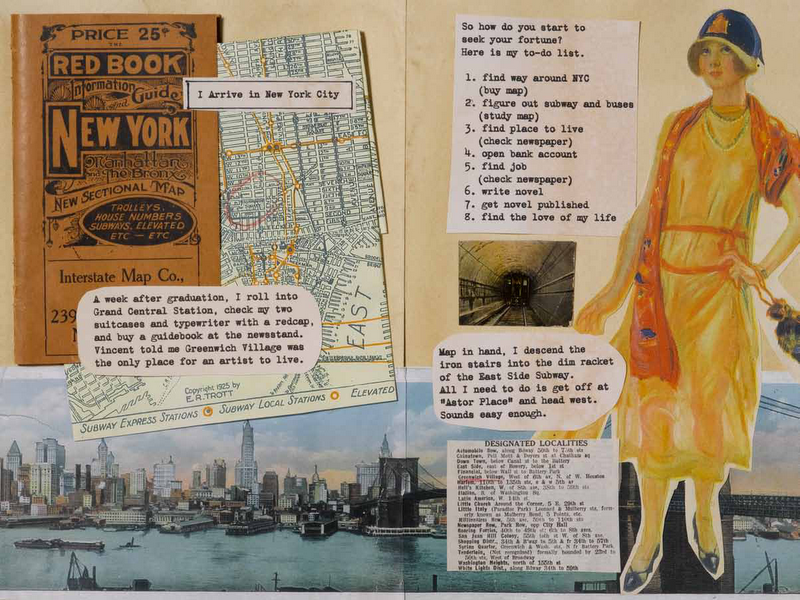
I love the concept behind Caroline Preston’s The Scrapbook of Frankie Pratt! The “first-ever scrapbook novel,” the novel takes the form of a scrapbook Frankie keeps from her high school graduation in 1920, through her days at Vassar, her struggle to be a writer in Greenwich Village and in Paris, and finally her return home in 1927. Somewhat similar in form to Griffin and Sabine, Scrapbook contains vintage memorabilia, designed as if they had been glued to the page. Pages include amusement park tickets, graduation invitations, photos cut from fashion magazine, even a magazine ad for Palmolive soap. Unlike in Griffin and Sabine, the memorabilia in Scrapbook are only images on the page, and therefore cannot be removed, but the entire look of the page is almost three dimensional.

Have you ever kept a scrapbook? Back in 2005, right before I moved to Canada, my sister gave me a scrapbook so that I would always have a piece of the Philippines with me. I turned that book into a record of my entire life — as many pictures and memorabilia as I could cram in. My scrapbook ended up looking nowhere near as artistic as Frankie Pratt’s, but it’s definitely one of my most treasured possessions. I flip through it every once in a while, and the book transports me instantly to my past, to people and memories that mean something to me.

Scrapbook transports us to the 1920s, a fascinating era in history. Frankie, voted the “smartest girl” of her graduating class, dreams of becoming a writer and finding the love of her life. Because of her ambition to be a writer, she gets to meet some of the literary luminaries of her time, such as Edna St. Vincent Millay and James Joyce. Including such significant historical figures, especially when they aren’t the subject of your story, is usually a delicate task, and it sometimes comes off as name-dropping. Preston, however pulls it off and it feels plausible. The scrapbook format also works really well, because giving each writer encounter a page or two of beautifully laid out snapshots, letters and typed lines acknowledges each encounter’s significance without either overwhelming us or trying too hard to be casual about it. Frankie’s scrapbook gives the impression that meeting James Joyce for work is as important to her as a letter she receives from a beau. I also love that Frankie is a reader. I love vintage book covers, and seeing 1920s cover art for This Side of Paradise and To the Lighthouse was just amazing. I especially love the feeling that while, for me, viewing these book covers was a trip to the past, for Frankie, these were contemporary titles, and she would have no way of knowing how significant they’d be over time.

Reading Scrapbook made me want to travel back in time to the 1920s. Well-written novels can certainly transport my imagination to the past, but the beauty of Scrapbook’s unique format is that it puts me as a reader into an interesting dual position. On one hand, I feel like a 21st century woman who happened upon an old scrapbook in an attic or a garage sale, and am viewing the significant moments in the life of someone from the past. On the other hand, I am also Frankie Pratt, viewing these things for the first time and being so excited by Beau Brummel with Mary Astor and John Barrymore that I simply must include the theatre program in my scrapbook. When I think of James Joyce’s Ulysses, I picture a heavy tome of classic literature that, because of its narrative style, is going to be a difficult read. In contrast, Frankie knows Ulysses as “the notorious banned novel!” Ulysses is the controversial novel that everyone talks about, but that is practically impossible to find. She reads it not because she wants to tackle a classic, but because it has for her the thrill of the illicit. The vintage memorabilia in the pages creates an atmosphere of magic, of passion and possibility, and I at least wished I could have been there with Frankie, experiencing all these adventures with her.

Scrapbook is also such a romantic novel! The question of whom Frankie will end up with isn’t too difficult to guess, but the relationships she forms are all so fascinating. Again, the scrapbook format enhances the romance. Images of dapper men in suits, of love letters, movie tickets and telegrams all work together to create a lush, evocative world, where a gentleman can come knocking at your door or a rogue can invite you for a spin in his brand new automobile. The scrapbook format also softens the edges of emotion. When a man breaks Frankie’s heart, we know this because of a couple of photographs and a few typed lines, over a two-page spread. Frankie has a great sense of humour, and so another painful experience is countered by a lighthearted image from a magazine ad. It is almost too easy to miss the pain behind these images, and the book forces us to stop at moments and discern all the layers of emotions revealed by Frankie’s choice of memorabilia.

I can keep going on about all the things that fascinated me in this novel, but Scrapbook is definitely better seen in person than read about. The book trailer is a bit too long, in my opinion, but it does give you an idea of how the pages in the novel look:

Scrapbook of Frankie Pratt is a beautiful, beautiful book. Frankie is a charming, intelligent, utterly delightful woman, and her personality shines through on every page. I just fell in love with this book, and I hope you will too.