Review | Dr. Brinkley’s Tower, Robert Hough

Dr. Brinkley’s Tower is a lush, beautiful novel about Mexico in the 1930s. The tiny town of Corazon de la Fuente has just survived a long, bloody revolution, the scars of which are beautifully illustrated in the condition of a mirror in the opening scene. A century of the Ramirez family’s use has created “undulations” in the glass and “a spidery hairline crack near the bottom,” but the “real dissolution” is the faint, sour smell that still lingered from the time Francisco Ramirez’s father hid the mirror under fermenting wheat to keep it away from government soldiers during the revolution.

It is easy to lose oneself in Corazon de la Fuente. Hough’s writing portrays the flavour of the small town beautifully. We are overwhelmed with the sights and sounds of the town coming together for a lucha wrestling match, our ear quickly becomes attuned to a natural blend of Spanish and English, and we are absolutely captivated by the fragility of this town’s innocence. At times, Hough gets heavy-handed with his symbolism. For example, a character describes tequila as “the taste of Mexico, captured in a glass.” What an apt, beautiful and evocative metaphor! Unfortunately, I found its impact diminished by the almost overbearing two pages of description that preceded it. That being said, I enjoyed the language overall. The publisher’s description compares Brinkley to Gabriel Garcia Marquez, and while the novel isn’t magical realism at all, there is a strong sense of nostalgia, and the potential for magic, throughout.

Central to the story is the romance between Francisco Ramirez and Violeta Cruz. I love, absolutely love, this love story. Francisco’s Quixotic devotion to Violeta is simply endearing, and I hated Dr. Brinkley before he even appeared, simply because I knew from the publisher description that Dr. Brinkley will catch Violeta’s eye. Violeta is torn between the wild animal passion she feels for Francisco, and the escape from Mexico offered by a relationship with Dr. Brinkley, so while I was rooting for Francisco all the way, I did understand her dilemma. Hough does a fantastic job portraying the town in its socio-economic context. Because Corazon de la Fuente is poor, and poorer still for the effects of the revolution, Dr. Brinkley’s radio tower does appear as a god-send, providing jobs and enticing foreigners with deep pockets to spend money in the town.

I grew up in the Philippines, where many live below the poverty line and, unlike in Canada, there is no social safety net to ensure everyone has food, housing and education. I was struck by how relevant this tale of 1930s Mexico can still be relevant today. After an incident where a contest literally leads to a riot over gumballs, Violeta realizes how much she longs “to live in a place where a simple contest didn’t turn into a showcase for violent degeneracy.” It’s a sad state, yet I remember an incident years ago where people were trampled while trying to enter a contest for money. Poverty leads to desperation.

Also striking is a scene where the Corazon de la Fuente mayor encounters racism in his own town:

– No speeky the Spanish, said a large gringo at the front of the line. – Go back to Mexico…

– I am in Mexico, said the mayor in English. – And you’re in my country, pendejo.

My ARC has that passage underlined and, in the margin, a scribbled “Yay mayor!” It’s an odd form of racism, yet it’s all too prevalent. Growing up in the Philippines, I remember how many skin whitening products are advertised, and also how much more intimidating it is to be berated in English rather than the local Tagalog, simply because the use of the English language is viewed as intellectually superior. I remember a story my aunt once told me, about a sales clerk who signalled for a tourist to jump the queue simply because he was Caucasian. The tourist was embarrassed and refused to do it, but it bothers me that it was the Filipino sales clerk who slighted other Filipinos in the first place. So when I see the mayor of this tiny (albeit fictional) town stand up for himself, I raise my glass to him. One of my favourite passages in the book.

The radio tower Dr Brinkley introduces to Corazon de la Fuente brings progress and prosperity, but it also creates problems. Other than the racism and the increase in homelessness, the radio waves also cause sound to come from metallic objects. It’s the classic debate between progress and purity — does the town sell its soul for a few pesos? — and Hough’s prose has a wonderful, nostalgic, rather regretful tone that makes his stance clear. The cast of characters is colourful. I already mentioned how much I love the mayor and the young couple in love. Also memorable is the cantina owner who goes for Dr. Brinkley’s infertility treatment (extracted from goats!) so he can make love to his wife again — such a charming man! Finally, there is the aging molinero and Laura Velasquez, a plain woman who nevertheless is the heart of the town:

In the workings of a small town, the satisfaction of a person like Laura Velasquez functioned as a sort of inspiration for those who were far luckier but who nevertheless considered themselves to be having a bad day. Her inner peacefulness… functioned as a source of illumination, particularly in difficult times…

I love that a plain woman has such a vital role in the town, and precisely because of her plainness! I also love that the molinero, a Don Juan all his life, sees her beauty, and falls in love with her. It’s a beautiful romance, and one that made me cheer.

Hough makes you cheer for the characters, and for their town, as they struggle against the compromises imposed by “progress.” I especially love how relevant this story feels, even as I felt transported into the past. Above all, I fell in love with Corazon de la Fuente and with Francisco, Violeta, the mayor, at all their neighbours.

AUTHOR Q&A

Stay tuned to my blog tomorrow for a Q&A with author Robert Hough!

WIN A COPY OF DR. BRINKLEY’S TOWER!

Would you like to be transported to 1930s Mexico? Win a copy of Dr. Brinkley’s Tower, courtesy of House of Anansi!

To win, simply comment on this post, and answer this question:

If you could re-visit any place from your past,
where would you go and why?

Contest ends March 22, 2012. (Canada only)

Author Encounter & Giveaway | Peter James

Now how could I resist an invitation like that? Meet an author, meet Harper Collins people I chat with on Twitter, and, most of all, eat snacks. Seriously, though, if you’ve caught my review of Peter James’ Dead Man’s Grip, you’d know that I’ve recently become a fan of his Roy Grace series. After meeting him last Wednesday, I must say I’ve become a major fan of the man as well.

Sometimes called the real-life Castle, Peter James researches his novels by going out with actual police officers on their beats. Once, he was with some police officers when they encountered a group of drunken men. Off to the sidelines taking notes for a book, Peter realized it was about to get violent and that he had to do something. “So,” he told all of us gathered at the Harper Collins Canada office, “I immediately looked for the smallest guy.” That brand of heroism explains the tiny handcuff pin he was wearing on his lapel, a joke gift from a police force because that was about the size of the criminals he was capable of arresting.

I don’t really know what I was expecting when I met Peter James, but it certainly wasn’t the super smiley, sweet and absolutely delightful man he turned out to be. After all, this was the man whose book turned me off salmon for weeks. (Interesting side note: I actually ate smoked salmon before meeting Peter, and regretted it when he mentioned the salmon scene in his talk.) Still, when he walked in with a glass of wine and a huge smile, he looked mostly like a kindly librarian, and you just can’t help but smile back.

I’m very nervous when meeting authors, so it helped that Peter was so friendly. It was so easy to chat with him that Cory from Harper Collins finally had to step in at around 9 pm and suggest that we ask our questions while getting our books signed.

Interesting things I learned about Peter James

  • He once had himself locked inside a coffin for half an hour, to see how it felt like, so he could write a scene authentically. “I wasn’t completely stupid,” he said. Before getting into the coffin, he’d asked someone how much air he’d have inside. Answer: 3 hours if he didn’t panic, 1 hour if he hyperventilated. So Peter went for 30 minutes. Still, as the funeral parlour man was walking off after sealing him in, Peter couldn’t help thinking about how old the funeral parlour man was. Plus, “What if he gets run over before coming back?”
  • He allowed himself to be locked in a van and submerged in Shoreham Harbour as a publicity stunt for Dead Man’s Grip. Why? Well, Jeffrey Deaver’s James Bond novel Carte Blanche was being released at about the same time. Peter wanted Roy Grace to give James Bond a bit of competition in publicity. Don’t believe me? Check out this video:

I asked Peter if he ever spoke to criminals for his research. I personally found Tooth (cold-blooded killer for hire in Dead Man’s Grip) a very well-developed character, without us getting too much of his back story, which is very rare for thrillers. Turns out, he does. He wanted to find out the motivations behind various crimes, so, for example, he once interviewed a career burglar. It also turns out that Peter intentionally shows all three perspectives in his books: victim, cop and killer. It’s an interesting choice, something I liked in Dead Man’s Grip, and definitely not an easy balancing act.

Win a signed copy of Dead Man’s Grip

It was a fun evening, and I especially love the way Harper Collins packaged our event swag. As I mentioned in my Dead Man’s Grip review, Shannon from Harper Collins had already kindly given me a copy a few weeks ago. Personally, I think he’s a fantastic writer, and if you haven’t read him before, I think Dead Man’s Grip is a great way to get into the series. (My review here) I’d love to introduce you all to this mystery series. (Or, if you’re already a major Peter James fan, I’d love to let you read his latest!)

So here’s the deal: leave me a comment on this post by October 15. Imagine you’re a novelist. What’s the wildest stunt you’d pull to research or publicize your book? (If you can’t think of anything, just leave whatever comment you want. I just think it’ll be fun to see what kind of stunts you’d come up with. 🙂 ) One of you, randomly picked, will win a signed copy of Dead Man’s Grip. (Sorry, I’m keeping the cool bookmark and ever cooler yellow crime scene tape for myself. 🙂 ) Canada only, please.

Vote Peter James

By the way, Peter is also in the running for ITV3 People’s BestsellerDagger Award. You can vote for him here till Oct 7th, 9 am. Whether you’re already a huge fan of the Roy Grace series, or you just want to give props to an author who’d actually lock himself in a coffin and risk drowning himself in a van, you can vote there up to 5 times. Bonus: If he wins, Cory from Harper Collins Canada has promised to throw an authentic English fish and chips party like the one Peter James promised his UK fans. Personally, I like Roy Grace, I think Peter locking himself in a coffin is insane but kinda cool, and I love fish and chips. So I voted.

EDIT: Yay! Peter James won the People’s Bestseller Dagger Award! Very well deserved, in my opinion.

Another Dagger winner is S.J. Watson, whose novel Before I Go to Sleep kept me up all night, literally. Loved it and blogged about it here.

Congratulations, Peter and S.J.!

Do leave a comment for your chance to win a signed Dead Man’s Grip. Trust me: you’ll love it.

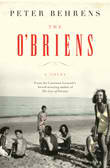
Blog Tour and Giveaway: The O’Briens, Peter Behrens

The O’Briens by Peter Behrens is a sprawling family saga that follows the life of Joe O’Brien. Chronicling Joe’s life from his childhood protecting his siblings from an abusive stepfather Joe’s business building a section of the railroad to his children going off to fight in World War II, The O’Briens also depicts a  slice of Canadian history. I haven’t read Behrens’ first novel, The Law of Dreams, and at first I was afraid I wouldn’t be able to understand this novel, but I found that O’Briens works wonderfully as a stand-alone as well.

Joe is a fascinating character, and I enjoyed watching him grow from a protective older brother to a scarred father. Like his own father, Joe has a thirst for travel, and I love how this restlessness was later inherited by Joe’s son Mike. In a novel about exploring North America and eventually settling down with a family, the O’Brien wanderlust is an apt family trait. The best parts of O’Briens are where Behrens really delves into very raw emotions, to the point that the situation can make the reader uncomfortable. The section, for example, where Joe leads his siblings in dealing with their stepfather is rather disturbing, mostly because the persons involved are young children, but I love seeing Joe’s struggle to be the father figure for his siblings and his desire to force them to grow up as well so they can survive even without him. I love the scene where Iseult has to give birth without Joe around, a terrifying episode, and Behrens captures the emotions wonderfully.

I also love the little quirks that define characters. Iseult’s obsession with photography for example, reminds me of my own mother, who loved taking pictures, though thankfully not to the extent Iseult does. The part about Iseult stopping to take a photo of her crying child before running over to see if first aid is required could have come off as gimmicky, but Behrens has set it up so well beforehand that the extent of her obsession feels natural.

Behrens’ descriptions are poetic, and I really liked some of the phrases. About stained glass windows, Behrens writes, “Rich shards of colour broke through those exuberant windows, and exotic scents — silver polish, English tobacco, China tea — drifted through the chiaroscuro rooms.” At times, I would’ve preferred a bit more subtlety in the way he depicts emotions: “Iseult felt her lungs deflate, withering as grief closed in. […] As [the phone receiver] dangled on its wire, she got slowly down on hands and needs, touched her forehead to the Tabriz carpet, then rolled over and lay on her side on the mottled wool, gasping and wheezing…” While I actually liked the image of lungs withering with grief, I found the scene getting somewhat melodramatic as it went on. What I did like, however, was that Behrens then immediately balances it out with humour, having the housekeeper Cordelia walk in and trip over Iseult’s body.

I liked the novel best when it was focused on Joe growing up. I wished it had shown more of his siblings other than Grattan — with the priest character so prominent in the first chapter, I was interested in seeing how the siblings who entered the religious life dealt with it — but I can understand Joe being completely separated from them. I didn’t find the chapters with Joe’s children as compelling, with the major exception of the part about Mike running away from home. The latter part of the novel, switching between Joe’s three children, felt somewhat disjointed, and I would’ve preferred having a central character in the next generation at least, or even Joe himself, to have provided a focal point of view.

Overall, a good book and compelling family saga. The book’s publisher Anansi has been kind enough to provide me with a copy of the book for to give away (Canadians only, please). To enter your name in the draw, just leave a comment telling me where your family is from and where in the world you would settle if you had the choice. Please also leave your email address, so we can contact you if you win. I’ll pick a random winner on June 13th.

Peter has also been kind enough to write a guest post for my blog. Keep an eye out for it tomorrow. Leave a comment on his post for an extra entry into the contest.