
I Try to Solve a Dorothy L Sayers Mystery | Gaudy Night (Lord Peter Wimsey and Harriet Vane)

gaudynight

Case number two for 2024 is by Dame Agatha’s contemporary. A blog commenter convinced me to give Lord Peter Wimsey another shot (I found Whose Body? well-written, but underwhelming), and they recommended the Harriet Vane starrer Gaudy Night.

The Story: A Book Review

I’m maybe two-thirds of the way through this book, and I’m absolutely adoring it! As someone who studied at an all girls Catholic school all the way from kindergarten to high school, and as an adult (ahem) woman close to a milestone (ahem ahem) high school reunion, Sayers’ descriptions of Shrewsury College at Oxford and their Gaudy Night reunion weekend gave me lots and lots of nostalgic feels. (I went to a co-ed university, so the associations aren’t quite the same.) My high school reunion, called a velada, is also colloquially known as Old Girls Day. I can’t find the specific line anymore (downside of print!), but there’s a reference to Gaudy Night being for the old gals or some similar phrasing, and it warmed my heart to see it.

I also very much enjoyed seeing Harriet experiencing the old campus after a decade or so away. I too haven’t been back to my alma mater’s campus in years, but I can imagine walking through it very much as Harriet does. I can imagine noticing both the familiar and the differences in sights, scents, and sensations. And while I still keep in touch regularly with my closest high school friends (thank you, pandemic Zooms!), I feel Harriet’s sensations of dismay and/or admiration as she meets old classmates for the first time in years, and realizes how little or much they’ve changed.

There are moments when Harriet does come off rather judgey, but well, that’s what naturally happens at these kinds of reunions, isn’t it? I’m sure, and Harriet is also aware, that her old classmates are judging her in turn, whether for her success as a mystery writer, or for her previously being suspected of murder. In a wonderfully mundane but real throwaway line, an old friend calls Harriet “successful,” and Harriet reflects that she knows the friend really meant “hardened.”

Beyond the nostalgia factor, Gaudy Night is also a wonderful exploration of women’s lives in the 1930s, when this was published. Sayers is fantastic at creating characters who breathe. In this novel, women from a diverse range of social classes, backgrounds, and lifestyles give voice to the societal tensions between pursuing academic accolades versus domestic bliss. All of this gets mixed in with Harriet’s own dilemma between wanting to remain independent and intellectual, and falling in love (despite herself) with aristocrat Lord Peter Wimsey. There are many fascinating conversations throughout this story, and I can imagine present-day university students geeking out in lively discussion about this novel and the societal contexts within which it was written. It’s fantastic!

The Mystery: What Actually Happens?

The incidents begin at Gaudy Night, when Harriet receives a couple of poison pen letters, of the O.G. cut-out letters from newspapers type. Even when she returns to London, she continues to receive mean notes. Yet she isn’t the sole target; students and faculty at Shrewsbury College also receive these notes, and all-in-all, the story spans an entire school year or more.

Some notes are petty (one accuses a student of stealing another’s boyfriend); some are mean (the ones to Harriet remind her of her previous murder charge). And one particularly vicious set of notes tells a student she is mentally ill and needs to die by suicide.

Beyond the notes are acts of mischief attributed to a ‘poltergeist,’ and like the notes, they form a spectrum of intensity. Some are mostly nuisance: the school library is turned topsy-turvy, a pile of scholars’ gowns is set on fire, and a book is burned. One is threatening: a dummy wearing a scholar’s gown is hung from the ceiling with a knife through its belly. And one seems particularly cruel: the manuscript that kind-hearted and naive scholar Miss Lydgate has been working on forever is defaced and destroyed, so that she has to start all over again. In an utterly chaotic and confusing chapter, the poltergeist targets several campus buildings in one evening; they cut the power, commit random acts of vandalism, and run off to the next building while Harriet, the Dean, and random assortments of residents give merry chase.

The Mystery: My Spoiler-Free Thoughts

As a case to solve, this mystery is rather baffling. The incidents (too benign to be actual crimes; too malicious to be merely pranks) strike me as without rhyme nor reason, and the targets too spread out to make the motive clear. Unlike Christie who provides us with a fairly manageable list of potential whodunnits, Sayers is unfortunately accurate in showing how challenging it is to narrow down a list of an entire campus-full of suspects. And each potential suspect has tons of opinions on the topic of women in academia. There are so many potentially important details that, for the first time, I used two pens to keep my notes straight; blue ink for suspects, and black ink for important events and clues.

In fact, the sheer volume of incidents even makes me consider if there could be a whole team of perpetrators. Could one person seriously commit all these acts by themselves? Yet there doesn’t seem to be a unifying motive strong enough to make several of them team up. On the other hand, amongst the twenty or thirty potential suspects I’ve met, which of them actually has a strong enough motive to do all these things? When Lord Peter Wimsey arrives to help solve the case, he tells Harriet, “There’s a method in it.” Harriet replies, “Isn’t the motive only too painfully obvious?” [p 358] I’m glad they think so, because alas for my poor ego, I don’t.

At this point, there is only one person whom I think makes sense as the perpetrator, and really, one particular scene that finally gave me a foothold to confidently name a suspect. Yet Peter and Harriet seem to be focusing on a different character, someone whom I suspected at first, yet eventually discarded in favour of my current prime suspect. I’m not gonna lie; their suspicions are shaking my confidence. Whereas I’m used to Christie throwing around red herrings galore, my (very limited) experience with Sayers is that she’s much more straightforward.

Most worrisome for my verdict is a scene where Peter is doing his sly best to pick up clues, and Harriet is noticing how productive his tactics seem to be. Alas for my ego, my suspect isn’t doing nor saying anything at all noteworthy! What on Earth are Peter and Harriet picking up on, that I’m missing?

Part of me wonders if my challenge stems from applying too modern a perspective on this case. Sayers steeps her mystery so much within the social milieu of her characters that I feel like the key lies in something that women of that era find incredibly important, but perhaps may not be as obvious to women in 2024. Or perhaps I’m just trying to make excuses.

Regardless, the suspect Peter and Harriet seem to be focusing on truly does not make sense to me. So I’m going to go with my gut, hope that Sayers is doing a last-minute red herring, and lock in my verdict.

Did I Solve It?

Yes I did! Boo-yah for going with my gut, and boo-yah for not letting Dorothy L Sayers lead me astray with her tricksy little red herrings along the way!

*** SPOILERS BELOW ***
Continue reading

I Try to Solve an Agatha Christie Mystery | A Pocket Full of Rye (Miss Marple)

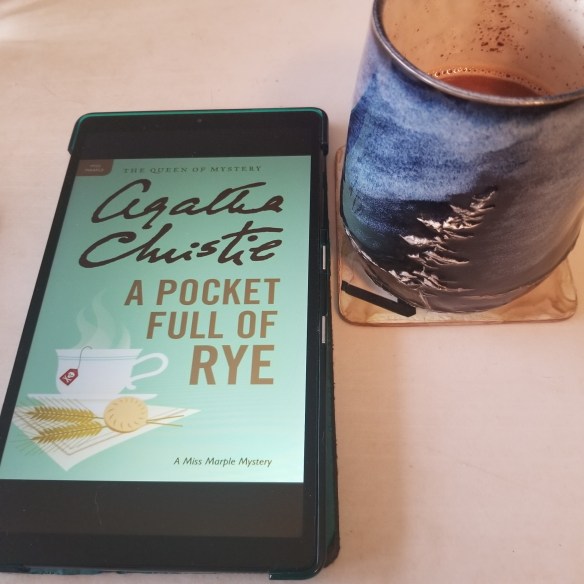
20231203_154648

Okay, first of all, I’m 86% into this novel, and absolutely LOVING it! One of my favourite scenes in an Agatha Christie, bar none, is Miss Marple’s entrance about 40% through. First, she swans onto the Fortescue estate in a taxi:

So charming, so innocent, such a fluffy and pink and white old lady was Miss Marple that she gained admittance to what was now practically a fortress in a state of siege far more easily that could have been believed possible. Though an army of reporters and photographers were being kept at bay by the police, Miss Marple was allowed to drive in without question, so impossible would it have been to believe that she was anyone but an elderly relative of the family. [41%]

And then she reveals that she’s there not to investigate the suspicious deaths of the wealthy Mr and Mrs Fortescue, but rather that of their nervous, “rabbity” maid, Gladys, whom it turns out Miss Marple herself trained for the service.

“It was the clothes-peg that really worried me,” said Miss Marple in her gentle voice.

“The clothes-peg?”

“Yes. I read about it in the papers. I suppose it is true? That when she was found there was a clothes-peg clipped onto her nose?”

Pat nodded. The colour rose to Miss Marple’s pink cheeks

“That’s what made me so very angry, if you can understand, my dear. It was such a cruel, contemptuous gesture. It gave me a kind of picture of the murderer. To do a thing like that! It’s very wicked, you know, to affront human dignity. Particularly if you’ve already killed.” [42%]

I just LOVE this image of an elderly woman managing to get past police barricades because of her fluffy pink and whiteness. And then, to have all that fluff pull back to reveal an avenging angel set to get justice for a dearly cared for servant girl. How wonderful it is that the main victims for this killer are presumably the super wealthy husband and wife, and yet it is the naive and innocent maid whose death will bring about their downfall! These passages are Christie’s masterful pen at work, and I loved every second of it.

Now for the case:

The wealthy Rex Fortescue dies at work after drinking a cup of tea. Yet the poison, taxine, is slow-acting, indicating he must have ingested it while still at home. Oddly, his pocket is full of cereal, rye to be exact.

At first, Inspector Neele suspects Rex’s much younger second wife, Adele, who is beautiful and glamorous, and also having an affair. Yet she’s the next to turn up dead, of cyanide poisoning in her tea. Then finally, Gladys’ body is found; she may have witnessed something about Rex’s murder.

Tying all three together is the nursery rhyme “Sing a Song of Sixpence,” which includes a pocket full of rye, a queen dead after eating bread and honey, and a maid whose nose is pecked off by a bird. The nursery rhyme also features blackbirds, which may provide a clue to the killer’s motive.

As for suspects, there’s a whole household full of them. There are Rex’s three children with his first wife: eldest son Percival, main heir to his father’s business; black sheep son Lancelot, who was summoned back home after Rex and Percival had a falling out, and daughter Elaine, who was in love with a man her father disapproved of. There are also the respective romantic partners: Percival’s quiet and lonely wife Jennifer; Lancelot’s independently wealthy wife Pat; and Gerald, Elaine’s communist ex-lover who left when Rex threatened to disinherit her, and returned after Rex was killed. And of course, the servants: cool and efficient head maid Mary Dove, whom Inspector Neele describes as almost performing her name; grouchy butler Mr Crump, and his grouchy wife, whose talent as a chef keeps them both employed. There’s also Vivian Dubois, the man Adele was having an affair with, and possibly the women working at Rex’s office.

Upon much reflection, I’ve narrowed down my suspect list to two key players. Per usual, I’ll type it out below, and check back in to see how I did!

Did I Solve It?

Kinda? I figured out the mastermind behind the murders, and I figured out their motive. But I got the method wrong, and my guess on an accomplice was totally off-base. There were a couple of clues that I skimmed past that turned out to be significant (or rather, I figured they may be important, but couldn’t figure out how, so I forgot about them); and at least one major clue I thought was significant but turned out to be nothing.

So, technically, this is a win, because I did figure out whodunnit and why. But I missed so many of the details that I feel only semi-victorious.

And, honestly, I’m happy about it. Because the big reveal I did not guess made me gasp out loud, and question everything I thought I knew about this case. And that, to me, is the hallmark of the most satisfying Christie mysteries.

Plus, of course, Miss Marple as a fluffy and pink and white avenging angel = sheer perfection!

*** SPOILERS BELOW ***

Continue reading

Review | Convenience Store Woman, Sayata Murata (translated by Ginny Tapley Takemori)

36739755Convenience Store Woman is short and powerful, about a 36 y/o woman who has never quite fit in, and a risk she takes to try for a “normal” life.

From the blurb, I’d expected Keiko to be socially awkward, but I love that she actually had zero clue about social / emotional / moral convention, yet actually cared about fitting in. For example, as a child, while her classmates were crying over a dead bird, Keiko thought it would be good yakitori for her father. And later, when two boys in her class got into a fistfight, and her classmates were screaming for someone to stop them, Keiko knocked one unconscious. So there’s a cold logic to her actions (chickens are birds, and knocking the boy out did stop the fight), but Keiko honestly couldn’t comprehend why people are so horrified by her.

So she spends her childhood keeping as low a profile as possible to avoid saying or doing the wrong thing, and then at 18, she finds a job at a convenience store and realizes she’s found the perfect fit. At the convenience store, there are rules that dictate how to behave and scripts that tell you what to say. At the convenience store, Keiko finally fits in, or at least knows how to fake being like everyone else.

But 18 years later, her part-time job is no longer enough for her family and friends, and her single status is earning her odd looks. So when she meets a single man looking for a wife, she thinks she’s found the perfect solution.

I loved this book so much. For all her unusual behaviour, Keiko is actually a very relatable, loveable character, and every time someone made her question her life choices, I just wanted to give her a hug. The guy she meets is a total asshole and deadbeat who is so not worthy of any woman — and I think many readers will agree pretty soon after he appears. I hated him so much. The way he spoke to Keiko (e.g. How lucky she is to have him because her womb is all shrivelled up and no one would want her) made my blood boil, and the way characters draw parallels between them (simply because they’re both single, in their 30s and somewhat odd) made me want to cry.

This book is a helluva punch, and it’s so beautifully written — tremendous emotion barely contained by the narrator’s detached language. It’s a wake up call to readers to question our relationship with social norms, and how we respond to people who don’t quite conform to expectations. Can one be happy without being “normal”?

The characters in this book ask Keiko some personal questions (even her co-workers) that may be easy to North American readers to dismiss as being culturally specific to Japan. (And certainly, some of her manager’s questions may get him fired in Canada.) But think about how people respond to adults who choose to remain single, or couples who choose to remain childless. This book will make you think hard about your assumptions about how happy such individuals are.

Convenience Store Woman is such an incredible book, and a fun read. I highly recommend it.

+

Thank you to Publishers Group Canada for an advance reading copy of this book in exchange for an honest review.