
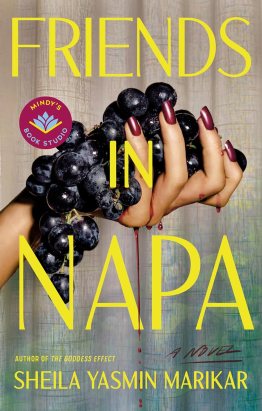
Review | Friends in Napa, by Sheila Yasmin Marikar

FriendsInNapaWell, this novel is a bit of a mess, and not in a fun way.

The premise had potential: wealthy couple Raj and Rachel invite old friends from college to Napa Valley to celebrate the opening of their new winery. As the weekend unfolds, relationship problems start to surface, old crushes are rekindled, and old rivalries reignited.

The thing is, for most of the novel, nothing really happens. Raj decides to flirt with Anjali, whom he semi-almost-dated back in college until he met Rachel. Anjali is stressed over her daughter’s vaping (medical, for anti-anxiety, but she keeps needing to increase the dose) and is also disappointed in her husband David’s gullibility and lack of critical thinking skills, so she decides to indulge. But just a bit, and never too far.

Hari starts sending out romantic feelers to Rachel, since she’s clearly unhappy with Raj, but she demurs. Raj yells at Rachel for breaking a glass, because it embarrasses him. He’s clearly a social climbing jerk, and at a few points, Rachel reflects that she’s never good enough for him, and that the fancy trinkets he buys her as apology aren’t enough anymore, but she never quite does anything about it.

And then there’s a sixth character named V, a social media influencer who’s boosting her ego post-divorce by being extra gorgeous online and letting randos pay her to do stuff online. She’s also an old friend of Rachel, but isn’t really part of the other characters’ drama, so honestly, she just felt superfluous.

There are clearly tensions running amok amongst the friends, and there are certainly moments of tension throughout. But there never quite feels like an escalation to the tension, and as a result, there is never quite a build-up of momentum instead. So when things do explode — like a random fist fight partway through that was maybe / maybe not fuelled by magic mushrooms? — it feels unearned. Worse, it doesn’t even really go anywhere. The big takeaway from the fist fight scene was a boxing pun by a side character influencer, but like, no one seemed to notice or even care that they were drugged without their knowledge?

All this comes to a head with a sudden and totally out of nowhere plot by three of the characters to take down another character. The motivation of at least one of the plotters was crystal clear, a second plotter maybe had some motivation, and the third plotter …just seemed part of the ride? Their target was certainly unlikeable, but their plan was way out of proportion. What exactly were they hoping to achieve? Possibly revenge, but then the plotter who’d want that would presumably be more concerned with setting things right. Possibly freedom, but the plotter who’d be motivated by that surely had other options at their disposal. And perhaps the third plotter wanted success, but again, there was no direct link between the plan and that goal.

Part of the challenge is that we never actually hear from the characters what their plan is. We just see them decide to do it, and then watch as it unfolds. Which would be fine if the plan made sense in the first place, but it doesn’t.

Also, at some point while the plan unfolds, the author seems to have decided that the target character wasn’t just unlikeable; they were downright evil. And so we see this character unveil an off-the-wall evil scheme of their own. Now, this character’s motivations make more sense than the three plotters’, but having them suddenly reveal all of this during that particular scene did not make sense at all. It just felt like random exposition, some final Hail Mary to justify the three “good” characters’ actions.

Finally, the ending just confused me. Shouldn’t there have been more consequences for these characters’ actions? The novel tried to hand-wave past all that with some lines about image management and online intrigue, but I don’t buy it. Or rather, I may be willing to suspend my disbelief on that, but the novel didn’t quite do enough to convince me.

I really wanted to like this book. Old friends, a gorgeous vineyard, lots of drama, and (what I thought would be) a locked room mystery. But this just felt like a bit of a hodge-podge of plot points, and while I did finish it, I never quite got fully hooked into the story or its characters.

+

Thank you to Firefly Books Distributed Lines for an advance reading copy of this book in exchange for an honest review.
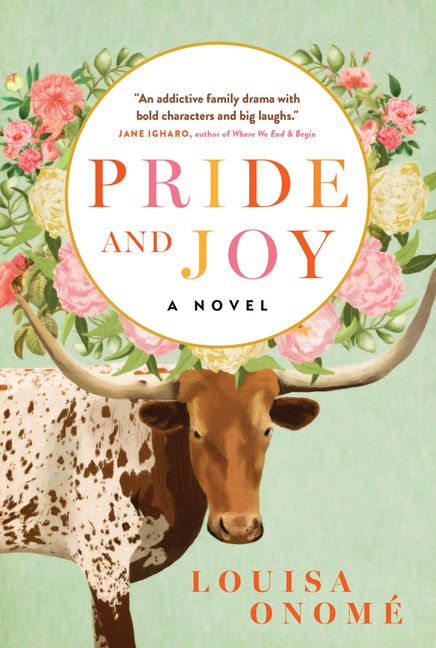
Review | Pride and Joy, by Louisa Onomé

PrideAndJoy

SUCH a fantastic book!

Pride and Joy hooked me with its very first paragraph:

Mama Mary Okafor is turning seventy today, Good Friday, and at first, no one was happy about this. Simply put, if there’s anything anyone, including Mama’s daughter, Joy, knows about Mama, it’s that she would rather die than upstage God, and yet, here she is turning seventy on a holy day.

As someone who grew up in a devoutly Catholic country and with a devoutly Catholic mother, this opening made me laugh. With two simple sentences, Onomé has painted me a vivid picture of exactly who Mama Mary Okafor and her daughter Joy are, and how they relate to each other.

Onomé’s skill in writing vivid characters carries through as the story continues to unfold. Mama Mary then proceeds to die in her sleep, and before Joy can even figure out how to grieve, Mama Mary’s sister, Auntie Nancy, declares that she has had a premonition that Mama Mary will rise from the dead on Easter Sunday. The declaration is both comic (she got the insight from seeing a brown cow on the road) and tragic (beneath it all is very real grief that the sister she has followed her entire life is gone, and to a place she cannot follow), and it’s testament to Onomé’s skill that the author balances both emotions so masterfully.

As the story progresses, an ever-intensifying escalation into absurdity barely conceals the family’s ever-intensifying struggle to manage their grief. A reporter comes to film the resurrection, dozens of Nigerian Canadians show up on the lawn to hold vigil, and a cousin shows up live streaming the happenings to her social media followers. All at the same time, relationships — between siblings, between romantic partners, amongst cousins, and across generations — deepen, fracture, and heal in varying degrees. And the birthday party turned resurrection vigil gradually morphs into a beautifully moving, raw, and gut-wrenchingly real portrait of a family coming to terms with a heartbreaking moment in their living history.

The Okafors are Nigerian Canadian, and, with the caveat that I’m not myself of that culture, the book very much feels Nigerian. Characters speak Igbo, details like the cow in Auntie Nancy’s premonition feels culturally specific, and when they Zoom in Pastor Lazarus and his congregation from Nigeria, it’s both hilarious (“Lazarus” being the name of someone who was brought back from the dead in the Bible) and also very vividly brought to life.

The book also feels very Nigerian Canadian, specifically in Joy’s anxiety that her son Jamil has learned more about his Italian heritage from his father than about his Nigerian heritage from Joy. With Mama Mary gone, who will teach Jamil the language and all the traditions that Joy isn’t confident about knowing herself? It’s an anxiety that struck a chord in me as an immigrant; my mom was my strongest link to my Filipino heritage, and ever since her death, I’ve felt more pressure to remember and keep alive all the many traditions and practices that used to be such a naturally large part of my way of life.

Overall, I absolutely adore this book. The way characters come together in the end, how they’ve grown as individuals, and how their relationships have evolved over the course of Easter weekend… it’s all so masterfully done. I particularly felt my heart swell at a scene near the end where Joy and her brother Michael “do something dumb.” The song “Sweet Mother” isn’t familiar to me at all, but I imagine it’s as meaningful to some readers as it is to Joy and Michael. The scene is pure silliness, and a vivid reminder of how cathartic and full of love silliness can be.

Read this book. It’s fantastic.

+

I won a copy of this book in an online giveaway, with no expectation of a review. I just loved it so much that I wanted to blog about it.

Review | Secret Sex: An Anthology, edited by Russell Smith

SecretSex“New risky fiction — with no names attached.”

What happens when you take 24 of Canada’s most prominent authors, invite them to write sex scenes, and promise them you’ll never reveal which scene they actually wrote? From the cover design (brilliant, by the way), to the anthology title, to the masquerade book launch, the marketing for Secret Sex turns out to be much sexier than the stories themselves.

To be fair, the editor makes it clear in the foreword that this is not a collection of erotica. Rather, it is a collection of sex stories written by literary fiction authors. So the sexiness is more akin to, say, D.H. Lawrence or Marian Engel than Sierra Simone, Sylvia Day, or even Shonda Rhimes’ take on Bridgerton.

So as someone who usually prefers sexy genre romance to literary fiction, and novels to short stories, I was prepared to flip through a few pages of this, figure out it isn’t my thing, and call it a day. Imagine my surprise then when I not only loved the first story (“Sext”), but actually read this all the way through to the end.

Not all the stories were my cup of tea, of course. As with any anthology, there are some hits and misses, and as with any fiction, especially the kind that features sex, your mileage will vary. I will admit that as a reviewer, not knowing who wrote which story also brings a kind of freedom. I can judge each story without thinking of the writer involved, or other books of theirs I may have enjoyed. Which does make my response to each story more candid than usual.

For me, there was a stretch maybe two-thirds through where the stories started to bore me, and I wondered if maybe I should have stretched this out one story at a time rather than try to read it all in a few days. But then a story (“Content Farm Confidential,” about a content ghostwriter who gets with her finance bro boss) revived my interest with its smart commentary on the sometimes soulless nature of sex and love, and remaining two stories (the voyeuristic “Mirror, Mirror” and the vampire story with Henry James undertones “Portrait of a Lady”) held my attention to the end.

My personal favourites:

  • “Politics of Passion” – an Indigenous man and a white woman meet at a conference on treaty issues. I absolutely adore the incisive political commentary and subversion of stereotypes that come through in sly little bon mot descriptions through an otherwise lighthearted, flirty-sexy story. For example, the woman is “colour challenged. Pigment denied.” The man “has a smile that told of strange and desirable secrets. Therefore, he was Anishinaabe.” (The “therefore” in that last quote sticks the landing.) And finally, no spoilers but the last two lines are the perfect ending. Brilliant piece.
  • “Bite” – vampire BDSM erotica. Sexiest story in the collection, IMHO, and the story most like what I would have expected and hoped from the marketing.
  • “Restoration” – this one was probably the most literary amongst my favourites, but I really liked how the author managed to fit an entire novel’s worth of story arc within a few pages.
  • “Watching You Watching Me” – beautifully sad, about a woman dealing with divorce. I especially love this part: “All flings depend on this foundation of fantastic, the relationship with a phantom other who lives only in our head… But marriage is a fantasy too, the most elaborate one of all… The fantasy of knowing an other, of being known,of knowability itself.”
  • And finally, “Sext” (about two adults sexting, one with perhaps more feelings than the other) and “Cloudburst” (about raining cocks, literally) are both punchy and hilarious snippets of fun. Both are made extra special by their surprisingly emotional gut punch endings.

The rest for me ranged from “not bad” to “meh, had to skim.” The only other standouts for me are “Calliope” (about a disembodied brain jealous of its human friend’s human lover) for the originality of its concept, and “Patience” (a fairly straightforward love story and sex scene) for the way it revealed the narrator’s trans-ness through their description of sex: “She is sucking what I have so much, more than enough to be a cock. When I come, my throat reveals itself the way she revealed the cock I know I have…” The narrator of “Patience” had earlier expressed dislike at being called “beautiful,” and it’s only during sex that it becomes clear why.

+

Thank you to Dundurn Press for a copy of this book in exchange for an honest review.