
Blog Tour: Stones for My Father, Trilby Kent #SFMF #50BookPledge

“There once was a little dikkop that had spotted wings and knobbly knees, and a tiny voice that squeaks.” So begins a story Corlie Roux tells her brother Gert and “one or two other children” at an internment camp in Kroonstad. The British have invadedSouth Africaand are driving Boer families like Corlie’s out of their farms and into internment camps (women and children) or war prisons (men). It wasn’t as if this had come out of nowhere – Boer families have lived in fear of British invasion for a while, and many Boer men, including Corlie’s father, have already died defending their land.

Corlie is a brave girl. When faced with British soldiers, she wishes she could fight with the men instead of having to hide with the women and children. She says she wants to be a pirate when she grows up. And she tells stories, indulging her imagination and delighting Gert, even as her mother warns her that a girl should focus more on household chores and less on “spinning lies.” Her Ma admonishes her to be more practical, but it is Corlie’s stories that help her and Gert deal with such a horrific situation as war. Corlie tells the story of the dikkop because “my brother and I had seen all we needed to see of human suffering, and it was the wild beasts of the veld that helped us escape into our memories.” And so she spins tales.

See, the little dikkop is thirsty, but the lake is guarded by much larger and stronger animals like hippos and rhinos. The dikkop has wings, but is too afraid to fly. Then a klipspringer comes along and offers to help the dikkop get a drink. Can the dikkop trust the klipspringer? More importantly, should the dikkop take the klipspringer’s advice and work with the hippos and rhinos rather than fear them? Like the dikkop, Corlie meets a Canadian soldier who appears sympathetic. And like the dikkop, Corlie must decide if perhaps the British aren’t so different from her after all, and if the Anglo-Boer war isn’t a simple, black and white battle of good vs evil.

In Stones for My Father, Trilby Kent tells the story of a brave young girl forced to grow up far too early. This is a good book for children ages 9 and up who are interested in historical fiction. It’s a touching look at the Anglo-Boer War from the perspective of a child, and Kent even includes a short epilogue about the war, which provides helpful background information to readers who, like me, are unfamiliar with that point in history. Stones for My Father uses the gritty realism of such details as maggots in the flour to express the need to escape into fantasy once in a while, and more importantly, the need to try as hard as you can to hold on to childhood as along as possible.
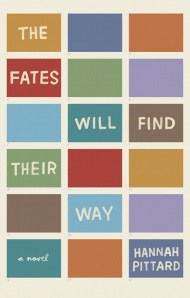
The Fates Will Find Their Way, Hannah Pittard #50BookPledge

I read The Fates Will Find Their Way because at least three people insisted I should. One went so far as to say it was the best book he’s read all year. Quite a bit of pressure for such a small book, eh? My verdict: I love it, and I urge you to read it as well. Fates is a beautiful, beautifully written book. Set aside a few hours (it’s a short book), make yourself a cup of hot cocoa, curl up with a blanket and lose yourself in Pittard’s writing.

Fates begins, “Some things were certain; they were undeniable, inarguable. Nora Lindell was gone, for one thing. …For another, it was Halloween when she went missing, which only served to compound the eeriness, the mysteriousness of her disappearance.” Nora was sixteen when she disappeared, and the unnamed narrators (the boys in Nora’s hometown, identified by the collective “we”) inform us, the phone tree system spread the word. “By the time the tree had been completed, many mothers had already gotten word of Nora’s disappearance—either from us…or from Mr. Lindell himself, who’d broken phone-tree etiquette and continued making calls… It was a breach in etiquette that our mothers forgave, obviously.” The latter passage, I think, sets the tone for the rest of the book. Pittard’s writing is subtle and wry, managing to treat such a tragedy as a young girl’s disappearance with both respect and light, at times self-deprecating humour.

Still, as the narrators say later on, “But forget about Nora for now. That’s the point.” Fates is not about the mystery of Nora’s disappearance. We do not get to see detectives scrounge for clues. In fact, when a reporter comes into town years later to investigate the case, the narrators balk at the idea: “It felt like something that was ours alone, and always had been, was slowly slipping away… Who was this Gail Cumming to think she could barge in out of nowhere?” Key words: ours alone. Fates is about the neighbourhood boys, and how Nora’s disappearance has impacted their lives. Fates is about childhood, about memories and the mythologies built around them, and about how much we try to hold on to these as we, inescapably, grow up.

Pittard traipses back and forth in time, often within the same scene: “At the time it never made sense to us – Trey Stephens’ insistence that he didn’t find Mrs. Dinnerman sexy – but looking back on it, we begin to understand.” The narration is wonderfully fluid, at times, making us ache with nostalgia for the innocence of the narrators’ past, because it is so coloured by the knowledge of their adult present.

Despite the narrators’ insistence that “the point” isn’t about Nora, they are obsessed with her story. What happened to Nora Lindell? Was she abducted by a Humbert Humbert in a Catalina? Did she fly toArizonaand have children of her own? Pittard grounds these conjectures in fact, however flimsy. Two of the boys thought they saw Nora get into a Catalina the day she disappeared. A flight attendant saw a girl who looked like Nora on a plane toArizona. How much can we trust these stories? Does their accuracy even matter?

Take a childhood friend whom you haven’t seen in years. What do you think he or she is doing now? Now, think: how much does this fantasy you’ve built for your friend say about you, and about your fantasies/dreams/wishes for yourself?

Nora Lindell is gone. Like phone trees and curfews and furtive drags of pot behind the school, the reality of Nora Lindell is in the past. Her mythology however is very open to interpretation, and her storyline, as constructed by the neighbourhood boys, reveals much about these boys as they grow up. The idea of Nora falling victim to a Humbert Humbert comes with both the present-day narration of one of the men having been arrested for having sex with an underage girl, and the childhood memory of a female classmate who had been raped. The idea of Nora starting a family of her own inArizonais interspersed with scenes of the boys themselves growing up and struggling to accept their new roles as adults. And, as we read their stories, we too remember our childhoods, and understand, along with the narrators and along with their fictional Nora, just how much we’ve changed since then.

Fates is a soft, haunting narrative of growing up. Read it. Savour it. And I hope you end up loving it as much as I did.

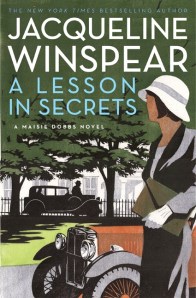
A Lesson in Secrets, Jacqueline Winspear #50BookPledge

It all started when my friend Jen asked if I read Maisie Dobbs. She knew how big a fan I am of Agatha Christie, and thought I’d enjoy Jacqueline Winspear’s novels as well. She happened to have an advanced reading copy of the latest in the series, and gave it to me. All I can say is, thank you, Jen! I just love Maisie Dobbs, and, like the Harper Collins executive who wrote the ARC’s cover letter, I too have become “an unabashed fan.”

A Lesson in Secrets begins with Maisie realizing that her car was being followed. In a style that reminds me of classic Nancy Drew, Maisie turns the tables on her pursuers and quite charmingly requests that they tell her why they were tailing her. It turns out the British Secret Service wants Maisie to go undercover as a lecturer at a private college in Cambridge, just to keep an eye out for any potential threats to the government. It’s 1932, and while the up-and-coming Nazi party still isn’t viewed as a threat, Britain is still reeling from the First World War and eager to establish stability. The college’s founder, Greville Liddicote, is a staunch pacifist, a controversial stance when love for one’s country is equated with the willingness to fight and die for it. So when Liddicote is found murdered, the novel broadens far beyond one man’s death, and tackles the overall sense of fear and confusion in Britain post-World War I. Winspear portrays the era wonderfully – we see the struggle between the war-engendered suspicion of foreigners and the desire for international cooperation, the discrimination against conscientious objectors to the war and its effect on their families, and Maisie’s own growing apprehension about the Nazis.

In Lesson, Winspear makes a strong case for the power of words. A lot of the mystery focuses on a children’s book about a group of fatherless children who try to end the war. The book was censored for its effectiveness at promoting pacifism: “The plight of orphaned children will always tug at the heartstrings.” Still, it was distributed widely through underground channels, and was rumoured to have caused a mutiny and an increase in conscientious objectors. Later on, during a debate, Maisie “felt a tremor of foreboding” because she sensed that a student “had stepped up with an intention to set the hall afire with his rhetoric” rather than “win the debate with honor.” Quite fittingly, Maisie’s primary weapons are her words. She investigates by talking to people, by reading between the lines and using sympathy and charm to get the information she needs. She lies easily, and more than once wonders at her ability to lie without blushing.

Above all, in an era when the very idea of nationalism is questioned, Maisie is adamant in her belief in Britain, to the point that her concerns about its future palpably affects her: “She had already seen much that she thought was not in the interests of the country she had served in a war still too easily remembered.” She, like Britain, has been scarred by the War, and again, like Britain, all she wants is to be able to live in peace. And she fights for this peace, eagerly and with conviction.

I especially love Maisie’s vulnerability in her personal life. In contrast to her confidence in solving murders and acting as a secret agent, Maisie is very hesitant when it comes to romance. Upon finding out that her lover James may have lied to her about his whereabouts, Maisie worries that her internal sensors have failed her somehow. Asked by friends about the possibility of marrying James, Maisie balks, partly because of the social convention that women give up their careers after marriage, but also partly because, she realizes, she’s afraid to believe in a “happily ever after.” Her concerns are very much grounded in the reality of women in her time, reminding us of all the women who have been left behind by those who’ve died in the War, and making her even more real.

A Lesson in Secrets has nuanced characters and an interesting mystery, and offers a fascinating look at Britain between the wars. I am now officially a Maisie Dobbs fan, and will be checking out the other books in the series.