
 I love the idea behind this novel — four friends from college graduate and drift off into separate lives, the novel dipping into their stories intermittently over the next twenty years. I love coming of age stories, and I especially love stories where the “coming of age” chronicles the transition into adulthood and the various milestones (job, marriage, children) that come afterwards.
The main character is Eva, who is secretly in love with playboy Lucien in college and who graduates to become an investment banker. (Kudos to Alice Adams — I think an investment banker heroine is fairly rare in popular fiction, particularly with the amount of industry-specific detail included here. The author’s background in finance is evident, with so much financial terminology and dialogue that it reminded me of my experience watching The Big Short — slightly confused and slightly struggling to care about what are obviously very big and exciting deals.)
Secretly in love with Eva is Benedict, a physicist who, kudos to him, moves on to other women when it’s clear Eva isn’t interested in a relationship with him at that time. Lucien is a playboy in college who goes on to become a professional partier in adulthood, age turning him from charming to sleazy and from fun-loving to rather pathetic. Lucien’s sister Sylvie is an aspiring artist for whom adulthood is a harsh dose of reality.
I enjoyed this story, particularly as it chronicled the shift from the rather rosy expectations the characters have in college to the reality of adulthood, where your talent may not be enough to build a viable career, where the man who pined after you for years may no longer be available when you decide to reciprocate his feelings, where you can land your dream job and do everything right and still not succeed.
Sylvie really stood out to me as the most compelling character, with her descent from popular talented college girl to a woman who can barely make ends meet and can’t figure out what to do with her life. She and Lucien took a much smaller role as the story progressed, with the main focus being Eva’s career and her on-again/off-again will they/won’t they type of romance with Benedict, but I couldn’t help wishing Adams had given us much more of Sylvie’s story.
Invincible Summer is a good book and well-written, but it never quite latched on to me or made me feel so invested in the characters that I had to keep reading. I think it’s because the characters mostly fell flat for me. The character I found most compelling (Sylvie) was relegated to the backseat so ended up feeling flatter than she could have been, whereas the character who was the primary focus (Eva) was okay but a bit too bland to carry the novel. Lucien almost felt unnecessary — he was set up as Eva’s crush in the beginning, but never really stood out as all that appealing, even for a young woman in the mood for a bad boy, and after graduation, he mostly just seemed inserted into the story at sporadic moments, seeming more like the vaguely creepy guy you avoid on the subway than someone who is truly menacing, truly charismatic or truly pathetic. Benedict had potential to be interesting — he is on the team working on the hadron collider! — but his marriage seemed tepid at best, more an obstacle to his happily ever after with Eva than an actual emotional impediment.
Still, it’s a quick read, well-written, and an interesting peek into the lives of 20- and 30-year-olds. Fans of One Day may enjoy the format.
+
Thanks to Hachette Book Group Canada for an advanced reading copy in exchange for an honest review.
 Eleven year old Pip, her thirteen year old sister Grace and their mother move into a cozy London neighbourhood flat where their neighbours have all grown up knowing each other. One summer evening, Pip discovers Grace lying unconscious and partially undressed in a hidden corner of the neighbourhood’s communal rose garden. The mystery around who did what to Grace drives the story, and Jewell takes us to the weeks before the incident and to the days in its immediate aftermath.
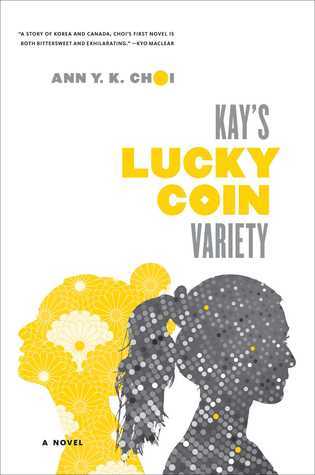 Korean-Canadian teenager Mary is tired of having to manage her family’s convenience store. Part of her wants nothing more than to be modern and Canadian, but another part of her is unable to fully leave behind the expectations of her traditional Korean family. This dilemma plays out in different ways: she uses the name Mary but can’t help that her parents sometimes call her by her Korean birth name Yu-Rhee. She is in love with her English teacher, but her parents want her to set her up with a Korean boy named Joon-Ho. There’s also the unspoken family secret about her mother’s estranged sister, and how that may tie in to Mary’s own struggle.
 Literary Treats