
Review | The Cat Who Solved Three Murders, by LT Shearer

Murder! Cats! Art theft! Seriously, take a look at that adorable cover. How could I not fall in love with this book?!

The Cat Who Solved Three Murders is a cozy mystery starring a retired detective, Lulu Lewis, and her talking calico, Conrad. He talks only to Lulu; to everyone else, he simply says “meow.” It’s a unique concept, but one that, I’m afraid, turned me off somewhat. As a cat person, what I love most about cats in books is how the author manages to bring to life all the wonderful ways cats communicate without having to say a word. By giving Conrad human dialogue, I feared that LT Shearer simply created a regular human-like sidekick who just happened to have four legs and a tail.

That being said, Conrad does get his lovely moments of pure kitty cat. He comforts people by sitting on their laps and purring. He delights people by how skillfully he balances on Lulu’s shoulder. And in two delightful scenes, he turns action hero with claws and hisses. (My cats may, of course, argue that any self-respecting cat would’ve skillfully disappeared from sight in those scenes rather than put themselves in such danger, but, ehh, kudos to Conrad the action hero kitty.)

The mystery that Lulu and Conrad tackle is pretty good. The story begins when Lulu is invited to the mansion of a wealthy friend, Julia, for Julia’s husband Bernard’s 60th birthday party. But when Lulu and Conrad (her plus-one, which I thought was cute) arrive, they learn that Julia and Bernard’s home had been burgled. Julia was fortunately out of the house when it happened, but an insurance agent who’d been at the house to assess the value of some paintings had been killed, and Bernard injured. Some of the details around the burglary strike Lulu and Conrad as odd, and when someone is killed at the birthday party, they realize the need to dig deeper.

Like I said, the mystery aspect is pretty solid. The clues aren’t very subtle, so the big reveals are easy enough to figure out, but it’s still fun to see the story unfold. I like that Conrad is the one who discovers a significant clue by the pool, and there was a bit of fun in how Lulu had to come up with an elaborate story for why she’d noticed the clue herself but didn’t mention it till a day later.

Beyond that, as refreshing as I thought it was that this cozy mystery had a professional detective who was actually competent and receptive to the heroine’s contributions, I found it a stretch that Tracey included Lulu on so much of the investigation. It doesn’t matter that Lulu used to be a detective herself; surely, some of the things Tracey shared with her should have been confidential? Tracey treated her more like a partner than a civilian; she included Lulu in suspect interviews, allowed her to see the autopsy results, and just shared information like phone records without a single thought. Even though the author explained that Tracey was young and inexperienced, and even though it clearly worked for the best with this investigation, it still struck me as unprofessional on Tracey’s part, and I feel like that should have been addressed somehow.

And as much as I like Conrad, I do wish he’d been more cat-like. As affectionate and compassionate as he is in some scenes, his personality still came off as disappointingly flat. I do get that cats are often portrayed as jerks in books, so it’s kinda nice that this cat is portrayed as a nice character. But, well, Prozac in Laura Levine’s Jaine Austen mystery series shows more personality in a single scene than Conrad does over multiple chapters.

Conrad’s dialogue does often make him feel like a human stand-in. Even though he reminds Lulu about his cathood multiple times (like when he hears something that she doesn’t, and he reminds her it’s because cats have better hearing), it comes off as unnecessary. Worse, it’s a glaring reminder of how easy it is to forget that Conrad is a cat, not because he’s such a special creature for being able to speak, but because he isn’t quite as compelling as real kitties are. Also, as much as I love cats and appreciate how many characters seem delighted by Conrad’s presence, the whole “that’s a cat!” “he’s on your shoulder!” “he meows!” type of scene actually got old. Even for me, which says a lot, because normally, I love scenes of people gushing over cats. But here, it just happens so often, and in pretty much the same way each and every time, that the novelty and charm eventually wore off.

Still, overall, Conrad is still a pretty cool cat, and I like that he literally saves the day a couple of times. Lulu seems a good series lead, and the mystery itself was fun to read about. This may not have met my (admittedly ridiculous) high hopes of becoming my new favourite mystery series, but it’s a fun mystery nonetheless. And I’m all for more cat detectives in fiction, please and thank you!

+

Thank you to Publishers Group Canada for a copy of this book in exchange for an honest review.
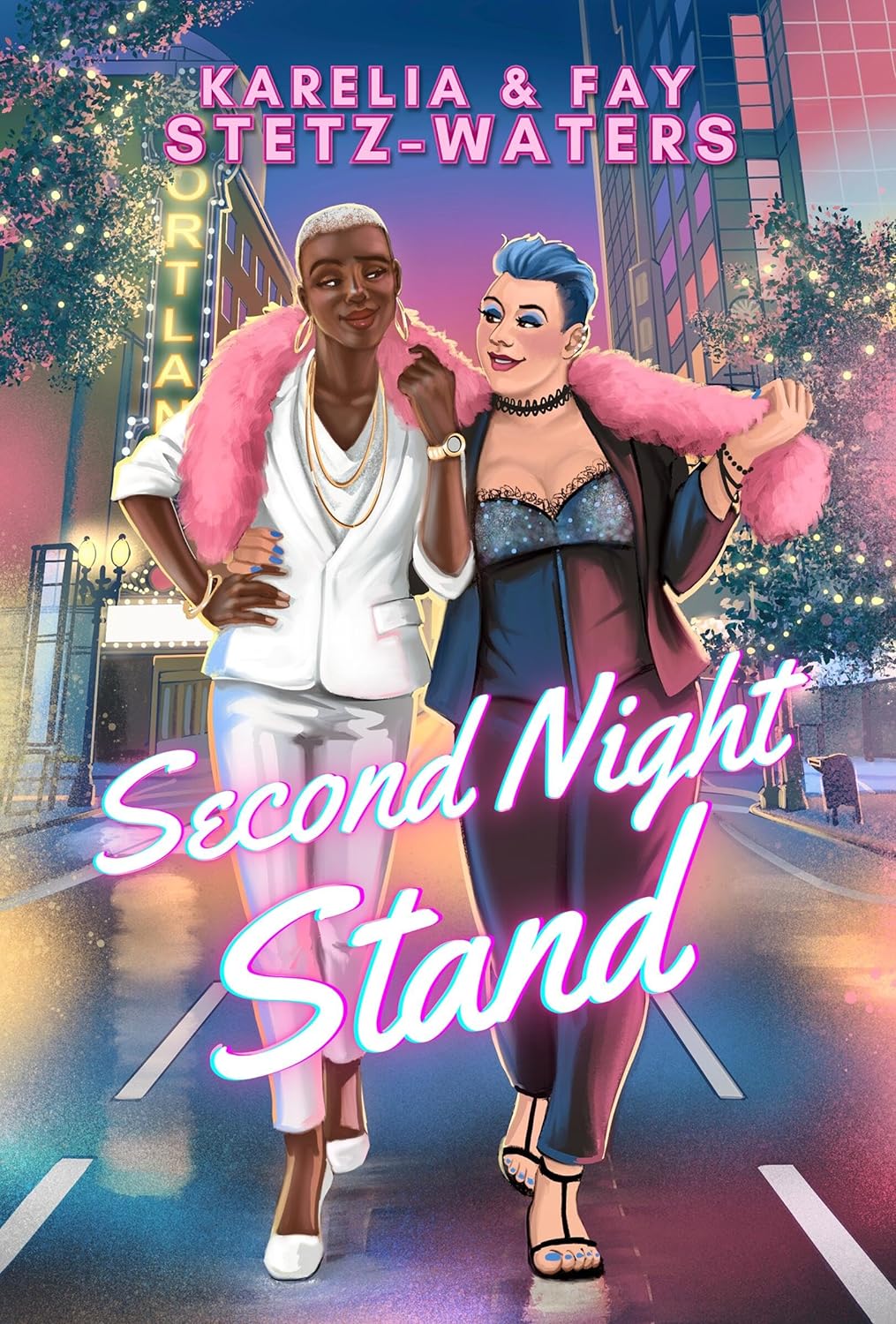
Review | Second Night Stand, by Karelia and Fay Stetz-Waters

SecondNightStandKarelia Stetz-Waters’ Satisfaction Guaranteed was one of my favourite books in 2021, so when I saw she had a new romance coming out this year, this time co-written with her life partner Fay Stetz-Waters, I immediately wanted to read it.

Second Night Stand is a sexy-sweet romance between two dancers competing on a reality show with a $1M cash prize. Lillian Jackson is a super talented ballet dancer and head of an all-Black ballet company. The company is losing their sponsorship, so she needs to win in order to keep the company going. Izzy “Blue Lenox” Wells is a curvy burlesque dancer who leads a group of gender-diverse and body-diverse performers. She’s purchased a fixer-upper theatre to use as a community gathering and performance space, and needs the cash prize to make necessary repairs.

The romance between Lillian and Izzy is sweet, and just as with Satisfaction Guaranteed, consent and mutual respect play prominent roles in their relationship. I like that they both shared a strong sense of responsibility for the welfare of their respective chosen families, and how they both had to deal with complex relationships with their families of origin. And I especially like how their relationship with each other helped them learn valuable things about other aspects of their lives, and grow both as individuals and as a couple.

Where the book fell flat for me was in the set-up itself: the dance competition. I get a strong sense of why Lillian’s group is a contender at the competition, but I was never quite convinced about how Izzy’s group stayed on for so long. The depiction of their first performance was just messy. The whole point of their group is to provide a space to belong for all peoples, regardless of identities and performance interests, and while that’s a wonderful goal from a community-building aspect, it doesn’t make for a cohesive performance.

The book tries to explain this away by saying that the producers put them on as an amateur sacrificial lamb, so to speak, destined to be knocked off in the first round. Even Lillian, watching the group members perform one after the other, is certain that they’re about to be eliminated. The book, and Lillian, then try to make us believe that Izzy’s performance is so charismatic and captivating that she single-handedly convinces the audience to vote them in to stay. Unfortunately, as likeable as Izzy the person is, whatever magic she worked on-stage to get her group past Round One does not translate well on page. I was unconvinced, and the longer they stayed on, the more convenient it felt, as there was often one competitor or another who messed up so badly they had to be sent home. With a $1M prize at stake? Puh-lease.

I also tend to not be a huge fan of overly detailed descriptions, especially of background characters, so this is a rare instance when I actually wanted to see more of the dance competition. The front runner for the prize is a hip hop group that pretty much all the competitors agree is amazing and tough to beat, but we never actually get to see them dance. I don’t even remember meeting the dancers in this group at all, even though we meet a random assortment of other dancers. For a book centred on a dance competition, there isn’t much of it.

Speaking of competition, there’s also a chapter where the producers try to provoke Lillian, Izzy, and their dancers to trash talk each other, and both groups flat-out refuse to do so. Lillian and Izzy’s attempt quickly turns flirty, so the producer swaps them out with other performers on their respective teams, but then those performers seem incapable of doing anything but compliment each other. And I get it. Manufactured competition is silly, the producer was pushy, and kudos to the characters who refused to call their competitors the B-word, because it’s such a gendered insult.

But honestly, as over-the-top and sometimes mean as those scenes can sometimes play out, not engaging in it at all just feels very killjoy-ish. And however much the performers may respect their competitors’ talents, there is very little sense at all that any of them consider this competition important. Part of that is on Lillian and Izzy for not being open with their respective groups about their real motivations to win the competition. (It’s not just for funsies! It’s to save the ballet company / community theatre!) But even when the truth comes out, the competition takes second place to the characters’ morals and values. Which, okay, good for them. But if the characters themselves don’t care about winning the competition, how am I, as a reader, supposed to care about either of them winning? Despite the real futures at stake, the story takes a very gentle approach to the competition driving the story forward, and that in turn blunts much of what gives the story edge.

Overall, this is a sweet and feel-good romance, with lots of body positivity and love within found families. It’s a bit of a let-down for me after the brilliance that was Satisfaction Guaranteed, but it’s a good story nonetheless, and a fun way to spend a weekend.

+

Thank you to Forever for an e-galley of this book in exchange for an honest review.

I Try to Solve a Japanese Honkaku Mystery | The Inugami Curse, by Seishi Yokomizo

When the wealthy patriarch of the Inugami clan dies, his will brings into high relief all the jealousies, rivalries, and petty conflicts within his family members. Sahei Inugami’s will leaves his estate behind, not to his grandsons Kiyo, Take, or Tomo, but rather to Tamayo, the granddaughter of Sahei’s mentor and rumoured once-lover. In particular, Tamayo has three months to choose one of Sahei’s grandsons to marry, and her husband will inherit the estate.

If Tamayo refuses, or dies before the three months are up, she forfeits the inheritance, and control of the family business passes to Kiyo, assisted by Take and Tomo. The remainder of the estate will be divided into five, with one share going to each of the grandsons, and two shares going to Shizuma Aonuma, the son of Sahei’s former mistress.

If Kiyo, Take, and Tomo all refuse to marry Tamayo, or die before the three months are up, Tamayo receives the full estate, and is free to marry whomever she wants. 

It’s a set-up that practically guarantees extra-juicy family drama, and The Inugami Curse doesn’t disappoint. Secrets come to light; siblings and cousins turn on each other, and soon enough, people start getting killed. 

I absolutely adore this book! I enjoyed my previous adventure with Detective Kosuke Kindaichi, and this story was even more my kind of whodunnit. Whereas The Honjin Murders had a very Sherlock Holmes feel with the focus being more on the howdunnit of the locked room mystery, The Inugami Curse feels much more like my personal fave, Agatha Christie. There’s a whole cast of suspects, each of whom has varying degrees of motive and opportunity, and I feel like the psychology of these characters — or the whydunnit, so to speak, holds the key to identifying the killer.

Even better, the clues are easy enough to follow; Kindaichi even helpfully lists them all for us in a chapter called “A Monstrous Riddle.” Various revelations come to light about the characters, each of which disproves one theory or another while raising new possibilities. And one clue in particular has Kindaichi thinking that finally, the puzzle pieces are falling into place. 

Alas for my ego, all these clues just leave me more confused than ever. And honestly, fair play to the author: he did give me all the tools I need to solve this case; I just can’t make sense of how they all fit together. I especially appreciate how often throughout the novel I’d come up with a theory that I consider absolutely brilliant, only for Kindaichi himself (or worse, Police Chief Tachibana!) to bring up that very theory only a few pages later. The first time it occurred was within the first few chapters, so it was far too early for such a major reveal. And honestly, I just feel like this is the author’s way of thumbing his nose at readers like me for thinking we’re cleverer than we actually are.

am proud that at least I managed to guess a fairly big reveal. Does that reveal even matter in solving the mystery? I’m going to guess yes. As confused as I am with how the puzzle pieces fit together, I have two theories floating in my brain, and I’m just going to lock in the one my gut thinks is right. I have very little confidence I got it, but the next chapter is called “Confession,” so I figure it’s now or never for me to issue my verdict. 

(Side note: Yokomizo’s other mystery The Honjin Murders has pride of place as the one mystery where I read the big reveal before realizing I should’ve stopped reading and made my guess. So, I’m taking the fact that I actually stopped before the big reveal this time as a sign of progress. Go, me!)

Did I Guess Right?

Absolutely not, LOL. My verdict is not even close.

I did guess somewhat close to the truth with my second theory, which I ultimately discarded because I was giving myself a headache trying to make sense of it, and still couldn’t make the puzzle pieces fit together.

Gah, this was frustrating! I had the clues, but put the puzzle pieces together wrong. It’s like, if I’d only tilted my head in the other direction, or looked at a couple of key pieces of the puzzle from a different perspective, I might have figured it out. As Sherlock Holmes would say: I see, but I do not observe. Gah!

But honestly, fair play to Seishi Yokomizo. This was a very well-constructed puzzle, an absolute joy to read, and the ending turned out to be a touch more heartwarming than I expected. And really, this just makes me even more determined to solve my next Kosuke Kindaichi mystery. Onward and upward!

*** SPOILERS BELOW ***

Continue reading