
I Try to Solve an Agatha Christie Mystery | Sad Cypress (Hercule Poirot)

Sad Cypress begins with a courtroom scene: Elinor Carlisle is accused of murdering Mary Gerrard. She had several reasons to dislike Mary: first and most hurtful, the man Elinor loves, Roddy, is in love with Mary instead. Then, shortly before her aunt, Mrs. Welman’s, death, Elinor receives an anonymous letter, warning her that Mary, the daughter of Mrs. Welman’s tenants, is after her aunt’s fortune.

Sure enough, one night when Mrs. Welman is seriously ill, she asks Elinor to call her solicitor; she wants to make provisions for Mary in her will. Unfortunately, she dies before the solicitor can be called, and it turns out she never made a will at all. Having died intestate, her entire fortune goes to Elinor, who then honours her aunt’s wishes by giving Mary a generous sum from the estate.

Some weeks later, Elinor is cleaning out her aunt’s estate. She invites Mary and Mary’s friend, Nurse Hopkins, to join her for lunch. And Mary ends up dead, killed by morphine while Elinor and Nurse Hopkins were washing dishes. Elinor is arrested for the death, but fortunately, her aunt’s doctor, Peter Lord, is convinced of her innocence, and enlists the help of Hercule Poirot to prove it.

I loved reading this mystery! I had great fun parsing through the clues, and adding my little kitty sticky notes to pages with clues, ideas, or comments I wanted to mark. Whodunnit feels pretty straightforward; I had a bad guy in mind from the start, and now a few pages from the big reveal, I still think that person’s the most likely culprit.

I admit I was also tempted to let my mind spin out into wild alternative theories. Certainly, there are enough gossipy tidbits and long-ago scandals to throw suspicion on other individuals. But at my last attempt at solving an Agatha Christie mystery, the solution turned out to be simpler than I expected, so I’m going to go against the grain here, and stick with the simplest reveal. I’ll type it below, and then lock it in.

Did I Solve It?

Nope. My other strong suspect turned out to be the killer, but I ultimately ended up accusing someone else. To my credit, I did pick up on a lot of the important clues; I just figured there must have been another reason behind them. Bah, Dame Agatha, you’ve fooled me again!

***SPOILERS BELOW***

Continue reading
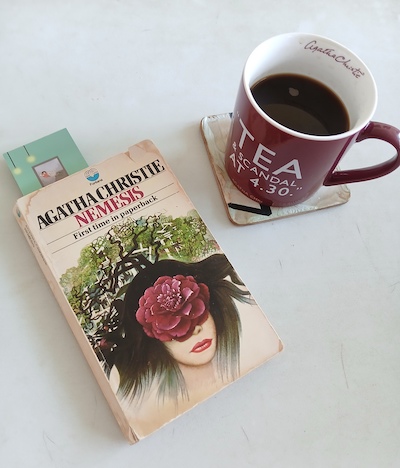
I Try to Solve an Agatha Christie Mystery | Nemesis (Miss Marple)

Mr. Rafiel from A Caribbean Mystery is back, this time with a posthumous mission for Miss Marple: “investigate a certain crime” and after a year, she will be entitled to GBP 20,000 from his estate. “Our code word, my dear lady, is Nemesis,” he writes in his letter. It’s a reference to something she tells him in A Caribbean Mystery and Miss Marple understands it to mean that he’d like her to correct a miscarriage of justice.

Nemesis is only the second-to-the-last Miss Marple novel, but to me, it feels more like her grand finale than Sleeping Murder does. Partly because Miss Marple feels older here. Nemesis has a larger cast of characters than Sleeping Murder, and also involves a physically strenuous walking tour, so there are more people here commenting on Miss Marple’s age and frailty. She plays along with it, as she does to help gather clues, but I also can’t help feeling that she is a bit more physically frail here than usual.

But more importantly, the mystery in Nemesis also feels more grandiose and more of a magnum opus, so to speak, than the one in Sleeping Murder. There are more references to other aspects of Miss Marple’s life: Mr. Rafiel, of course, but also references to her nephew Raymond and her old friend Sir Henry Clithering. And the mystery itself is also such a Mystery. Not just whodunnit and why, but also, what evern was done in the first place?

The journey to get to these answers is wonderfully twisty and complex. And the more I read, the more I realized that the reveal is likely to be really sad, with the kind of insights into human relationships that Agatha Christie is so good at.

First, the cast of suspects is huge. Mr. Rafiel sends Miss Marple on a tour that has fifteen other people on it. Presumably, at least one of those people is involved in the crime Mr. Rafiel wants Miss Marple to solve. Also possibly, could this turn into a Murder on the Orient Express situation, and all of them turn out to be involved?

Just as I was turning over that possibility in my mind (and getting cross-eyed staring at the list of suspects), Christie throws in another twist: Mr. Rafiel has also asked some old friends (a trio of sisters) along the tour route to invite Miss Marple to their home. The official reason is that he wants to give Miss Marple a break from one of the more strenuous days on the tour, but of course, we all know that it’s likely one or more of these sisters is actually involved in the crime.

Gradually, we learn that Mr. Rafiel’s son, Michael, was in prison for murdering a young woman. There were other young women who’d also gone missing and were presumed dead around the same time period, so even though Michael was convicted of one murder, it’s possible he was also responsible for others.

Important context is that Michael was known as a bad guy; he’d also previously been accused of raping another woman. I’ll flag here that characters in this novel express some outdated attitudes around sexual assault and false accusations from victims, which is very much a product of Christie’s time and thankfully no longer widely acceptable. But the basic thrust is that, however spotty Michael’s sexual history is, is he actually guilty of murder? And if he didn’t kill the young woman, who did and why?

And then, while Miss Marple is with the sisters, a member of the tour group is struck by a boulder and sent to hospital in critical condition. Who’s responsible, and is it in any way connected to the young woman’s murder?

Yes! Or at least I mostly did. I thought a second character was involved in the crimes, who turned out to be innocent. But I guessed the killer for the most important crime, and I also picked up on pretty much all the important clues! So I’m going to clock this as practically a win, and laugh at the fact that I actually tried to complicate matters more than Christie herself intended.

Continue reading

Review | With Friends Like These, by Alissa Lee

Alissa Lee’s With Friends Like These is a propulsive thriller. It kept me fliipping pages late into the night and early again the next morning, all because I wanted to find out how things turn out. I also really like how Lee depicts the existential crisis that plagues many of us early 40s millennial women.

The narrator, Sara, and her friends all graduated from Harvard, which should have set them up on a life filled with nothing but success. But reality came to bite each of them in different ways: Sara gives up a high-paying banking job to pursue her dream of becoming a photographer, yet now at 43, money problems have her considering taking on a corporate photography gig instead. Allie has a happy family and a good job in marketing, but she had to give up her dream career as a teacher to get it. Even the friends who seem to have their lives together — Dina, a professor on the tenure track; Bee, a District Attorney running for mayor; and Wesley, a wild child trust fund heiress — seem to have more problems than at first glance. Lee does a fantastic job at revealing details about her characters’ lives layer by layer, and it becomes increasingly clear that none of them have the life they’d really wanted. Speaking as a woman also in my early 40s, that part of the story felt real and raw, and also very relatable.

The mystery part of the story isn’t bad. The five friends are doing one last hurrah of an annual tradition they’d had since college: a “killing” game held the first week of each January. Each woman draws a friend’s name as their first “target.” They “kill” the target by shooting a water pistol, and the person “killed” gives up a medallion with their initials to the “killer,” who then goes on to the next name on the list. Whoever collects all five medallions by the deadline wins that year’s game. Some of the women want to end the game, so they decide to make this their last year, winner take all. And thanks to some savvy investment just after college, the prize is up to almost a million dollars.

Challenge is that Sara starts seeing someone she’d thought long dead: their sixth college roommate, who’d died under mysterious circumstances while playing the game in college. And then some of the women start getting threatening notes telling them to stop the game or else. And for one of the women, the threat turns frighteningly real.

Is one of the players taking the game too far, or is it someone else after them all? The big reveals are easy enough to guess, and the resulting insights about the importance of friendship are just okay. But it’s still a propulsive read; Lee’s writing keeps you turning the pages.

The weak link of the book for me is the hook of the game itself, which required quite a tremendous suspension of disbelief on my part. The trope of a college tradition turned deadly is a fairly common one, and Lee’s version isn’t necessarily more over-the-top than others in this genre. Yet the gameplay itself sounds so miserable that it’s tough to believe this group of friends keeps it going for over two decades in the first place.

The game’s supposed purpose is to make them feel extra-alive, and remind them to live life to the fullest. I can imagine some college kids thinking that will be fun, and maybe even some adrenaline-loving adults. And yes, I can even buy that the real-life consequences (one of them breaks a leg one year, another ends up arrested another year) may be worth the risk of the adrenaline rush.

But the gameplay itself seems so filled with anxiety and so low in high-adrenaline fun that it’s hard to believe they kept it going for so long, especially since most of them didn’t even know about the money until the present-day game. For example, Sara describes herself and her friends as being extra twitchy and with bloodshot eyes, because their “killer” may be hiding behind the corner. Sara hasn’t taken a shower in almost a week, because apparently these friends like “shooting” each other in the shower. They’d even had to set up rules like kids are off-limits (one of the friends went so far as to kidnap another’s children one year) and fake emergencies are off-limits (past games have involved fire alarms and calls about loved ones in hospital). There are more rules created from extreme past behaviour that I can’t remember anymore, but yikes. Without the almost a million dollars cash pot, and with paranoia to the extent that you can’t even feel safe showering in your own bathroom…why would anyone put up with this for so long?

Like I said, it’s a tough sell, but overall a fun read regardless, and a relatable glimpse into some of the struggles of being 40 and realizing you haven’t actually fulfilled all the dreams you’d set out to do.

+

Thank you to Simon and Schuster Canada for an e-galley in exchange for an honest review.