
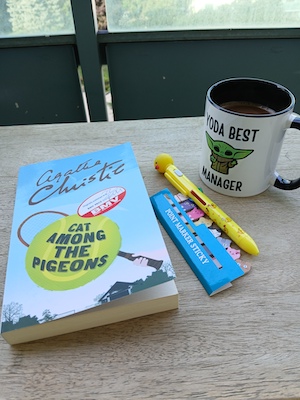
I Try to Solve an Agatha Christie Mystery | Cat Among the Pigeons (Hercule Poirot)

The prince of Ramat, a fictional Middle Eastern country, dies in a revolution. Before he does, he asks his English pilot to find a way to get his jewels, worth three quarters of a million pounds, out of the country and safely out of his enemy’s hands. The pilot spends a mysterious twenty minutes alone in the hotel room of his sister and teenage niece, and when his and the king’s bodies are later found, the jewels aren’t with them.

The story then moves to an exclusive all-girls boarding school in England, Meadowbank. Among its pupils are the pilot’s niece Jennifer, her best friend and the daughter of a former intelligence agent, Julia, and the dead king’s cousin, Princess Shaista. The faculty and staff include school co-founder and formidable headmistress, Miss Bulstrode; her co-founder and reliable right-hand, Miss Chadwick; her presumed successor, Miss Vansittart; the new secretary, Ann Shapland; an unlikeable games mistress with a history of uncovering people’s secrets, Miss Springer; a smart English and Geography teacher, Miss Rich; a snobby French teacher, Mademoiselle Blanche; and a handsome young gardener, Adam, who’s actually a British intelligence officer undercover to ferret out anyone who may be after the king’s jewels. All lovely and idyllic, until one late night when Miss Springer is found dead in the new Sports Pavilion.

Cat Among the Pigeons is a bit of a mixed bag for me. I LOVE boarding school mysteries, and as someone who grew up in an all-girls Catholic school, stories that take place in that kind of environment are among my favourite kinds. But I’m also not fond of mysteries involving international espionage. Nothing against them, they’re just not my thing. And even though, at its heart, this mystery is about missing diamonds, there’s a lot of international intrigue flavouring the crimes.

As a mystery I’m trying to solve, this case unfortunately falls a bit flat for me. The location of the diamonds is obvious really early on. They’re clearly at the centre of the whole thing, so the motive behind the murders also seems easy enough to guess. The methods are also fairly straightforward: Miss Springer is shot from four feet away, and the blunt object used to kill the second murder victim is mentioned within the same chapter. All that’s left to figure out is whodunnit.

This isn’t to say that the murderer’s identity is easy to suss out. I’m actually at the point right before the big reveal, and I don’t know who the murderer is. I have my suspicions, of course, but I don’t feel particularly strongly about them. The trouble is, what I usually LOVE in Agatha Christie mysteries is the psychology aspect. Give me ALL the drama! Give me ALL the overwhelming emotions and personality clashes! If money is involved, then let the suspects be all shady and scheming and trying to appear perfectly innocent. With the whole espionage angle and GBP750,000 at stake, there’s a bit of professional detachment to this crime, and that in turn makes it not quite as gripping for me as her other works.

That being said, this is still a good book, and an enjoyable read. I loved reading about the school and all the personalities in it. There’s a chapter composed of characters’ letters to home that I found really interesting. I also really enjoyed the subplots about characters’ lives, like Miss Bulstrode choosing her successor, Miss Chadwick worried about upcoming changes to her beloved school, Ann Shapland being a restless sort with a series of different jobs and not wanting to settle down and marry her nice but dull boyfriend, and so on.

It’s just as a mystery where I’m trying to piece together the clues that this case isn’t quite as much fun for me as some of Christie’s others. I may have enjoyed it more if I’d simply read it as a story rather than tried to solve it, but even then, I wish there had been a lot more focus on the boarding school intrigue and personality clashes amongst students and staff, and a lot less on the whole hidden diamonds thing.

Did I Get It Right?

30% yes? Which in this case is pretty much a no, LOL. I did figure out one of the murders, and I actually did suss out quite a number of details about other characters. I even guessed the ultimate big reveal at one point. Unfortunately, I then dismissed that guess as a red herring, and deemed the actual big reveal villain to be innocent. Oops.

The epilogue, about the ultimate recipient of the prince’s diamonds, was a surprise to me, and also really sweet.

***SPOILERS BELOW***

Continue reading
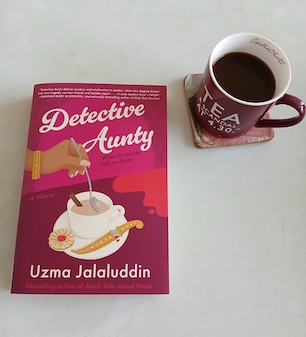
I Try to Solve an Uzma Jalaluddin Mystery | Detective Aunty (Kausar Khan)

I wish I’d made chai for this occasion, but the truth is that I didn’t intend to try and solve Detective Aunty until I had a flash of insight in the middle of Chapter 26 that convinced me I knew who the killer was. If you’ve read the book, or oh my gosh, if you’re Uzma Jalaluddin herself, and know that the vital clue has not been dropped yet by this point, then please feel free to laugh at my hubris! Either way, I’m going to go with my gut and lock my guess in.

As some of my friends know, Uzma Jalaluddin is my die-hard auto-buy author. I loved Ayesha at Last, absolutely adored Hana Khan Carries On, and gave my heart over to Much Ado About Nada. And as long-time readers of this blog will know, I absolutely ADORE cozy mysteries, especially those by Agatha Christie, so when I learned about Detective Aunty, I had it on my buy list long before the actual release date.

Kausar Khan is a widow in her mid-50s who has always had a knack for observation and mystery-solving. When her mid-30s daughter, Sana, is the prime suspect in a murder, Kausar leaves her comfy home in North Bay to help her daughter out. The victim, Imran Thakur, is the landlord at the shopping plaza where Sana owns a desi clothing store; he was found at her store before hours, stabbed with a dagger from the window display. By many accounts, Imran is a terrible person, who cares only about making money, and isn’t above taking advantage of people to get it.

Long-time Jalaluddin fans will be thrilled to note that the mystery takes place in the Golden Crescent shopping plaza in Scarborough. It’s a nice shoutout to the Golden Crescent neighbourhood in Jalaluddin’s romances, though if there are any fun crossover Easter eggs, I missed them. (I was especially on the look out for Three Sisters Biryani Poutine to make an appearance, but alas, no.)

Long-time mystery fans will enjoy Kausar Khan as a detective. The obvious parallel is Miss Marple: like Christie’s sleuth, Kausar is often underestimated due to her age, and strategic meekness with a dupatta. Like the Marple novels, Detective Aunty is an insightful skewering of society’s often dismissive attitudes towards older women. Kausar gets away with bold questioning of suspects, and at one point, with actually getting caught snooping in a private area, simply because people assume she’s just after gossip for the neighbourhood aunties’ group chat.

Jalaluddin adds her own touches to the Marple archetype: Kausar is much younger for one, only in her mid-50s. This opens up possibilities for romance (LOVE that subplot!), and also a different sort of energy: while Marple is content to knit and quietly make her observations, Kausar is set for her next stage in life. Having married young, and been a stay-at-home mom all her life, widowhood now gives her the chance to live on her own, and discover for herself who she is, independent of her husband and his career. There are cultural and generational nuances that add richness to Kausar’s journey, and I’m totally here for it.

Kausar is also more overtly feisty than Miss Marple. While Christie’s detective veils her razor sharp barbs with a gentle veneer of wide-eyed harmlessness, Kausar doesn’t hesitate to let hers fly. For example, while dealing with an infuriatingly condescending man, she snaps that they’re so close in age that he should call her Mrs. Khan, not Aunty. Then she gives him a saccharine sweet smile, because, of course, she was only being polite.

Finally, Kausar also has shades of Sherlock Holmes. She makes observations about physical details, that then lead to major clues. The parallels are a bit more subtle, but like Holmes, her talent for observation doesn’t always rub people the right way.

Overall, I’m absolutely adoring this book. I love Kausar, and I LOVE her sidekick BFFs, May in North Bay and Fatima in Toronto. I also like the romance brewing between her and the silver fox lawyer, and I love all the complexities of her family relationships. There’s so much rich material here for the series, and I’m excited to see where Jalaluddin takes this.

Did I Solve It?

No, I didn’t, not even close. I was so far off-base, in fact, that the character I’d selected as the killer wasn’t even invited to Kausar’s big reveal gathering. When I fail, I fail spectacularly.

Honestly, the actual big reveal made me sad. Jalaluddin did a great job at making me care for some of these characters, and I felt bad for how things are likely to unfold for them after this reveal.

On the bright side, the novel does end with a bit of a teaser for the next mystery. Kausar Khan will be back at Golden Crescent someday (hopefully soon!), and I’m really excited to see more of her story unfold.

***SPOILERS BELOW***

Continue reading

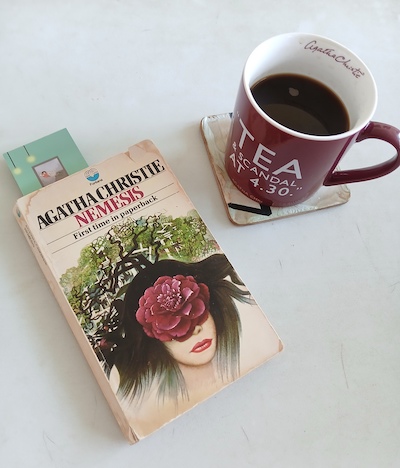
I Try to Solve an Agatha Christie Mystery | Nemesis (Miss Marple)

Mr. Rafiel from A Caribbean Mystery is back, this time with a posthumous mission for Miss Marple: “investigate a certain crime” and after a year, she will be entitled to GBP 20,000 from his estate. “Our code word, my dear lady, is Nemesis,” he writes in his letter. It’s a reference to something she tells him in A Caribbean Mystery and Miss Marple understands it to mean that he’d like her to correct a miscarriage of justice.

Nemesis is only the second-to-the-last Miss Marple novel, but to me, it feels more like her grand finale than Sleeping Murder does. Partly because Miss Marple feels older here. Nemesis has a larger cast of characters than Sleeping Murder, and also involves a physically strenuous walking tour, so there are more people here commenting on Miss Marple’s age and frailty. She plays along with it, as she does to help gather clues, but I also can’t help feeling that she is a bit more physically frail here than usual.

But more importantly, the mystery in Nemesis also feels more grandiose and more of a magnum opus, so to speak, than the one in Sleeping Murder. There are more references to other aspects of Miss Marple’s life: Mr. Rafiel, of course, but also references to her nephew Raymond and her old friend Sir Henry Clithering. And the mystery itself is also such a Mystery. Not just whodunnit and why, but also, what evern was done in the first place?

The journey to get to these answers is wonderfully twisty and complex. And the more I read, the more I realized that the reveal is likely to be really sad, with the kind of insights into human relationships that Agatha Christie is so good at.

First, the cast of suspects is huge. Mr. Rafiel sends Miss Marple on a tour that has fifteen other people on it. Presumably, at least one of those people is involved in the crime Mr. Rafiel wants Miss Marple to solve. Also possibly, could this turn into a Murder on the Orient Express situation, and all of them turn out to be involved?

Just as I was turning over that possibility in my mind (and getting cross-eyed staring at the list of suspects), Christie throws in another twist: Mr. Rafiel has also asked some old friends (a trio of sisters) along the tour route to invite Miss Marple to their home. The official reason is that he wants to give Miss Marple a break from one of the more strenuous days on the tour, but of course, we all know that it’s likely one or more of these sisters is actually involved in the crime.

Gradually, we learn that Mr. Rafiel’s son, Michael, was in prison for murdering a young woman. There were other young women who’d also gone missing and were presumed dead around the same time period, so even though Michael was convicted of one murder, it’s possible he was also responsible for others.

Important context is that Michael was known as a bad guy; he’d also previously been accused of raping another woman. I’ll flag here that characters in this novel express some outdated attitudes around sexual assault and false accusations from victims, which is very much a product of Christie’s time and thankfully no longer widely acceptable. But the basic thrust is that, however spotty Michael’s sexual history is, is he actually guilty of murder? And if he didn’t kill the young woman, who did and why?

And then, while Miss Marple is with the sisters, a member of the tour group is struck by a boulder and sent to hospital in critical condition. Who’s responsible, and is it in any way connected to the young woman’s murder?

Yes! Or at least I mostly did. I thought a second character was involved in the crimes, who turned out to be innocent. But I guessed the killer for the most important crime, and I also picked up on pretty much all the important clues! So I’m going to clock this as practically a win, and laugh at the fact that I actually tried to complicate matters more than Christie herself intended.

Continue reading