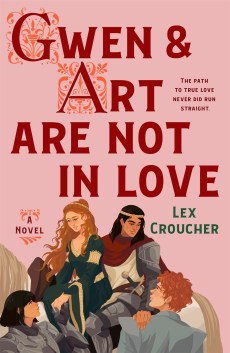
Review | Gwen and Art Are Not in Love, by Lex Croucher

GwenAndArtThis book takes a cute spin on the traditional forced marriage (forced betrothal?) + fake dating premise. Gwen and Art are betrothed, but they’re very much not in love. Such a set-up usually promises an enemies-to-lovers romance, but in this case, both main characters are gay, and so they actually do find their happily-ever-afters with other people. Gwen harbours a years-long crush on Bridget, a badass knight and only female knight in the kingdom; Arthur starts off kissing a stable boy, but eventually develops feelings for Gwen’s studious brother Gabriel. When both main characters find out about each other’s romantic secrets, they agree to fake-date to get their parents off their backs.

It’s a cute premise, and one I’d expect to love. Unfortunately, the book started off slooooooow for me. The first couple of chapters failed to hook me at all, mostly because it took so long for the main characters to win me over and make me care about them. Gwen just seemed like a miserable person to spend time with, and while I can kinda see why she wouldn’t want to marry someone as irresponsible and unreliable as Arthur, the specific incidents she complained about just made her seem bratty and petulant.

Arthur won me over more quickly, partly because his struggles with alcoholism and a power hungry father made him a more nuanced and textured character from the get-go. But what really made Arthur’s scenes shine almost from the start is his side kick (body guard? man servant?), Sidney. To me, Sidney stole the show. I found him witty and compelling, and I would totally read a whole book about his misadventures and his eventual romance with Gwen’s maid.

In fact, Gwen and Arthur owe a lot to the secondary characters. Despite Gwen and Arthur eventually going through full character arcs (Gwen needs to learn to get over her cowardice, and Arthur needs to learn to step up to his responsibilities), it’s the secondary characters, specifically Sidney and Bridget, who drive the momentum of most of the plot. It isn’t until later in the book that Gwen and Arthur actually start taking matters into their own hands. When they do, the story definitely picks up, but it takes a while to get there.

The final third or so takes a sharp turn from lighthearted romance to inter-kingdom politics and battle. The seeds were planted throughout, and the climactic battle is certainly a powerful section. Both Gwen and Arthur have their respective moments to shine, and demonstrate their character growth.

But the eventual happy ending does come at a cost, and a rather surprising tonal shift that unfortunately felt rushed. And while the denouement makes sense, it also feels oddly flat. Not quite rushed and not quite perfunctory, but not quite satisfying either. There’s a rather momentous point in the battle that adds so many layers of complexity to what comes next, yet it feels like the ending glosses over all that and focuses only on the happily-ever-afters of the central romances. Don’t get me wrong: I love genre romance and I love happily-ever-afters. Yet in this case, it doesn’t quite hit its emotional mark.

+

Thank you to Raincoast Books for an e-galley of this book in exchange for an honest review.
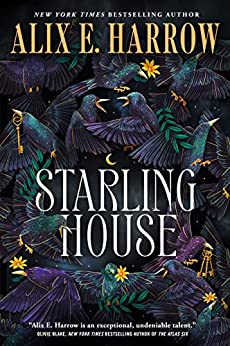
Review | Starling House, by Alix E. Harrow

StarlingHouseStarling House is a contemporary gothic fairy tale about an ugly old house full of secrets, the unfortunate man doomed to be its caretaker, and the desperate young woman who may hold the key to turning things around.

The story is more archetypal than super unique — heroine Opal struggles to make ends meet, and so takes a job cleaning Starling House so she can earn enough for her brother’s tuition. She’s scrappy and sarcastic, with enough street smarts for the entire family. Starling House caretaker Arthur is reclusive and beastly — almost literally: the story often compares him to the Beast from Beauty and the Beast, to the point that in one scene, he saves Opal from wolves and she dresses his wounds. The comparisons to Wuthering Heights also get heavy-handed; ‘Heathcliff’ must have been mentioned at least a dozen times.

But somehow, Harrow manages to make it all work. Underpinning the conflict is an evil developer who wants to purchase the land Starling House is on, and this developer’s minion flip-flops between bribing and blackmailing Opal for helpful intel. There’s also an old children’s tale from a woman who lived in the house centuries ago; a story about monsters who live beneath the grounds and are both fearsome and comforting for young girls.

This isn’t really the type of story I would normally pick up, yet Harrow’s writing drew me in. The author does a great job in interweaving fairy tale elements with contemporary real world struggles. And despite the archetypal associations for some characters, she’s also succeeded in creating compelling individuals to root for. I respect and admire Opal’s fierce determination to provide for her younger brother, and Arthur’s equally fierce determination to be the last person doomed to be Starling House’s caretaker. The way Opal and Arthur move through the conflict is very much within an eerie dreamscape, yet also very much infused with tangible trauma, and very real work needed to move past it.

Minor note but it matters: I also very, very much appreciate that both Arthur and Opal are described as unattractive. And not just in a ‘they feel ugly but everyone else sees how gorgeous they are,’ nor even in a ‘they’re ugly to everyone but each other,’ but that they actually seem unattractive on an objective level. As much as they are attracted to each other, and as much as they admire each other’s traits, neither Opal nor Arthur describes the other as beautiful or handsome. And among the other characters, even those who love them aren’t complimenting their looks. The whole ‘feels ugly but is actually gorgeous’ trope is used so often that I very much appreciate Alix E Harrow for letting these characters simply be ordinary-looking, perhaps even ugly. Because it isn’t just the gorgeous Hollywood look-a-likes who can save the day.

+

Thank you to Raincoast Books for an e-galley of this book in exchange for an honest review.
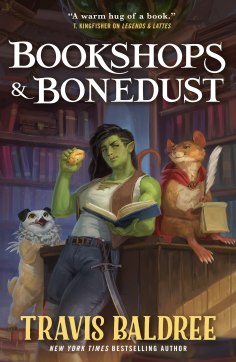
Review | Bookshops & Bonedust (Legends & Lattes # 0), by Travis Baldree

BookshopsAndBonedustA prequel to his bestselling Legends & Lattes, Travis Baldree’s cozy fantasy Bookshops & Bonedust seemed just like my brand of nerdy catnip. When warrior orc Viv is injured in battle, she must recuperate in a small town where she befriends the cantankerous owner of a bookshop. It’s got books, a gigantic cat-like creature, and some mild fantasy adventuring — all of which are elements I usually love.

Unfortunately, it didn’t really come together for me in this book. I do love how Viv resisted reading at first, until she discovered the joys of steamy sex scenes in action-packed adventure stories. I found that adorable, especially with how Viv’s reluctance to admit liking the books went head-to-head with her desire to read more titles.

But other than that, I found myself bored. Viv’s romance with a baker was sweet, but it’s hard to really feel invested in a relationship we know won’t really last till the next book. The subplot about the eager beaver adventurer who wants to prove her worth in joining Viv’s gang is mildly amusing, but honestly not all that compelling. The main conflict, so to speak, about a skeleton golem (the ‘bonedust’ in the title) longing for a quiet life but beholden to an evil mistress, definitely has promise. But it took so long for that plot to ramp up that by the time it did, I no longer really cared.

I get this is a cozy fantasy, so it really isn’t meant to be action-packed. And at first I thought maybe the genre just isn’t as much for me as I thought it would be.

But then I happened to find Travis’ first book, Legends & Lattesat the library, and decided to give it a go. And I found it magical. I devoured that book within a week. I absolutely adored how Baldree turned things as ordinary as lattes and cinnamon rolls into things that are new and wondrous to behold. Cafe experiences are all new to Viv and crew, and Baldree did an excellent job at delivering them anew as well to us real-world readers.

Yet that magic didn’t quite translate into Bookshops. Perhaps it’s because experiencing books for the first time isn’t quite as sensory nor sensual as experiencing coffee and pastries? While Legends made me drool in imagining the deliciousness of cinnamon rolls, and made me crave for a steaming mug of coffee and (oat) milk, reading about Viv and other characters getting excited about reading just didn’t hit as hard.

Overall, Bookshops is…okay. And once the fantasy adventure element kicks into high gear, it becomes interesting. But it took me more than three months to finish this book, and if I hadn’t happened to read and love Legends & Lattes during that time, I may very well have marked this DNF.

Verdict: read Legends & Lattes instead.

+

Thanks to Raincoast Books for an e-galley of this book in exchange for an honest review.