
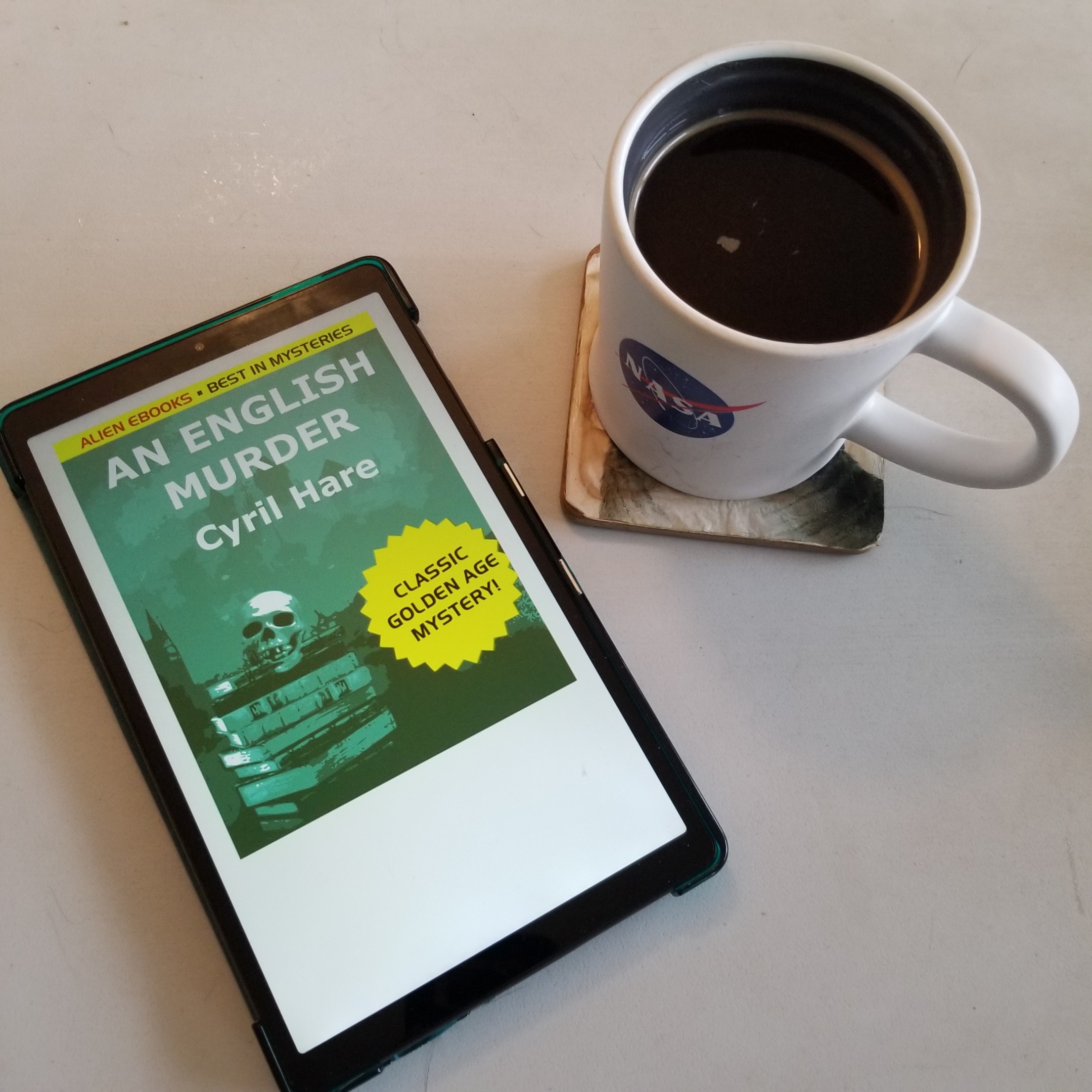
I Try to Solve a Golden Age Mystery | An English Murder, by Cyril Hare

I looked up Cyril Hare’s An English Murder at my local library after seeing it listed in The Guardian as one of the Top 10 Golden Age Detective Novels. I’m always eager to expand my grey cells’ repertoire beyond Agatha Christie (and perhaps even give my inner detective a fighting chance every now and then!), so I decided to give this a go.

First, I’ll say I was almost turned off by the cover design. Having never read this author before, I was too cheap to purchase a copy with a better one, but just for my own satisfaction, here’s the gorgeous cover of the original 1951 mass market paperback edition:
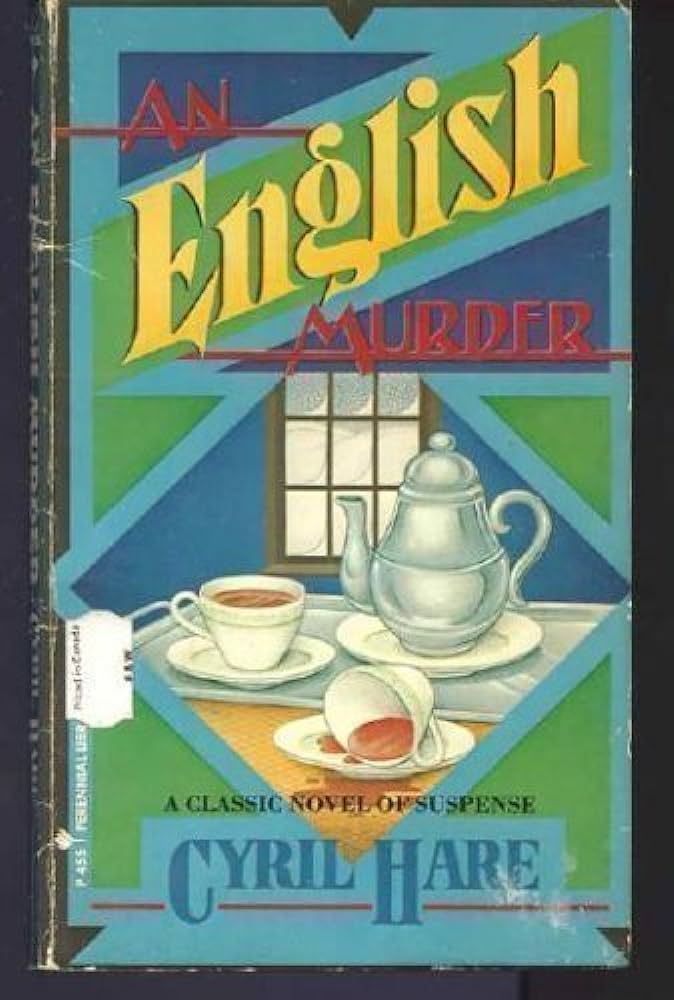
EnglishMurderClassicCover

The set-up is one of my favourites: it’s Christmas at Warbeck Hall, a beautiful and old English country estate, and family and friends have gathered to celebrate the season. On the guest list are: a socialist politician, the leader of a fascist group, an earl’s daughter nursing unrequited love for the fascist, the ambitious wife of a mid-level government worker, and a Jewish history professor and concentration camp survivor who is researching the family’s history. In the servant’s hall are: the family butler, his daughter, and the police officer acting as the politician’s bodyguard. Add in a winter snow storm, a rather juicy secret, and a dying patriarch, and to paraphrase Sherlock Holmes, murder is certainly afoot.

I love how this story touches on the politics and economic realities of post-WWII Britain. Briggs the butler comments on the challenges of putting on a party with such a small household staff. He and his daughter Susan also represent two generations’ approaches to generational wealth, with Briggs being bound by social order and Susan wanting to do away with it. Sir Julius and Robert Warbeck lock horns over competing politics: Sir Julius thinks Robert’s fascism is reprehensible; Robert views Sir Julius’ socialism as being a traitor to their class.

Dr Bottwink’s experiences at a concentration camp are mentioned only in passing, but he isn’t shy to tell Briggs he’d prefer not to eat with Robert. And when Sgt Rogers later comments at how much Dr Bottwink has moved around, the professor corrects him that it’s more accurate to say he was moved, and that this circumstance has turned him leftist — not quite communist, but “anti.” There’s a great moment after the first murder where Dr Bottwink is first to breakfast, and he asks Briggs not to leave the dining room till the next guest arrives. Life experiences have taught him to be cautious: on the off-chance someone dies at this meal, he can’t afford to have been left alone with the food at any time. Neither Briggs, nor Sir Julius who arrives next, both of whom are Englishmen, even realize why that could be a risk.

The mystery itself unfolds at a quick and entertaining pace. Events occur, information is revealed, and tea and champagne are served. I have a feeling that when the big reveal finally unfolds, the killer’s identity and motive will turn out to be so utterly obvious that I’ll hang my head in shame that I didn’t guess it at all.

The thing is, the first murder is easy enough to predict. The victim is someone whom pretty much everyone else at the estate had reason to hate, so when they declare they have a big announcement to make, and then promptly drink a glass of champagne, it’s no big loss when they drop dead. Figuring out whodunnit is trickier, because so many people had motive to.

But then two more deaths follow, and the third death in particular doesn’t fit the pattern at all. Who could have wanted that third person dead? How does their death fit in with the other two? 

I have my theories, and none of them make sense. Alas, I’m reaching the 90% mark of the ebook, and things are beginning to wind down. So I’m going to give this a go, and see how I do!

UPDATE: Some significant new clues in the penultimate chapter! I may need to revise my verdict… Now at the start of the final chapter, and it’s now or never to lock my verdict in!

Did I Solve It?

Ahahahahaha! Absolutely not! Not even close! In my defence, the reveal hinged on a bit of history and law that I knew absolutely nothing about, so despite all my research, all my careful note-taking, and all the workings of my poor little grey cells, there is absolutely no way I would have guessed that motive. Honestly, I had to read the final chapter twice over just to make sense of the key information that formed the motive, and by the second time, I was laughing out loud, because never was any of that even on the horizon of my knowledge.

Would British readers be better equipped to solve this case? Would history buffs? Possibly. I’m sure there are many, much smarter readers out there who could try their hand at this and find the solution super obvious. I didn’t, and in a rare occurrence amongst my many detecting failures, I don’t actually feel like I should have been able to put the clues together. Man, this case was wild! And a lot of fun to try and solve, failure or no!

*** SPOILERS BELOW ***
Continue reading

I Try to Solve a Dorothy L Sayers Mystery | Gaudy Night (Lord Peter Wimsey and Harriet Vane)

gaudynight

Case number two for 2024 is by Dame Agatha’s contemporary. A blog commenter convinced me to give Lord Peter Wimsey another shot (I found Whose Body? well-written, but underwhelming), and they recommended the Harriet Vane starrer Gaudy Night.

The Story: A Book Review

I’m maybe two-thirds of the way through this book, and I’m absolutely adoring it! As someone who studied at an all girls Catholic school all the way from kindergarten to high school, and as an adult (ahem) woman close to a milestone (ahem ahem) high school reunion, Sayers’ descriptions of Shrewsury College at Oxford and their Gaudy Night reunion weekend gave me lots and lots of nostalgic feels. (I went to a co-ed university, so the associations aren’t quite the same.) My high school reunion, called a velada, is also colloquially known as Old Girls Day. I can’t find the specific line anymore (downside of print!), but there’s a reference to Gaudy Night being for the old gals or some similar phrasing, and it warmed my heart to see it.

I also very much enjoyed seeing Harriet experiencing the old campus after a decade or so away. I too haven’t been back to my alma mater’s campus in years, but I can imagine walking through it very much as Harriet does. I can imagine noticing both the familiar and the differences in sights, scents, and sensations. And while I still keep in touch regularly with my closest high school friends (thank you, pandemic Zooms!), I feel Harriet’s sensations of dismay and/or admiration as she meets old classmates for the first time in years, and realizes how little or much they’ve changed.

There are moments when Harriet does come off rather judgey, but well, that’s what naturally happens at these kinds of reunions, isn’t it? I’m sure, and Harriet is also aware, that her old classmates are judging her in turn, whether for her success as a mystery writer, or for her previously being suspected of murder. In a wonderfully mundane but real throwaway line, an old friend calls Harriet “successful,” and Harriet reflects that she knows the friend really meant “hardened.”

Beyond the nostalgia factor, Gaudy Night is also a wonderful exploration of women’s lives in the 1930s, when this was published. Sayers is fantastic at creating characters who breathe. In this novel, women from a diverse range of social classes, backgrounds, and lifestyles give voice to the societal tensions between pursuing academic accolades versus domestic bliss. All of this gets mixed in with Harriet’s own dilemma between wanting to remain independent and intellectual, and falling in love (despite herself) with aristocrat Lord Peter Wimsey. There are many fascinating conversations throughout this story, and I can imagine present-day university students geeking out in lively discussion about this novel and the societal contexts within which it was written. It’s fantastic!

The Mystery: What Actually Happens?

The incidents begin at Gaudy Night, when Harriet receives a couple of poison pen letters, of the O.G. cut-out letters from newspapers type. Even when she returns to London, she continues to receive mean notes. Yet she isn’t the sole target; students and faculty at Shrewsbury College also receive these notes, and all-in-all, the story spans an entire school year or more.

Some notes are petty (one accuses a student of stealing another’s boyfriend); some are mean (the ones to Harriet remind her of her previous murder charge). And one particularly vicious set of notes tells a student she is mentally ill and needs to die by suicide.

Beyond the notes are acts of mischief attributed to a ‘poltergeist,’ and like the notes, they form a spectrum of intensity. Some are mostly nuisance: the school library is turned topsy-turvy, a pile of scholars’ gowns is set on fire, and a book is burned. One is threatening: a dummy wearing a scholar’s gown is hung from the ceiling with a knife through its belly. And one seems particularly cruel: the manuscript that kind-hearted and naive scholar Miss Lydgate has been working on forever is defaced and destroyed, so that she has to start all over again. In an utterly chaotic and confusing chapter, the poltergeist targets several campus buildings in one evening; they cut the power, commit random acts of vandalism, and run off to the next building while Harriet, the Dean, and random assortments of residents give merry chase.

The Mystery: My Spoiler-Free Thoughts

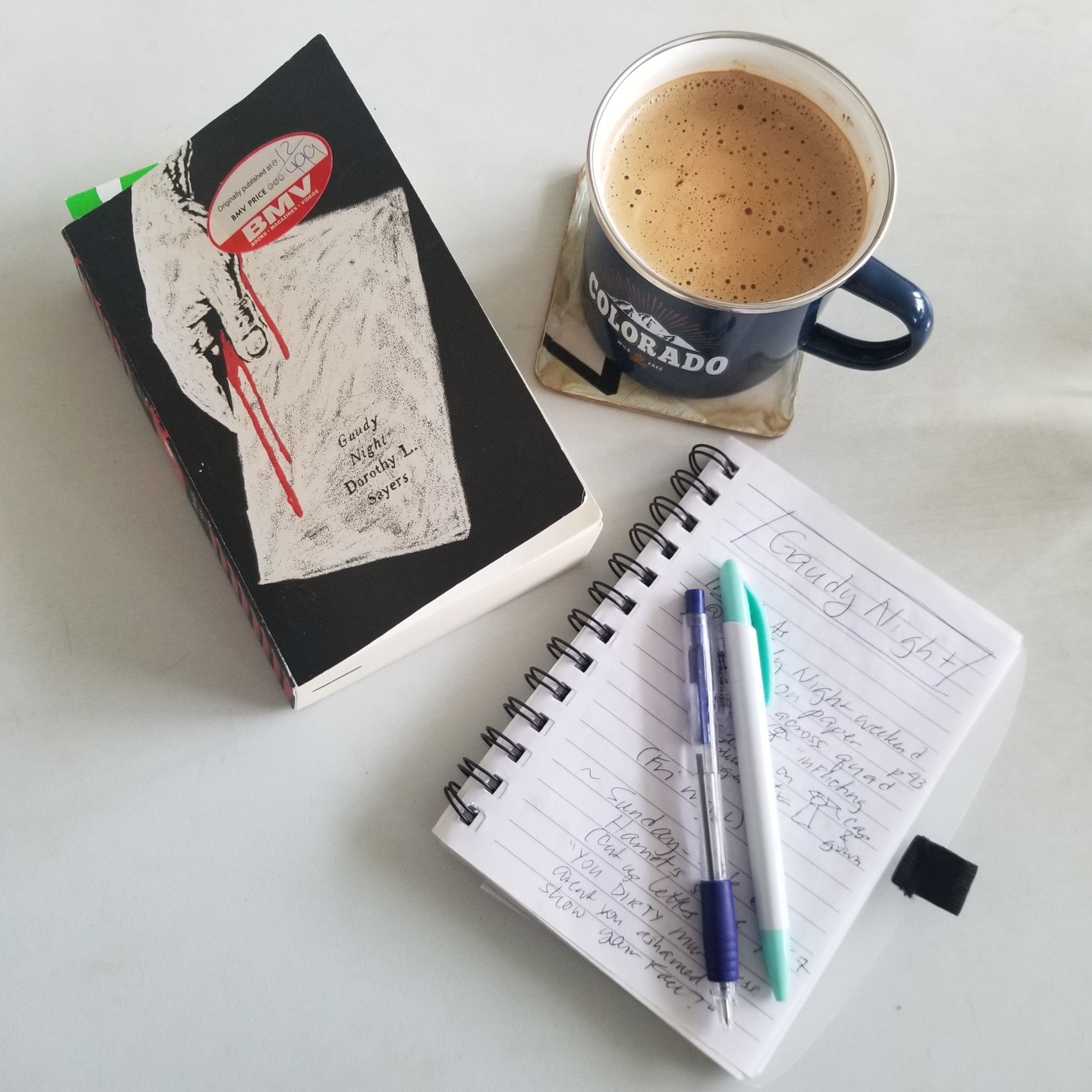
As a case to solve, this mystery is rather baffling. The incidents (too benign to be actual crimes; too malicious to be merely pranks) strike me as without rhyme nor reason, and the targets too spread out to make the motive clear. Unlike Christie who provides us with a fairly manageable list of potential whodunnits, Sayers is unfortunately accurate in showing how challenging it is to narrow down a list of an entire campus-full of suspects. And each potential suspect has tons of opinions on the topic of women in academia. There are so many potentially important details that, for the first time, I used two pens to keep my notes straight; blue ink for suspects, and black ink for important events and clues.

In fact, the sheer volume of incidents even makes me consider if there could be a whole team of perpetrators. Could one person seriously commit all these acts by themselves? Yet there doesn’t seem to be a unifying motive strong enough to make several of them team up. On the other hand, amongst the twenty or thirty potential suspects I’ve met, which of them actually has a strong enough motive to do all these things? When Lord Peter Wimsey arrives to help solve the case, he tells Harriet, “There’s a method in it.” Harriet replies, “Isn’t the motive only too painfully obvious?” [p 358] I’m glad they think so, because alas for my poor ego, I don’t.

At this point, there is only one person whom I think makes sense as the perpetrator, and really, one particular scene that finally gave me a foothold to confidently name a suspect. Yet Peter and Harriet seem to be focusing on a different character, someone whom I suspected at first, yet eventually discarded in favour of my current prime suspect. I’m not gonna lie; their suspicions are shaking my confidence. Whereas I’m used to Christie throwing around red herrings galore, my (very limited) experience with Sayers is that she’s much more straightforward.

Most worrisome for my verdict is a scene where Peter is doing his sly best to pick up clues, and Harriet is noticing how productive his tactics seem to be. Alas for my ego, my suspect isn’t doing nor saying anything at all noteworthy! What on Earth are Peter and Harriet picking up on, that I’m missing?

Part of me wonders if my challenge stems from applying too modern a perspective on this case. Sayers steeps her mystery so much within the social milieu of her characters that I feel like the key lies in something that women of that era find incredibly important, but perhaps may not be as obvious to women in 2024. Or perhaps I’m just trying to make excuses.

Regardless, the suspect Peter and Harriet seem to be focusing on truly does not make sense to me. So I’m going to go with my gut, hope that Sayers is doing a last-minute red herring, and lock in my verdict.

Did I Solve It?

Yes I did! Boo-yah for going with my gut, and boo-yah for not letting Dorothy L Sayers lead me astray with her tricksy little red herrings along the way!

*** SPOILERS BELOW ***

Continue reading

I Try to Solve an Agatha Christie Mystery | After the Funeral (Hercule Poirot)

AfterTheFuneral

New year, new Christie! For my first case in 2024, I’ve decided to try to solve After the Funeral. My sister and I had lunch together to celebrate New Year’s Eve’s Eve, and then treated ourselves to a bit of book shopping afterwards, and this was my year-end treat.

I usually prefer Poirot’s earlier cases, but this turned out to be really good! Wealthy patriarch Richard dies suddenly, and his relatives all gather in his mansion after the funeral for the reading of his will. At the reading, Richard’s sister Cora carelessly comments, “He was murdered, wasn’t he?” The next day, Cora herself is murdered, and the family solicitor turns to Hercule Poirot for help.

I’m having an absolute blast with this story. There’s lots of family drama, and it’s all filtered wonderfully through Christie’s sly wit. There’s a whole cast of suspects — all of them have strong motives, and none of them have a solid alibi. There’s a great moment where a private investigator tells Poirot all he’s found about each of the suspects, and their respective motives and alibis. When they get to the final name, Poirot says, “And it was quite impossible for her to have left Enderby that day without the servants knowing? Say that is so, I implore you!” Alas, that particular suspect also had her whereabouts unaccounted for at the time of Cora’s death.

Il ne manquait ça!” said Poirot with strong feeling. [p. 154]

I pretty much suspected every character at one point or another. In fact, I’d just settled on one suspect, simply because they seemed the least suspicious, only for them to be almost killed themselves. For another suspect, I decided on their innocence based on something I now fear is a red herring.

Still, Poirot is gathering the characters for his big reveal, and so it’s time to make my final accusation. Am I confident? Oddly, yes, but also, this is the kind of confidence that, from experience, often comes before the fall. So I’m locking in my answer and looking forward to learning how much I’ve gotten it wrong.

Did I Solve It?

YES I DID! YES I DID! AHHHHH!!! There was a delightful detail I did not at all guess, and a couple of clues I didn’t pick up on, but the whodunnit, as well as their motive and method, I totally did figure out!

Literary Treats 1, Agatha Christie 0. Fantastic victory to start the new year!

***SPOILERS BELOW***

Continue reading