
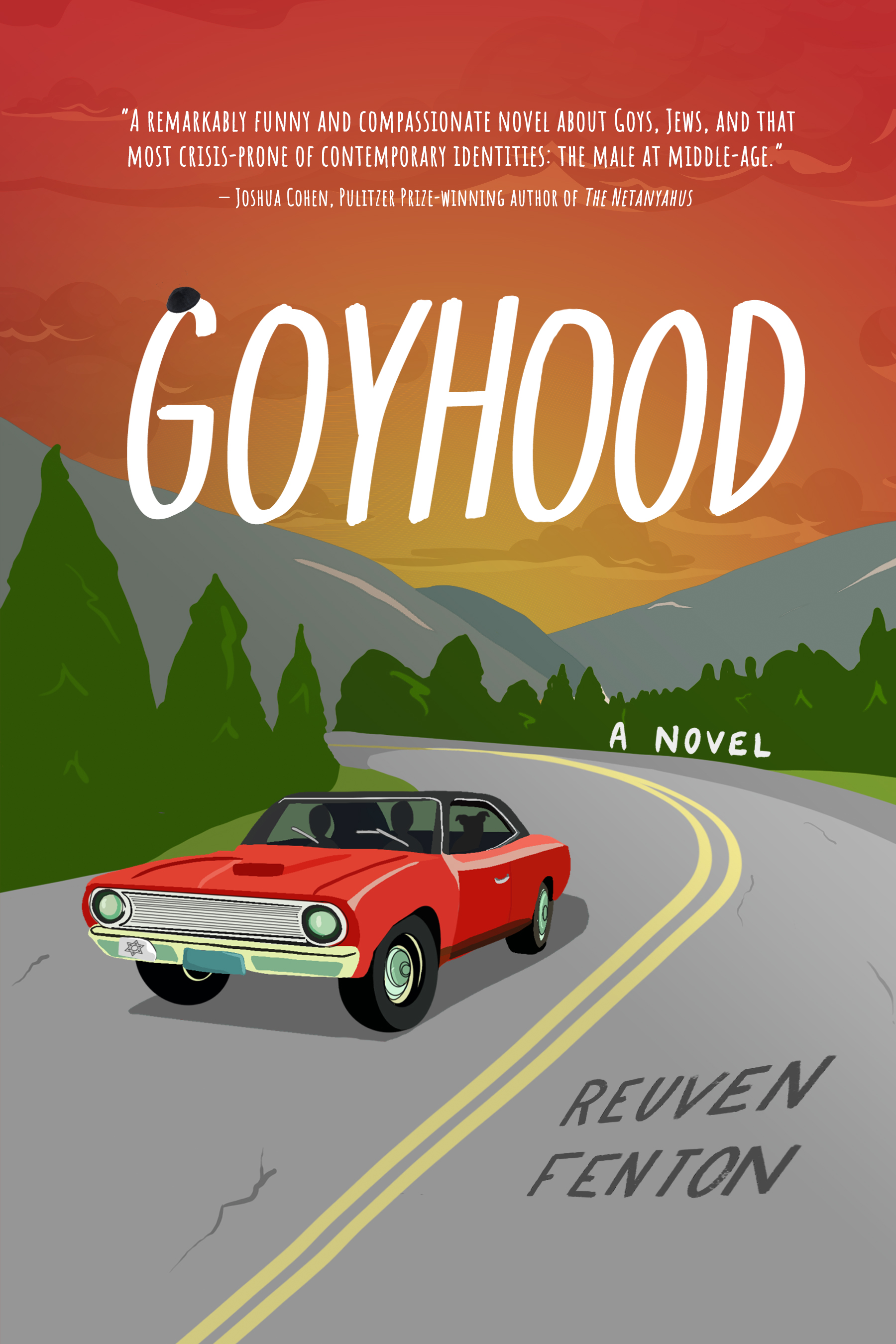
Review | Goyhood, by Reuven Fenton

When their mother dies, estranged twins David and Mayer learn that they’re not actually Jewish as they’d been brought up to believe. Worse, their mother’s grandfather was a Nazi.

The revelation isn’t a huge deal to David, who has lived a fairly secular life, but Mayer has dedicated his entire adult life to studying the Torah. A devout Orthodox Jew for decades, Mayer must come to terms with the revelation about his family’s past, and figure out how to break the news to his equally devout wife, Sarah, who is also the daughter of a very well-respected rabbi.

David suggests a road trip back to Mayer’s home in New York, and since Mayer doesn’t have enough money to pay for a flight home for himself, he is forced to agree. What follows is a light-hearted, sometimes absurd, but always heartwarming road trip novel, as the brothers come to terms with their family history and their long-ruptured relationship with each other.

I really enjoyed this novel. Both David and Marty respond to their non-Jewishness in different ways, but at both their cores is a deeply-rooted desire to figure out who they are exactly, and where they may belong. David’s desire to become better friends with his younger twin is equally obvious; Marty’s a bit too stuck on adhering to strict rules of morality and behaviour to be easily open to friendship with his more free-spirited brother, but it’s good to see him slowly emerging from his shell.

The story is populated with entertaining side characters: Charlayne the social media influencer on a quest of her own, and Popeye the rather mangy stray (read: abandoned) dog whom David convinces Mayer to let him take along. Each has their own role to play in the larger story, but for me, the story is strongest when it focuses on the relationship between the brothers. The story David tells of Marty standing up to a bully when they were younger was so full of brotherly pride that it made my heart burst to hear it. And the moment where David confesses his desire to convert to Judaism, only for Marty to unequivocally shut him down, is heart-breaking.

I’m not Jewish myself, but I imagine that all the little details about the nuances of different approaches to Judaism will resonate even more meaningfully for Jewish readers. As for me, I enjoyed learning about these nuances, such as: the restrictions around gentiles (non-Jewish people) participating in Jewish traditions; the term “Noahide,” which refers to gentiles who abide by seven laws (I looked them up, and it was interesting to me as a Catholic to see where they overlapped and differed with the ten commandments I knew); and processes around Jewish conversion and divorce.

I also really enjoyed this novel’s exploration of questions of identity, and what it’s like to have to redefine yourself after learning that the most essential aspects of yourself aren’t actually true. I also really liked the way the novel explores questions of faith and faith-based identities, and all the different ways one may choose to have a relationship with their god of choice.

Overall, this is a good book, and a fairly lighthearted romp, despite tackling some tough topics.

+

Thank you to the author for an advance reading copy of this book in exchange for an honest review.

Review | Little Book of Awakening, by Mark Nepo

Little Book of AwakeningLittle Book of Awakening is a handy pocket-size book of weekly reflections excerpted from Nepo’s earlier book The Book of Awakening, published in 2000. I haven’t read the original book, so I can’t speak to the comparison, but the portable nature of this version appealed to me. As much as I often enjoy books that invite me to immerse myself in its pages, for something like this, I feel like bite-size tidbits work better for reading over my morning cup of tea.

The book is set up into weekly reflections. Each week features a quote or pithy statement, followed by a brief reflection by the author, and guiding prompts and questions for our own reflections. His reflections are sometimes about a story from his own life, other times about a story he’s read somewhere. Week 2 for example talks about salmon, and how their powerful way of swimming can teach us about facing situations without fear.

I haven’t read through the full book yet; I want to space it out over a year. But I did flip through it for interesting tidbits for review, and I really like what I found in Week 43: “Birds don’t need ornithologists to fly.” The reflection that follows is about how much we long to be seen and understood by others, but not necessarily recognize the greatness that already exists in ourselves even without that external affirmation. Definitely food for thought!

I would consider the book secular, in that it’s definitely not a devotional, nor does it focus on philosophies or stories from any particular religion, but there are religious elements to it. From my quick flip through, Nepo does make some references to God and the story of Nicodemus from the Bible. So this may not be a good fit for readers who prefer more fully secular reflections, nor for readers who would prefer for fully religious content.

Overall, this seems like a handy little book. I don’t particularly love Nepo’s writing style, meaning I don’t really see myself looking for more of his books. But I do like some of the reflections he provides, and some of the prompts he suggests. These prompts may also be good for journaling; they don’t particularly inspire me to journal about them, but that’s just a personal response to the prompts I’ve seen and the way I respond to Nepo’s style. Other readers may feel differently, and honestly, if this was set up with some space for writing, I may have tried a bit of journaling.

Still, I do see myself using this before starting work on Monday mornings. It’s a nice bit of quiet and thoughtfulness before launching into the work week, and perhaps a nice complement to the mindfulness practice I’d like to re-start.

+

Thank you to Firefly Distributed Lines for a copy of this book in exchange for an honest review.

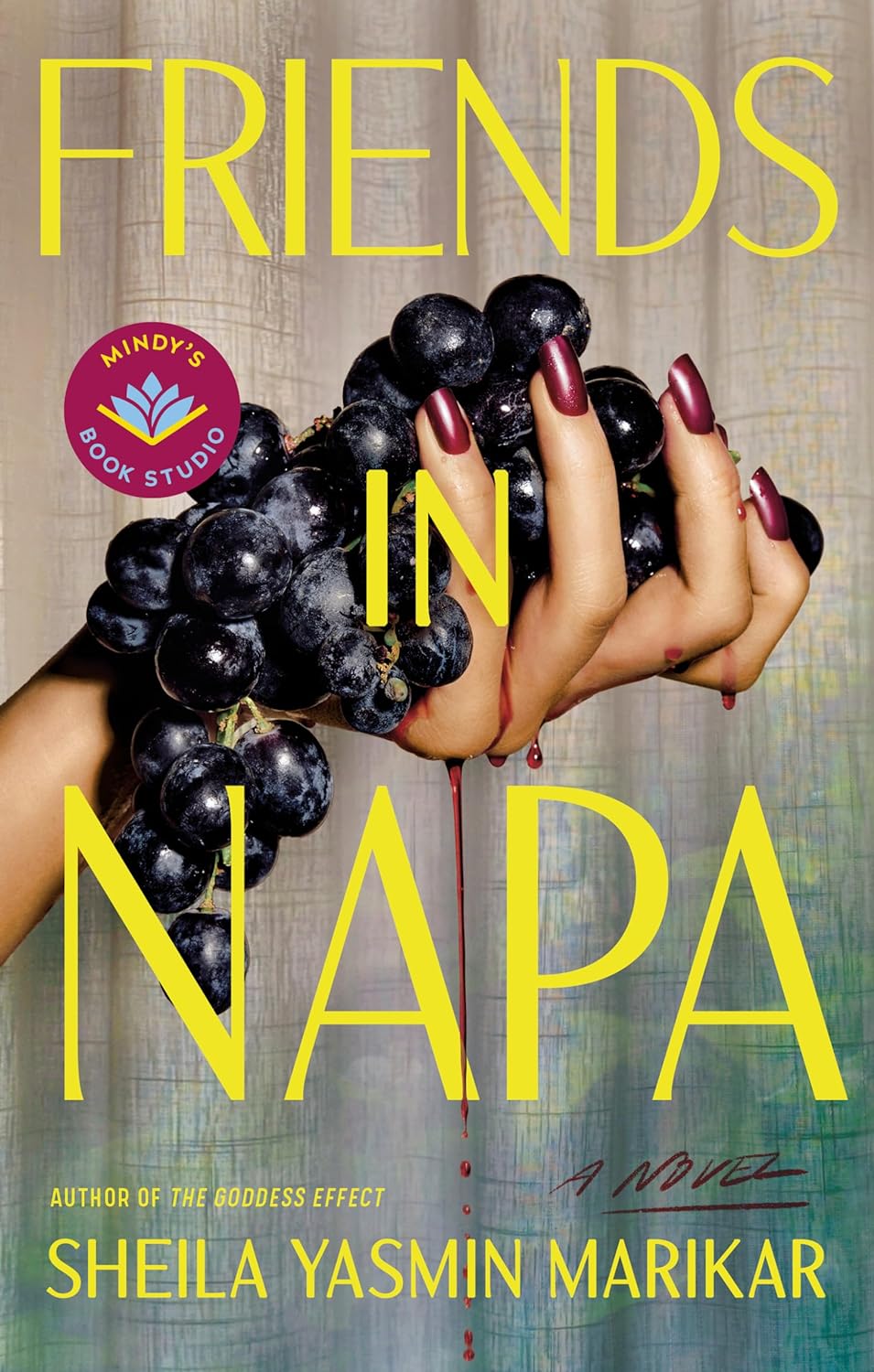
Review | Friends in Napa, by Sheila Yasmin Marikar

FriendsInNapaWell, this novel is a bit of a mess, and not in a fun way.

The premise had potential: wealthy couple Raj and Rachel invite old friends from college to Napa Valley to celebrate the opening of their new winery. As the weekend unfolds, relationship problems start to surface, old crushes are rekindled, and old rivalries reignited.

The thing is, for most of the novel, nothing really happens. Raj decides to flirt with Anjali, whom he semi-almost-dated back in college until he met Rachel. Anjali is stressed over her daughter’s vaping (medical, for anti-anxiety, but she keeps needing to increase the dose) and is also disappointed in her husband David’s gullibility and lack of critical thinking skills, so she decides to indulge. But just a bit, and never too far.

Hari starts sending out romantic feelers to Rachel, since she’s clearly unhappy with Raj, but she demurs. Raj yells at Rachel for breaking a glass, because it embarrasses him. He’s clearly a social climbing jerk, and at a few points, Rachel reflects that she’s never good enough for him, and that the fancy trinkets he buys her as apology aren’t enough anymore, but she never quite does anything about it.

And then there’s a sixth character named V, a social media influencer who’s boosting her ego post-divorce by being extra gorgeous online and letting randos pay her to do stuff online. She’s also an old friend of Rachel, but isn’t really part of the other characters’ drama, so honestly, she just felt superfluous.

There are clearly tensions running amok amongst the friends, and there are certainly moments of tension throughout. But there never quite feels like an escalation to the tension, and as a result, there is never quite a build-up of momentum instead. So when things do explode — like a random fist fight partway through that was maybe / maybe not fuelled by magic mushrooms? — it feels unearned. Worse, it doesn’t even really go anywhere. The big takeaway from the fist fight scene was a boxing pun by a side character influencer, but like, no one seemed to notice or even care that they were drugged without their knowledge?

All this comes to a head with a sudden and totally out of nowhere plot by three of the characters to take down another character. The motivation of at least one of the plotters was crystal clear, a second plotter maybe had some motivation, and the third plotter …just seemed part of the ride? Their target was certainly unlikeable, but their plan was way out of proportion. What exactly were they hoping to achieve? Possibly revenge, but then the plotter who’d want that would presumably be more concerned with setting things right. Possibly freedom, but the plotter who’d be motivated by that surely had other options at their disposal. And perhaps the third plotter wanted success, but again, there was no direct link between the plan and that goal.

Part of the challenge is that we never actually hear from the characters what their plan is. We just see them decide to do it, and then watch as it unfolds. Which would be fine if the plan made sense in the first place, but it doesn’t.

Also, at some point while the plan unfolds, the author seems to have decided that the target character wasn’t just unlikeable; they were downright evil. And so we see this character unveil an off-the-wall evil scheme of their own. Now, this character’s motivations make more sense than the three plotters’, but having them suddenly reveal all of this during that particular scene did not make sense at all. It just felt like random exposition, some final Hail Mary to justify the three “good” characters’ actions.

Finally, the ending just confused me. Shouldn’t there have been more consequences for these characters’ actions? The novel tried to hand-wave past all that with some lines about image management and online intrigue, but I don’t buy it. Or rather, I may be willing to suspend my disbelief on that, but the novel didn’t quite do enough to convince me.

I really wanted to like this book. Old friends, a gorgeous vineyard, lots of drama, and (what I thought would be) a locked room mystery. But this just felt like a bit of a hodge-podge of plot points, and while I did finish it, I never quite got fully hooked into the story or its characters.

+

Thank you to Firefly Books Distributed Lines for an advance reading copy of this book in exchange for an honest review.