Blog Tour and Giveaway: The O’Briens, Peter Behrens

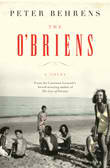
The O’Briens by Peter Behrens is a sprawling family saga that follows the life of Joe O’Brien. Chronicling Joe’s life from his childhood protecting his siblings from an abusive stepfather Joe’s business building a section of the railroad to his children going off to fight in World War II, The O’Briens also depicts a  slice of Canadian history. I haven’t read Behrens’ first novel, The Law of Dreams, and at first I was afraid I wouldn’t be able to understand this novel, but I found that O’Briens works wonderfully as a stand-alone as well.

Joe is a fascinating character, and I enjoyed watching him grow from a protective older brother to a scarred father. Like his own father, Joe has a thirst for travel, and I love how this restlessness was later inherited by Joe’s son Mike. In a novel about exploring North America and eventually settling down with a family, the O’Brien wanderlust is an apt family trait. The best parts of O’Briens are where Behrens really delves into very raw emotions, to the point that the situation can make the reader uncomfortable. The section, for example, where Joe leads his siblings in dealing with their stepfather is rather disturbing, mostly because the persons involved are young children, but I love seeing Joe’s struggle to be the father figure for his siblings and his desire to force them to grow up as well so they can survive even without him. I love the scene where Iseult has to give birth without Joe around, a terrifying episode, and Behrens captures the emotions wonderfully.

I also love the little quirks that define characters. Iseult’s obsession with photography for example, reminds me of my own mother, who loved taking pictures, though thankfully not to the extent Iseult does. The part about Iseult stopping to take a photo of her crying child before running over to see if first aid is required could have come off as gimmicky, but Behrens has set it up so well beforehand that the extent of her obsession feels natural.

Behrens’ descriptions are poetic, and I really liked some of the phrases. About stained glass windows, Behrens writes, “Rich shards of colour broke through those exuberant windows, and exotic scents — silver polish, English tobacco, China tea — drifted through the chiaroscuro rooms.” At times, I would’ve preferred a bit more subtlety in the way he depicts emotions: “Iseult felt her lungs deflate, withering as grief closed in. […] As [the phone receiver] dangled on its wire, she got slowly down on hands and needs, touched her forehead to the Tabriz carpet, then rolled over and lay on her side on the mottled wool, gasping and wheezing…” While I actually liked the image of lungs withering with grief, I found the scene getting somewhat melodramatic as it went on. What I did like, however, was that Behrens then immediately balances it out with humour, having the housekeeper Cordelia walk in and trip over Iseult’s body.

I liked the novel best when it was focused on Joe growing up. I wished it had shown more of his siblings other than Grattan — with the priest character so prominent in the first chapter, I was interested in seeing how the siblings who entered the religious life dealt with it — but I can understand Joe being completely separated from them. I didn’t find the chapters with Joe’s children as compelling, with the major exception of the part about Mike running away from home. The latter part of the novel, switching between Joe’s three children, felt somewhat disjointed, and I would’ve preferred having a central character in the next generation at least, or even Joe himself, to have provided a focal point of view.

Overall, a good book and compelling family saga. The book’s publisher Anansi has been kind enough to provide me with a copy of the book for to give away (Canadians only, please). To enter your name in the draw, just leave a comment telling me where your family is from and where in the world you would settle if you had the choice. Please also leave your email address, so we can contact you if you win. I’ll pick a random winner on June 13th.

Peter has also been kind enough to write a guest post for my blog. Keep an eye out for it tomorrow. Leave a comment on his post for an extra entry into the contest.

Blog Tour: Switch, Tish Cohen #50BookPledge

Have you ever wished you were someone else? I have. During the royal wedding fever, I thought about how amazing it would be to be Kate Middleton. Reading Harry Potter or The Hunger Games, I think of how it must feel to be J.K. Rowling or Suzanne Collins and know that you’ve touched the lives of so many readers. Heck, I look at people in my karate class who can easily do spinning back kicks without falling on their butt and wish I had their ability.

Andrea Birch, in Tish Cohen’s Switch, is no different. The only biological child of a foster family, she’s overwhelmed by responsibility (she gives up a modeling gig and free clothes to buy baby formula, reluctantly but otherwise without complaint) and wishes she could be Joules Adams, only child of rock star Nigel Adams. Andrea describes Joules as “not exactly human… This polish of what I can only describe as authenticity that covers every inch of her being like fairy dust.” Plus, Joules’ boyfriend is the love of Andrea’s life, Will Sherwood. So it’s easy to see why Andrea wishes to be her. Unlike us, however, Andrea does get her wish, and, as usually happens in this type of story, ends up learning that in many ways, she’s actually the lucky one.

Switch is a fun, entertaining read, and definitely a fresh take on the classic Freaky Friday story. I love that Cohen chooses to keep this book only within Andrea’s perspective, rather than switching back and forth between Andrea’s and Joules’ accounts. This makes the story more about how Andrea changes rather than how both girls have to adapt to very different lifestyles, which may have been more comedic (spoiled rich girl having to deal with diapers and half a dozen foster kids!), but might also have been less touching.

Real is an odd word to use about a book that has teenagers switching bodies, but Andrea’s problems are very real. Foster parenting is a difficult undertaking, and I applaud those who give so much of themselves to take care of other people’s children. Lots of books have also talked about the difficulties of being a foster child. But Switch has made me think about what it must be like to be the only biological child in such a family. Sure, Andrea is the only one allowed to call her parents Mom and Dad, but her parents also take it for granted that she has a perfect life, and so lavish more attention on the foster kids. It also struck home how Andrea could never allow herself to form strong friendships with the foster kids, because sooner or later, they’ll be transferred to another family.

There are a couple of things about Switch that I didn’t really like. Andrea just seemed too perfect. Immediately after she switched bodies with Joules, she already wanted to switch back and help her mom out with the kids. I agree that this is within her character — she really is super responsible — and shows how much she really loves her family. I also understand how she might worry that Joules is a completely incompetent baby-sitter and won’t be able to take care of the kids. But I kept thinking, if I were in her shoes, I’d totally spend at least a day or so living it up as Joules Adams. Andrea does enjoy having Will as her boyfriend, but I thought she’d enjoy having no kids around a bit more.

Even though I like that Cohen chose to focus on Andrea’s narrative, I’m also very interested in Joules’ story. She struck me as a very complex, possibly more interesting character, and by the end of the book, she ends up having to change so much more than Andrea does. I’d love to know what happens to her after the events of Switch. Those who’ve read the book, anyone agree with me?

Overall, a very good book. Even though Andrea sometimes comes off as too good, she does change after the switch, and becomes much more appreciative of her life. Nigel Adams is a rich, compelling character. I love how Cohen hints that, despite Andrea’s rose-coloured glasses view of him for most of the book, he actually has a lot of his own issues, and Joules has had to deal with those her whole life. I also love how, despite his issues, Nigel clearly very much loves Joules, and how it takes Andrea in Joules’ body to notice it. I love the quirky grandmother, and love how she gives only Andrea the weird things she picks up on her travels. Andrea doesn’t usually appreciate them, but they’re totally my kind of gift.

Blog Tour: Stones for My Father, Trilby Kent #SFMF #50BookPledge

“There once was a little dikkop that had spotted wings and knobbly knees, and a tiny voice that squeaks.” So begins a story Corlie Roux tells her brother Gert and “one or two other children” at an internment camp in Kroonstad. The British have invadedSouth Africaand are driving Boer families like Corlie’s out of their farms and into internment camps (women and children) or war prisons (men). It wasn’t as if this had come out of nowhere – Boer families have lived in fear of British invasion for a while, and many Boer men, including Corlie’s father, have already died defending their land.

Corlie is a brave girl. When faced with British soldiers, she wishes she could fight with the men instead of having to hide with the women and children. She says she wants to be a pirate when she grows up. And she tells stories, indulging her imagination and delighting Gert, even as her mother warns her that a girl should focus more on household chores and less on “spinning lies.” Her Ma admonishes her to be more practical, but it is Corlie’s stories that help her and Gert deal with such a horrific situation as war. Corlie tells the story of the dikkop because “my brother and I had seen all we needed to see of human suffering, and it was the wild beasts of the veld that helped us escape into our memories.” And so she spins tales.

See, the little dikkop is thirsty, but the lake is guarded by much larger and stronger animals like hippos and rhinos. The dikkop has wings, but is too afraid to fly. Then a klipspringer comes along and offers to help the dikkop get a drink. Can the dikkop trust the klipspringer? More importantly, should the dikkop take the klipspringer’s advice and work with the hippos and rhinos rather than fear them? Like the dikkop, Corlie meets a Canadian soldier who appears sympathetic. And like the dikkop, Corlie must decide if perhaps the British aren’t so different from her after all, and if the Anglo-Boer war isn’t a simple, black and white battle of good vs evil.

In Stones for My Father, Trilby Kent tells the story of a brave young girl forced to grow up far too early. This is a good book for children ages 9 and up who are interested in historical fiction. It’s a touching look at the Anglo-Boer War from the perspective of a child, and Kent even includes a short epilogue about the war, which provides helpful background information to readers who, like me, are unfamiliar with that point in history. Stones for My Father uses the gritty realism of such details as maggots in the flour to express the need to escape into fantasy once in a while, and more importantly, the need to try as hard as you can to hold on to childhood as along as possible.