Ten Thousand Saints, Eleanor Henderson #50BookPledge

Eleanor Henderson’s Ten Thousand Saints hooked me from the first line: “‘Is it dreamed?’ Jude asked Teddy. ‘Or dreamt?’” Not sure why I liked it so much, and I certainly don’t really care about the answer, but I do want to find out more about someone who would ask that question. I also love the way Henderson describes Teddy as wearing “opalescent, fat-tongued Air Jordans, both toes bandaged with duct tape” and Jude as “the one in Converse high-tops, the stars Magic Markered into pentagrams.” Character and time are established with such vivid, concrete detail, and there’s something endearing about the image of Magic Markered pentagrams and duct taped toes.

It’s no secret that Teddy’s about to die; the very first page situates the story “on the last morning of 1987 and the last morning of Teddy’s life.” By the second page, it probably isn’t much of a mystery either how he dies. Adopted by a pair of diehard hippies, Jude grew up taking drugs like other kids take pop, and the novel begins with Jude and Teddy  “celebrating Jude’s sixteenth birthday with the dregs from last night’s bowl.” So when Teddy dies of an overdose, how is a guilt-ridden Jude supposed to cope? He goes to live with his pot-dealing father in New York (he even names his bongs!), and that’s where the story really takes off.

Jude meets Teddy’s half-brother Johnny, who introduces him to straight edge, an underground youth culture that is vehemently against drugs, meat and sex. There’s quite a bit of irony in Jude’s parents shaking their heads and wondering where they’d gone wrong raising a son who now rejects drugs. There’s also quite a bit of wistfulness as Henderson explores the generational gap. Jude’s mother is a sweet, sympathetic character, whose decision at one point to be a part of the gang rather than a mother leads to hurt feelings. I also love how she wonders why her generation’s music about sex and drugs sounded so mellow and peaceful, while her son’s songs about morality and just saying no had to be so angry. Jude’s friend Eliza is such an intriguing character as well — she’s pregnant, and so is forced to grow up quickly (as are Jude and Johnny, who band with her and vow to help support the child), and at the same time, foreshadows a future generational gap that she will face with her own child. Her pregnancy both highlights the urgency of the trio figuring themselves and their lives out, and also expands the story of three teenagers into a bit of a family saga.

There is so much I can say about this book! It’s the kind of story that builds slowly, drawing you in closer and closer as you keep reading, until it ends and I, at least, was left with thinking, “Wow! What an ending.” I love the way Henderson develops her characters. I didn’t grow up in the 80s, and straight edge culture isn’t something I’m familiar with. But I was definitely drawn in by all these complex characters, who are all dealing in their own way with Teddy’s death and their potential role in it, and trying to figure out who they are and who they want to become. I just made the book sound incredibly cheesy, but it’s not; Henderson’s narration is subtle, humorous and heartfelt.

I love the way Henderson describes things: “he placed his finger under her chin and tilted her head slowly, slowly up until her eyes met his, the way a parent will prepare a child for a reprimand, or the way a man will prepare a woman for a kiss.” Tender, and what a spot-on image parallel! Or: “‘It’s a nice face,’ she said. Nice. It was so much more than nice, but she couldn’t think of a better word. You didn’t call a boy beautiful, not a boy who was your husband’s best friend, not a boy who didn’t like girls and who went around picking fights and who you really did think was beautiful.” Again: spot on, with the last phrase.

Saints goes beyond just wonderful characters and descriptions; it encapsulates an entire era — the reaction against the consequences of hippie lifestyles and the realization that, no matter how cool you may be, your children will always seek to differentiate themselves from you. Saints also deals with homosexuality and the advent of the AIDS crisis. I love the way Henderson reveals that a character is gay: “‘You want to know what it feels like? Bein’ with a girl?’ Rooster dropped his hand. ‘It feels like bein’ a fuckin’ coward.’” Bam.

Henderson’s characters feel very, very real, and so does their story. I don’t know if I’d call it a page-turner, but it does make you live in Jude, Eliza and Johnny’s world. To be honest, after the first page, I didn’t really get into it until Teddy died (which, because I glossed over that bit in the first page and didn’t bother to read the plot summary, came as a complete shock to me). But, like I said, it just kept building, and the ending is just wonderfully wistful. Beautiful, wonderful book. Highly recommended.
My Dear I Wanted To Tell You, Louisa Young #50BookPledge

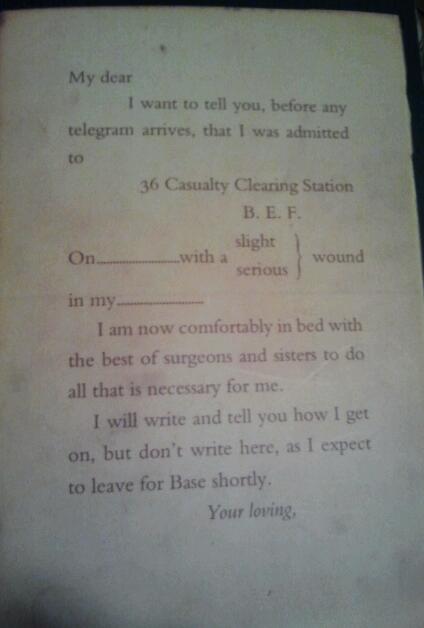
ARC cover of My Dear I Wanted to Tell You

I don’t usually post images of ARC (advanced reading copies) covers, but I just thought the ARC cover of Louisa Young’s My Dear I Wanted to Tell You unbelievably poignant. It depicts the fill-in-the-blanks postcards provided to injured soldiers at hospitals in World War I to send to their loved ones. The pain, loss, and love encapsulated in this single, impersonal document touched me, as did the book. I found the scene where this card is filled out literally gut-wrenching, in my opinion, the best scene in the book.

My Dear deals with a difficult topic – World War I – and Young doesn’t shy away from the gory details. In one scene, Julia, a nurse, talks to her cousin-in-law and non-nurse Rose about a patient whose face had been burned off. Julia describes in excruciating detail exactly how the doctor grafted the patient a new face using skin from his chest. It was horrific, which I think is Young’s point. It’s like Young presents us with snapshots of the war taken with a soldier’s point-and-shoot camera: this is war; deal with it.

The strength of My Dear lies in the characters, and with such an emotional subject, its impact is best felt when Young writes with a bit of detachment. Take for example the following passage, about a young man signing up to enlist: “He went next door to fill in forms. …Length of service: one year or duration of war. Duration of war, of course. He didn’t want to spend a whole year in the army.”

Conversely then, the impact is lessened for me whenever Young lapses into wordiness. The narrator and the characters editorialize at times, and in trying to be descriptive, grandiose and emotional, just ends up being long-winded. On one hand, there is a bit of nostalgia associated with this style of writing, which at times reminds me of some Victorian novels. On the other hand, I sometimes found it too much telling rather than showing, and on a personal level, I found myself detaching emotionally from the story at these points.

That being said, it was really the characters and their stories that stuck with me. They were all wonderfully fleshed out, and I found myself pulling for them. Young even manages to make Rose, seemingly a vain, silly character too delicate to help out in war efforts, sympathetic. Rose’s primary characteristic is great physical beauty, and while this has served her well before the war, it is Julia’s more practical set of skills (intelligence, the ability to dress wounds without fainting) that are valued. Rose’s husband Peter is off to fight in the war, and Rose obsesses about properly performing her duties as a soldier’s wife. Young’s account of her struggle to be useful, a “private war,” so to speak, turns what could’ve been an annoying character into a complex, textured human being. At times, Rose was even more sympathetic than Julia, the purported heroine who nurses soldiers back to health.

Published cover of My Dear I Wanted to Tell You

The most interesting plot point to me though was the love story between working class Riley Purefoy and socialite Nadine Waveney. They are in love, but are kept apart first by Nadine’s mother, then later by the war. Their letters to each other are beautiful and touching — long and emotional, with almost old-fashioned language, yet sincere rather than maudlin. Quite simply, I believed in their love, and I wanted them to be happy together.

With their old-fashioned language, Young again takes what could’ve been annoying and makes it work somehow. For example, when it comes to sex, both Nadine and Riley are quite prudish, unable to utter the words and relegated to blushes and ellipses. Normally, I’d be annoyed at such a potentially cutesy move. Yet, here, I found their shyness endearing; I found their romance endearing.

My Dear is definitely not a happy book. But it is a hopeful one, filled with very human characters. Even the death of a secondary character affected me. They’re that real.

Lost in Shangri-La, Mitchell Zuckoff #50BookPledge

It began as an afternoon treat – an aerial tour of the hidden valley whimsically called Shangri-La. Stories about Shangri-La include tales of lush vegetation and a Stone Age civilization with people over seven feet tall. No outsider has ever set foot in Shangri-La, and very few have flown over it. The air space was just too treacherous. Yet on May 13, 1945, Colonel Peter Prossen decided to treat his staff to a sightseeing trip on a transport plane over Shangri-La.

Due to a number of factors, the plane crashed, and only three passengers survived — Corporal Margaret Hastings, Lieutenant John McCollom and Sergeant Kenneth Decker. They knew nothing about the terrain,

and have heard only terrifying stories about the natives. Mitchell Zuckoff chronicles their story in Lost in Shangri-La, and tells the tale of how a group of brave Filipino-American soldiers mounted a rescue operation that, by all accounts, offered little chance of survival, much less success.

I don’t read a lot of non-fiction, nor do I read a lot of history books, yet I couldn’t put this book down. It’s that thrilling. Zuckoff is an award winning journalist, and I can see why. He writes with journalistic detachment, and creates an exciting, moving narrative because of it. I love that Zuckoff doesn’t editorialize. Opinions expressed in the book are from interviews and personal documents like journals. While readers can generally guess at Zuckoff’s own slant on certain subjects (e.g. a certain comment showed frat boy humour), his language is detached, and he presents a balanced view: “Changes in a valley during the ensuing decades have been dramatic, but whether for better or worse is a matter of debate.” The picture he proceeds to paint is bleak, suggesting that the changes have been in fact for the worse, but Zuckoff uses facts (poverty levels), imagery (native elders now begging for change) and interviews (a quote from a documentary filmmaker) to make his case.

I also love Zuckoff’s attention to detail. Even the people who died in the crash were fully fleshed out because of the details Zuckoff mentions. About John McCollom’s twin Robert, who was on the plane as well, Zuckoff notes that the twins were “known to family and friends as ‘The Inseparables.’” When Robert got married, “both McColloms were in uniform [at the wedding photo]; the only way to tell them apart is by Adele’s winsome smile in Robert’s direction.” Private Eleanor Hanna, who was also on the plane “had a reputation…for singing wherever she went.” Sergeant Helen Kent, who’d lost her husband in a military plane crash, left behind her best friend Sergeant Ruth Coster, who was “swamped with paperwork” and couldn’t join the tour. These details made even these secondary characters real to me, which I appreciated.

Probably the most tense moment in the book was the account of the survivors’ first encounter with the natives. All they’ve heard was that these natives were war-like and cannibalistic. “We haven’t any weapon,” McCollom tells Margaret and Decker. “There is nothing to do but act friendly. Smile as you’ve never smiled before, and pray to God it works.” The survivors smiled and held out Charms hard candies as peace offerings.

Even better, Zuckoff has interviewed some natives who were children when the plane crash occurred, so he’s able to present their perspective on the events as well: “[Yaralok] saw creatures that resembled people, but they didn’t look like any people he’d ever seen. The skin on their faces was light, and they had straight hair. The skin on their bodies was strange. They had feet but no toes. Only later would he learn that coverings called clothing shielded their skin and that shoes encased their toes.” This, I think, was when it really struck me how alien these cultures were to each other. Yaralok and his tribe have never seen fair skin or Western clothing, much less Charms hard candies.

It’s hard to imagine in these days when we have such a global culture and meeting people with different clothing and skin colour is a daily occurrence. But what if we encounter someone who doesn’t meet any of our ideas of humanity? What if I meet a “creature” that looked like a person, but had, say, green skin, was covered in scales and was holding out to me brightly coloured balls of goo? How would I react? By telling the story from both perspectives, Zuckoff recounts cultural misunderstandings and ways in which humans adapt when faced with the unfamiliar.

Zuckoff also gives due credit to the Filipino American soldiers who mounted the rescue mission. From the always cheerful Corporal Camilo “Rammy” Ramirez to the shy, efficient Sergeant Benjamin “Doc” Bulatao, the Filipino Americans were heroes, parachuting into the valley on a potential suicide mission. It was courageous, especially in light of the discrimination Zuckoff shows these soldiers have faced as Filipinos. Part of this discrimination, which frustrated their captain, Earl Walter Jr, is the way the media coverage ignored their contribution. So I’m glad Zuckoff remedies this media oversight in his book. The courage of Walter and his team is balanced by their “Bahala na” (Come what may) attitude, which paints a portrait of the team as cheerful in the face of danger.

Filled with first-hand accounts, journal entries and personal observations, Mitchell Zuckoff’s Lost in Shangri-La is an exciting book, both hopeful and tragic. No wonder Zuckoff became a finalist for a Pulitzer in investigative reporting.