Review: The Disciple of Las Vegas (Ava Lee Book 2), Ian Hamilton

The Disciple of Las Vegas, book 2 in Ian Hamilton’s Ava Lee series, is even better than the first. The mystery is tighter, with more emphasis on the actual mystery than on the exotic locales and cuisines. As a mystery lover and a woman, I also appreciated the additional focus on the mystery and the lessened attention on Ava’s beauty and effect on various men. There’s still the hot guy who is disappointed by Ava’s homosexuality, which if I remember correctly, also happened in the first book, and characters still comment on Ava’s looks, but there seems to be less emphasis on how people underestimate Ava because of her looks. This leaves more time to develop the mystery, which I actually found more exciting and easier to follow than the first book.

Chinese-Filipino billionaire Tommy Ordonez hires Uncle and Ava to track down $65 million stolen from his company in Canada, which his younger brother Philip manages. Ava’s investigation leads her to discover that the stolen money is linked to a gambling scam involving poker legend David “the Disciple” Douglas and his partner Jeremy Ashton. Hamilton again manages to make a financial crime as exciting as murder, and I loved reading the scenes where Ava uses bak mei to subdue bad guys.

As a Filipino, I am thrilled to have the Philippines featured in a Canadian book, especially a mystery, since the only Western fiction books I’ve seen that featured the Philippines and Filipinos are literary fiction, usually written by authors with Filipino roots themselves. (I’d love to be proven wrong, by the way. If you know of any well-written fiction books written by a Westerner, with a Filipino character or the Philippines as a setting, where the character/setting is as mainstream as a Chinese/Japanese character/setting, please let me know.) So I loved having aspects of the Philippines shown in Hamilton’s book, like the express line at the airport and balikbayan boxes (minor correction, Mr. Hamilton: balikbayans are Filipinos returning home; the boxes are called balikbayan boxes). I would’ve loved a scene with mouthwatering Filipino cuisine as well, but that’s just me.

One thing I would have liked changed, and this, again, is as a Filipino: When Ava asks Uncle about the long lines of Filipinas at the airport lugging balikbayan boxes, Uncle says they are all domestic workers flying home. Ava then remembers her own Filipina nanny and speculates that these domestic workers sending foreign currency home probably make up a large portion of the country’s GNP. Somewhat accurate — there are certainly lots of Filipinos working abroad and sending money home, and a lot are nannies and domestic workers.

However, there are also lots of Filipinos working abroad in all sorts of professions: nurses, doctors, English teachers, and businesspeople. Perhaps I’m sensitive because of an incident a few years ago where a dictionary in Europe defined a Filipino as a domestic worker. Perhaps I’ve just noticed how in books (not just this one), if a character is labelled Filipino, he/she is usually household help or part of the maintenance staff. Perhaps it’s just time writers go beyond the stereotype and show Filipinos in other lines of work, eh?

Overall, The Disciple of Las Vegas is a fast-paced, exciting financial mystery. There are some bloody scenes, so if that’s not your thing, be warned. I also thought the Jackie Leung subplot was unnecessary, given how action-packed the main mystery was already. Still, overall, a good book, better than the first.

Blog Tour and Giveaway: How The Law of Dreams and The O’Briens are linked, Guest post by author Peter Behrens

Peter Behrens (c) Ryan Goodrich

The Law of Dreams and The O’Briens are connected. The first novel is a story from my great-great grandfather’s generation; the other is from my grandfather’s era. They are both “family stories” though fictionalized: based on family history, family stories, family myth. The character Joe in The O’Briens is based on my grandfather. The character Fergus from The Law of Dreams is based on my great-great grandfather.

My grandfather “Joe” was 17 when “Fergus” died; I was 17 when my grandfather died (that’s how close we are to the Irish Famine — we can almost reach across to touch hands of that generation). I had to make up a lot of Fergus’ story because the facts of his journey were lost: all I knew was the bare outlines of geography and history and emigration.

In The O’Briens, Fergus is never named, but he is referred to on one of the early pages as Joe’s grandfather who had “an appetite for geography and change” and whose life and death is shrouded in mystery . . . he’d been a “buffalo hunter in Ruperts Land;” a horse trader; he may or may not have been murdered in Texas, or drowned at Cape Horn.

Ireland is also a connection between these two novels. Fergus, in TheLaw of Dreams, comes out of Ireland. Joe is the grandson of the Famine refugee, and has very little sentimental feeling for Ireland. In fact, he even tells his brother Grattan, who wants to return to fight in the Irish war of independence, that he, Joe, “doesn’t give a rat’s ass for Ireland.” Yet the family remains very Irish in some of its ways: it’s vestigal Catholicism; Frankie’s belief in the “second sight” — the ability to see into the future — that she shares with her “Black Irish” father.

Note: Just a reminder, Anansi has been kind enough to give me a copy of The O’Briens to give away. To enter your name in the draw, just leave a comment on this post, or on yesterday’s post telling me where your family is from and where in the world you would settle if you had the choice. Please also leave your email address, so we can contact you if you win. I’ll pick a random winner on June 13th.


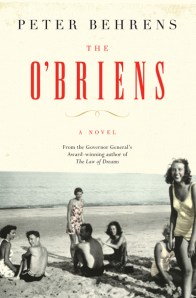
Blog Tour and Giveaway: The O’Briens, Peter Behrens

The O’Briens by Peter Behrens is a sprawling family saga that follows the life of Joe O’Brien. Chronicling Joe’s life from his childhood protecting his siblings from an abusive stepfather Joe’s business building a section of the railroad to his children going off to fight in World War II, The O’Briens also depicts a  slice of Canadian history. I haven’t read Behrens’ first novel, The Law of Dreams, and at first I was afraid I wouldn’t be able to understand this novel, but I found that O’Briens works wonderfully as a stand-alone as well.

Joe is a fascinating character, and I enjoyed watching him grow from a protective older brother to a scarred father. Like his own father, Joe has a thirst for travel, and I love how this restlessness was later inherited by Joe’s son Mike. In a novel about exploring North America and eventually settling down with a family, the O’Brien wanderlust is an apt family trait. The best parts of O’Briens are where Behrens really delves into very raw emotions, to the point that the situation can make the reader uncomfortable. The section, for example, where Joe leads his siblings in dealing with their stepfather is rather disturbing, mostly because the persons involved are young children, but I love seeing Joe’s struggle to be the father figure for his siblings and his desire to force them to grow up as well so they can survive even without him. I love the scene where Iseult has to give birth without Joe around, a terrifying episode, and Behrens captures the emotions wonderfully.

I also love the little quirks that define characters. Iseult’s obsession with photography for example, reminds me of my own mother, who loved taking pictures, though thankfully not to the extent Iseult does. The part about Iseult stopping to take a photo of her crying child before running over to see if first aid is required could have come off as gimmicky, but Behrens has set it up so well beforehand that the extent of her obsession feels natural.

Behrens’ descriptions are poetic, and I really liked some of the phrases. About stained glass windows, Behrens writes, “Rich shards of colour broke through those exuberant windows, and exotic scents — silver polish, English tobacco, China tea — drifted through the chiaroscuro rooms.” At times, I would’ve preferred a bit more subtlety in the way he depicts emotions: “Iseult felt her lungs deflate, withering as grief closed in. […] As [the phone receiver] dangled on its wire, she got slowly down on hands and needs, touched her forehead to the Tabriz carpet, then rolled over and lay on her side on the mottled wool, gasping and wheezing…” While I actually liked the image of lungs withering with grief, I found the scene getting somewhat melodramatic as it went on. What I did like, however, was that Behrens then immediately balances it out with humour, having the housekeeper Cordelia walk in and trip over Iseult’s body.

I liked the novel best when it was focused on Joe growing up. I wished it had shown more of his siblings other than Grattan — with the priest character so prominent in the first chapter, I was interested in seeing how the siblings who entered the religious life dealt with it — but I can understand Joe being completely separated from them. I didn’t find the chapters with Joe’s children as compelling, with the major exception of the part about Mike running away from home. The latter part of the novel, switching between Joe’s three children, felt somewhat disjointed, and I would’ve preferred having a central character in the next generation at least, or even Joe himself, to have provided a focal point of view.

Overall, a good book and compelling family saga. The book’s publisher Anansi has been kind enough to provide me with a copy of the book for to give away (Canadians only, please). To enter your name in the draw, just leave a comment telling me where your family is from and where in the world you would settle if you had the choice. Please also leave your email address, so we can contact you if you win. I’ll pick a random winner on June 13th.

Peter has also been kind enough to write a guest post for my blog. Keep an eye out for it tomorrow. Leave a comment on his post for an extra entry into the contest.