
 I absolutely loved Farzana Doctor’s new book All Inclusive. The publisher’s summary begins with the intriguing question “What’s it like when everyone’s dream vacation is your job?” The novel takes place at an all-inclusive resort, and I loved the behind-the-scenes peek at the employees simply going through a work day while having to deal with starry eyed travellers expecting a five-star-everything experience. Anyone who’s worked in tourism, and possibly even retail, may be able to relate.
I love the way Doctor writes about family, and about the tensions that arise from having multiple heritages. One of my favourite parts of her earlier novel Six Metres of Pavement is Ismail’s struggle with his family’s cultural norms in the face of new relationships. Family and self-realization are major themes as well in All Inclusive. Protagonist Ameera, a resort employee whose career is jeopardized by a customer complaint, struggles with never having met her father, who disappeared the morning after she was conceived. Unbeknownst to her, her father Azeez is looking for her, and the reason behind his disappearance makes this quest ever more bittersweet.
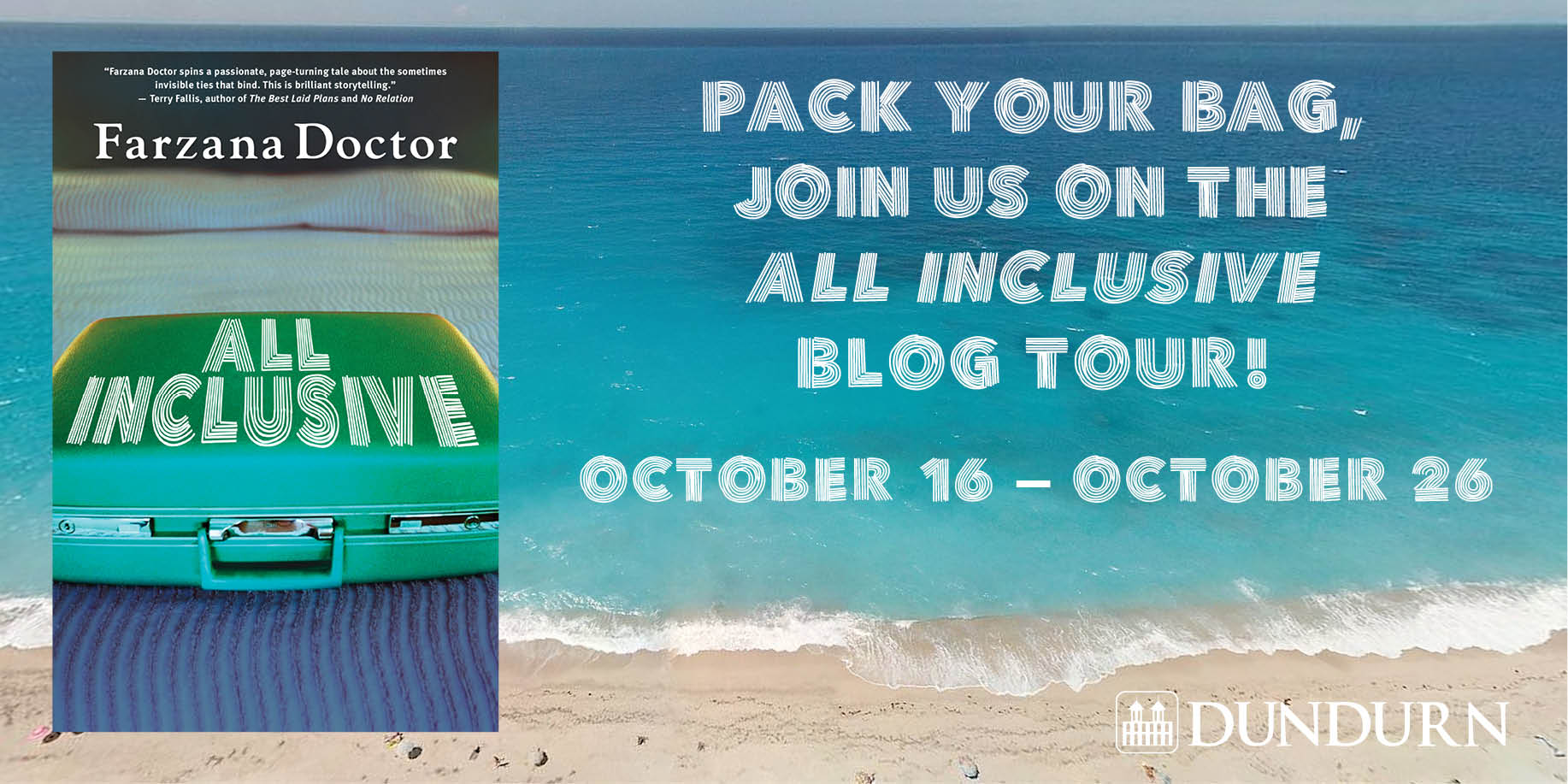
Dundurn Press has kindly invited me to be a part of their blog tour for All Inclusive, and I took the opportunity to ask Farzana some of the burning questions I had while reading the book.
Q & A with FARZANA DOCTOR
 Q: Ameera works at what many people consider a “dream vacation.” Why did you choose such a setting, and what insight does this career choice give us into her character?
An all-inclusive resort, rife with inequality, seemed like a good setting for Ameera’s struggles. She hopes the job will provide an escape from her life, but instead she finds herself in a walled-in amusement park where she must face herself.
Q: Ameera and her father Azeez’s search for each other takes a much different form than I expected. Why did you choose to have Azeez’s story take that trajectory, and were there any particular challenges that resulted from it?
Azeez’s story came to me by magic. During a period of deep discouragement I heard a voice telling me about his character and his back story. I listen to voices when I can hear them—they always guide me well. At first I didn’t want to write what I was being told; I don’t have personal links to the real-life tragedy in the story and I worried that it might not be respectful to those who do. But the more I researched the issue, the more obsessed and compelled I felt about writing it.
Q: Ameera is compared to a house with a roof and windows, but no walls, because of her lack of knowledge of who her father is. How important is an understanding of one’s origins to one’s sense of rootedness?
It’s not essential, of course (many people don’t know their ancestry). However, I chose this to be an important part of her journey. On a personal note, being connected to my roots makes me feel more grounded.
Q: Ameera is very unfamiliar with the South Asian aspect of her heritage, and the story’s setting away from Canada adds another layer of uprootedness. What is it about this double separation from heritage/home that intrigues you, and how difficult/easy was it to put yourself in Ameera’s shoes?
I wanted to create a liminal space that would magnify her sense of otherness for the reader. This in-between place also offers her freedom to explore things she cannot at “home” in Canada. You know, it wasn’t that hard to put myself in her sandals! So many of us diasporic folk feel this sense of not belonging anywhere.
Q: In one of the most (to me) touching scenes, Azeez advises the pre-teen daughter of a con artist that her parents’ problems are not her own, yet the daughter’s shoulders remain stiff and unyielding. How much do you think children take on their parents’ burdens, and is this reflected in Ameera’s relationship with either or both of her parents?
We know that trauma can be inter-generationally inherited, even if that trauma is not directly witnessed. In this example, the child might not realize exactly what her parents are doing, but she senses the wrongness and stress. Ameera inherited her mother’s solid, independent approach to life. She mostly inherited her father’s physical attributes, but I also wanted to imagine how his losses might impact her without her knowing.
Q: Did you do any fun research about Mexico and resorts for this book? If so, what was the highlight of this research trip?
The research wasn’t intentional. I went to an all-inclusive resort in Huatulco about six years ago and was very awake that trip. I noticed the foreign tour reps and wondered how they lived. I saw the intense beauty around me. I cringed at the unequal relations between workers and vacationers, the food and water waste, the history of land appropriation. All this fed my imagination and helped me create “Atlantis”.
+
Thanks to Farzana for answering my questions!
And thank you to Dundurn Press for a copy of this book in exchange for an honest review, and for inviting me to be a part of this blog tour!
All images courtesy of the publisher. Join the conversation on Twitter with the hashtag #AllInclusiveNovel.


 Literary Treats