
Review | Off the Page, Jodi Picoult and Samantha Van Leer

23278280Off the Page by mother and daughter team Picoult and Van Leer, is a sequel to their earlier collaboration Between the Lines

If, like me, you haven’t read Between the Lines, here’s a quick overview (spoiler warning): shy and bookish Delilah falls in love with a prince, Oliver, in a fairy tale book. It turns out Oliver wants to escape the monotony of fairy tale life himself (he and the other characters have to act out the story each time someone opens the book). They track down the author of the fairy tale, who modelled the character of the prince on her own son Edgar, and by the end of the book, somehow manage to have Oliver and Edgar switch places.

Off the Page takes place a couple of months after. Delilah is thrilled to have her fairy tale prince as a real life boyfriend, until she realizes that the traits she finds so charming about him are also making him the most popular boy in school. The high school queen bee wants him for herself, and Delilah is beginning to wonder if bringing him into her world is worth having to share him with everyone else.

Other complications arise as well. The fairy tale begins sending Oliver messages to return home. Other real life and fairy tale characters accidentally switch places. And Edgar’s mother reveals something that may mean Edgar needs to return to the real world.

This is a fun, lighthearted read. It was entertaining to read about Oliver’s reactions to ordinary things in the real world, and it was easy to see why he was so immediately well-liked. Delilah was a bit more annoying. It seemed selfish of her to be jealous of Oliver’s social success, and her pouty jealousy over an on-stage kiss seemed petty. That being said, I do remember bouts of irrational insecurity as a teenager, so her responses are likely realistic.

What I loved the most was the relationship between Delilah’s best friend Jules and Edgar. They bond over zombies and oddball references, and while Jules’ prickliness could at times be over the top, I did find myself pulling for them even more than I was for Delilah and Oliver.

This is a great book for younger readers. I can imagine myself at ten swooning over the idea of a fairy tale prince coming to life and head over heels in love with me, and then getting all worked up about the circumstances that may keep us apart. The storytelling has a bit of a fairy tale feel as well — a straightforward, simple story line, beautifully illustrated, and featuring a flying dragon, a string of words taking physical form in the air, and a special star you can hold in the palm of your hand. The ending too has a nice, family friendly feel, with a son’s love for his mother being the driving force. There’s an almost Disney-like feel that sets this apart form the grittier, more realistic YA that are very popular these days.

It’s not a Jodi Picoult read by any means — if you’re a fan of her in-depth tearjerkers, this is more an escape from real life than a dive into it. Nor does it completely transport you into the idea of literature as magic — for that, Cornelia Funke’s Inkheart is far more magical.

But it’s a nice read, a great way to spend a lazy afternoon. And if you happen to know a ten or eleven year old bookworm who is a true blue romantic, this would be a great gift.

+

Thanks to Random House Canada for a copy of this book in exchange for an honest review.
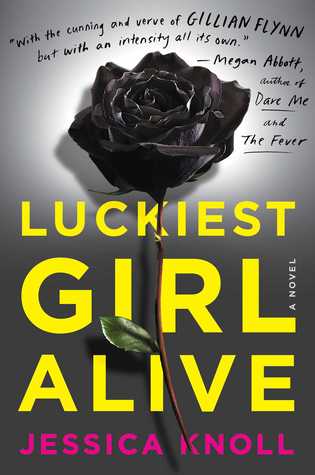
Review | Luckiest Girl Alive, Jessica Knoll

22609317Ani FaNelli appears to have the perfect life – a glamourous job at a glossy magazine, a gorgeous figure, and a handsome blue blood fiance. But beneath the facade are scars that she has worked for years to keep hidden, and a team of documentary filmmakers may very well bring the truth to light.

When I began Luckiest Girl Alive, I thought it was going to be just like Gone Girl. Ani reminded me of Gone Girl’s Amy in many ways — beautiful, cold and calculating. And right on the very first page, Ani is contemplating slipping a knife blade into her fiance’s stomach. So I figured, it was like Gone Girl, but  we know the woman is a psychopath from the beginning.

Fortunately I was wrong. Luckiest Girl Alive wasn’t the straightforward psychological thriller I was expecting, and it was a much better book because of that. Knoll takes great pains to make Ani seem like a coldhearted bitch, but slowly peels back the layers of her past to reveal a very vulnerable young woman. There are a couple of big reveals about her past, and we realize why doing the documentary is so important to her. I found the flashback scenes powerful, and I was impressed with the contrast between Ani at fourteen and the much more guarded, faux confident Ani in the present day.

As a whole, the novel doesn’t quite come together completely. Perhaps it’s partly because her supposedly “perfect” adult life never really feels perfect. As well, Ani the adult just doesn’t quite add up — she seems more a wannabe rich bitch than an actual one, yet doesn’t quite show the vulnerability that could make the wannabe aspect work. Ani as a teenager felt more real, and I’m wondering if the personality shift could have been better integrated.

I also wish we knew more about Ani’s fiance. As it was, I didn’t quite understand why doing the documentary was such a big deal. And later on, I was mostly confused about his responses to various situations. At times, it felt like he was there more as a prop for the plot than an actual character.

The ending as well seemed really sudden. Elements of it made sense, but the shift to get to that point seemed to happen really quickly, and there was a minor tidbit that was left hanging for some reason. Perhaps the author felt she didn’t have to explain how that tidbit turned out, but it felt like such an important part of the story that I wish it had been closed off more neatly.

Overall though, the segments about Ani’s past really made the book for me. These raised some powerful, timely and highly relevant issues, and I thought the author did a great job in presenting teenage Ani as a complex, multi-layered character. At one point, remembering a particularly traumatic moment, Ani confesses to some really dark thoughts, and to me, that bit of darkness is far more interesting than the bitchy facade the author uses to make her character seem evil and unlikeable. These are the most powerful moments of the book, and the ones that make the slow start very much worth it.

+

Thank you to Simon and Schuster Canada for an advanced reading copy of this book in exchange for an honest review.
+

RESPONSE TO QUESTIONS ABOUT THE ENDING
EDIT NOVEMBER 21, 2015 

Since posting this review, I’ve received quite a number of questions about the ending, and I now really wish I hadn’t given my copy away because I’m now wondering if I’d missed things in my original reading.

Short response: I’m afraid I don’t remember anymore. I’d read it so long ago, and I no longer have a copy to refresh my memory.

So for anyone asking about the ending, here’s the reply I sent to one of the earlier emails I received, and please note that my interpretation of the seashell is by no means at all confirmed as accurate:

I agree on the big reveal (that Ani’s conversation with Dean was miked up to catch his confession), mostly because I didn’t think it was as much of a surprise as the build up led us to believe. That being said, I like that Ani finally got the confession she deserved all those years ago, and having it recorded puts the power back in her hands.

I thought the story as a whole could’ve held together better. What I like the most is that I thought it was one kind of story at the beginning (Gone Girl), but it was really about a young girl’s trauma. So in that sense, the conversation being miked and going public is a fitting happy ending. Personally, I thought the whole Gone Girl angle/fiancé subplot felt unnecessary – it would have been more powerful (and IMHO less confusing) if the author had stuck to the high school trauma story. Even the shooting part wasn’t really necessary – like the author tried to put so many reveals into one story.
Re seashell: It’s been a while since I’ve read it, but I don’t remember the seashell playing a significant role necessarily, other than as a souvenir of the day with Arthur. I thought it was mostly part and parcel with the photo, and so both kinda meant a lot to her and her memory of Arthur, so her fiancé (can’t remember his name) being so casual about it just shows how little he really knows her.

Hope this helps, and if anyone has alternative explanations of the seashell or the ending, feel free to write in the comments!


Review | Fatal Affair and Fatal Justice, Marie Force

81628289230121

If you love romantic thrillers, check out this awesome series by Marie Force. Nine titles are already out in ebook, but only the first two have been released in print so far (Book 3 Fatal Consequences and Book 4 Fatal Flaw hit shelves June 2015).

FATAL AFFAIR (BOOK 1)

The series begins with the death of a US Senator. DS Sam Holland, just coming off a tragic assignment that jeopardized her career, is assigned to the case. The man who discovered the body is Nick Cappuano, the Senator’s Chief of Staff, and also the man with whom Sam had spent a memorable evening with years earlier. Their sexual chemistry is still off the charts, and Sam learns that what she’d perceived then as Nick’s loss of interest was actually the result of scheming by her controlling roommate and now ex-husband to keep them apart.

The mystery about the Senator’s killer is interesting, but it’s the chemistry between the leads that really propels this book forward. I love their bantering, and I especially love how they both respect each other’s boundaries given their respective careers. Nick sometimes tries to be alpha male and protective of Sam, but in this context, Sam is a trained police officer and Nick is a civilian, so she naturally pushes him out of harm’s way and is the one to chase after the bad guys. I love that, and while Nick at times has trouble accepting it, I love that he makes the effort.

I also really like the cast of secondary characters. Sam’s father in particular provides a rich story arc for the series, a former police chief who had been paralyzed by an unknown assailant while on the line of duty. Boyishly handsome straight-laced Catholic Freddie, Sam’s eager young partner, is probably my favourite — I love his mentor-mentee relationship with Sam, and I especially love seeing him get all flustered when one of the leads they have to interview turns out to be a beautiful woman heavily into kink.

This print edition also includes the novella One Night with You, which is about Nick and Sam’s first meeting and fateful night together. The chemistry in this was sizzling, and I felt bad thinking about how they would then be kept apart for years afterwards.

FATAL JUSTICE (BOOK 2)

In the second book a highly controversial Supreme Court nominee is killed. Sam has been promoted to Lieutenant, Nick is now a US Senator, and their relationship is in the media spotlight, which means that both are even more embroiled in this case than in the previous.

I found the mystery in this book more compelling — the victim had family issues that added some interesting angles to the investigation. Sam and Nick’s relationship deepens, and despite some snags where one tries to keep some information from the other for whatever reason, I love the overall openness of their communication. Finally, Freddie gets his own romantic subplot, which I found very sweet and that I look forward to reading more about later on.

+

Overall, these are a promising beginning to the series. The author gives us enough of the characters’ lives beyond the mysteries to make them feel real, yet never meanders too far off course. The chemistry between the characters is fantastic, and I’m sure it will continue to propel the series forward.

More titles are available in ebook format, but if you prefer print and are willing to wait a bit, print versions will be rolling out later in the year.

+

Thanks to Harlequin Books for a copy of these books in exchange for an honest review.