
Review | China Rich Girlfriend, Kevin Kwan

22674105There’s rich, then there’s crazy rich. And then there’s China rich. As Eleanor Young explains to her son Nick, “Aiyah, these people aren’t just everyday rich with a few hundred million. They are China rich! We’re talking billions and billions.” And in this spectacular sequel to Crazy Rich Asians, Kevin Kwan takes us into an even more deliciously decadent, ostentatiously opulent world.

I absolutely adored Crazy Rich Asiansso when I saw that a few ARCs of the sequel were available at the Random House Canada Spring Blogger Preview, I immediately dove for a copy like Carrie Bradshaw at a Manolo Blahnik sample sale. I then pushed the rest of my reading pile off to the side and settled in for an escape into the glitzy glamour of the 0.0001%.

China Rich Girlfriend brings back a lot of the beloved characters from the previous book. Rachel Chu and Nick Young are all set to marry. Singapore’s It Girl Astrid Leong is slowly discovering that her husband’s recent financial success has gone to his head. Former soap opera star Kitty Pong is unable to climb to the upper echelons of Hong Kong society, despite her billionaire husband and efforts to fit in. We also meet new characters, billionaire bad boy Carlton Bao, his girlfriend celebrity fashion blogger Colette Bing, and the catalyst that sets this novel’s plot in motion: Rachel Chu’s birth father.

China Rich Girlfriend has a more soap operatic feel than Crazy Rich Asians. While the first book focused on Rachel’s relationship with Nick and her introduction to his world, their story almost takes a back seat in this sequel. Instead we get drawn into an almost dizzying array of subplots, and I strongly suggest reading/re-reading Crazy Rich Asians before this book. Getting acquainted/re-acquainted with the large cast of characters felt confusing at first, but once you’re settled in, it’s an exhilarating ride.

My favourite plot thread by far is that of Astrid and her friendship with Charlie Wu, who I see from my review of Crazy Rich Asians also stole the show for me in that book. He still holds a torch for her, yet manages to maintain a respectful distance and provide emotional support while she struggles with her husband’s personality shift. The affection between them is beautiful, and after some particularly jerky behaviour by Astrid’s husband, I was on Team Charlie all the way.

As with Crazy Rich Asians, China Rich Girlfriend skewers the materialism of the super upper class. The sequel has a bit less affection and therefore a bit less bite than the original, but is just as much a pleasure to read. A Paris shopping spree scene made me yearn so badly for a shopping trip myself, and only -40 degree weather (I’m writing this on a February day in Toronto) saved me and my credit card from doing anything we regret. This scene of course was closely followed by a luxurious spa scene, which again made me long for all the treatments the characters describe. Despite his satirical treatment of the characters’ behaviour, Kevin Kwan does for high end shopping what Devil Wears Prada does for fashion, and it’s hard to read all those brand names and celebrity mentions without wishing you could experience such a lifestyle, even for just a day. Reading Kwan’s fiction allows us to live vicariously through these characters, lampooning their excess while imagining ourselves in their Louboutin heels (presented personally by their dear friend Christian, of course). That being said, the truth behind a much lauded white linen dress gives hope to us all and makes for one of the funniest moments in the book.

The food is just as gloriously described here as in the first book, and I’m not ashamed to say I ordered Chinese takeout for dinner after finishing the book. Sweet and sour pork may not quite compare to the delicacies described in these pages, but again, a fantastic scene featuring ramen in Paris shows us that at times, the rich really aren’t so different from you and me.

I’m so glad Kwan decided to write a sequel to Crazy Rich Asians. This is such a fantastic world to visit, and his writing is just hilarious. Reading it feels like watching a particularly glittery soap opera, where the jewels are ten times as large and the outfits a thousand times more expensive. Look beyond the glitz and glamour though, and at its heart, this novel is about love and family. How does a young woman deal with finding her birth father? How does a sudden increase in income change a man? And how can a privileged young man deal with having caused a terrible tragedy? Kwan refrains from delving too deep into the sad aspects of the plot, but they add some measure of reality to the story, and remind us of the human beings behind the dollar signs.

+

Thank you to Random House Canada for an advanced reading copy of this in exchange for an honest review.

Review | The Fangirl’s Guide to the Galaxy, Sam Maggs

22926684Are you a fangirl? Do you geek out over Star Trek, know every YA novel headed for the big screen, or wish Sherlock and John Watson would just hurry up and get it on already? Let’s be real: when you heard the title of this book, you either squealed with joy or said “meh” and moved on. If you are a fangirl in any way, shape or form, this book is for you.

Here’s a quick proviso: The Fangirl’s Guide to the Galaxy is not an in-depth analysis of all things geeky. Rather, it’s a light-hearted primer into how awesome geekdom can be. Did you know that Disney fans are called “Disnerds”? Me neither, but Maggs’ description of them having “big dreams, big eyes, big hair” made me laugh. I also wish I’d read this book before going to my first convention — the tips on bringing water, a charger, and cash would’ve come in handy. (“Sure, cons have ATMs, but the lines typically stretch all the way back to Narnia.” And worse, by the time you get to the front, the machine may already be out of cash. I’m never making that mistake again.)

I especially love the informal Q&As with celebrity geek girls — and my own fangirly little heart skipped a beat when I saw Kate Beaton was included! Maggs also includes some girl power type chapters on contemporary feminism, which in the light of things like Gamergate, is particularly relevant to any geek girl. Maggs’ message is simple: don’t let anyone ever tell you that you’re not geek enough. And that’s a message worth hearing.

Maggs includes a variety of geeky topics in this book, which is particularly useful for anyone who wants to try out another geekdom. For example, I’ve been intrigued by superhero comic books, but I never knew where to begin. I’ve always found comic book stores pretty intimidating. It’s hard to ask for advice about where to start, when everyone around you appears to know exactly what they’re looking for, and even when you find a series you’d like to try, it’s hard to find a good issue to start with. Fortunately, Maggs includes some book recommendations in her introductions to Marvel and DC fangirls, so maybe I’ll give those a try.

She also includes a chapter on kickass heroines to check out in various media, as well as a list of geek girl-type websites. There are a lot of books, movies, TV shows and websites I haven’t tried out yet, and I can’t wait to get started!

It’s a wide galaxy for fangirls out there, and Maggs provides us with a fun roadmap into what we can do with our fandom.

+

Thank you to Random House Canada for an advance reading copy of this book in exchange for an honest review.

Review | Lost Boi, Sassafras Lowrey

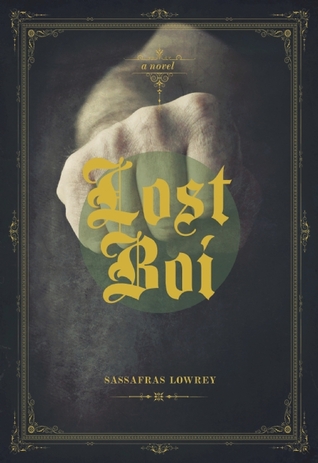
23129755There are books that provide a pleasant way to spend an afternoon. Then there are books that surprise and delight and make you glad you took a chance on it. And then there are books that completely suck you in, plunge you into a world of the author’s making, and refuse to let you go until you turn the last page. Sassafras Lowrey’s Lost Boi is just such a book. Rarely have I been so blown away by an author’s talent, or so immersed in the act of reading that I look up at the real world and have to take a moment to re-orient myself. Much like Lowrey’s lost bois enmeshed in the pirates’ ropes, I found myself held captive by Lowrey’s words, and while it wasn’t necessarily a wholly pleasurable experience, it was certainly a memorable one.

Lost Boi is a queer punk reimagining of Peter Pan, where the choice to never grow up is a choice to adopt a particular kink lifestyle. The conflict between the lost bois and the pirates is a conflict between two particular approaches to kink — the bois rejecting the rigidity of the pirates’ rules and rituals. Battles are consensual play and the enmity between Hook and Pan is much more complex than even they can explain.

Lost Boi contains layers upon layers of metaphor. I love the contrast between the lost bois choosing to live as children, and the pirates adopting an adult lifestyle yet, as Lowrey’s narrator Tootles points out, not quite completely giving up their childhood either. I love how Lowrey translates the various elements of the Neverland mythology into an urban environment, and somehow makes it all seem real. And I love how Lowrey manages the reverse as well — there’s a rough enchantment to the urban landscape and even pigeons can appear to possess some magic.

Kink is a world unfamiliar to me, and to be honest I don’t quite understand the appeal of a D/s lifestyle, especially beyond the bedroom, yet when the bois call Pan “Sir” and agree to wear his cuff, somehow it all just makes sense. And perhaps that’s part of Lowrey’s genius – ze so completely immerses you in Neverland, and is so subtle about explaining the bits and pieces of this world, that you too feel like an insider, like you are just as much part of Neverland as the characters are.

Lost Boi also stands out for me in being possibly the most gender fluid novel I’ve read. It’s tempting to, as I initially did, impose a sense of gender binary on the characters (“bois” are male and “grrls” are female), yet Lowrey’s characters defy such binaries. John Michael is a tomboy who lived with Wendi in a foster home for girls and at least one lost boi is referred to as “she”. Pan himself is referred to as “he” throughout the book but when he meets an adult outside Neverland, the narrator refers to the adult being unsure if he were a man or woman. True to the Neverland ethos, even age is fluid — the bois are referred to as children yet we have no idea how old they really are, and Pan appears a biological adult with muscular forearms, tattoos, and near the end of the story, grey in his hair.

To be honest, I wasn’t sure if I would like this book. It’s described as “punk” and I don’t quite understand what punk is. It’s based on Peter Pan, and while I well understand the desire to remain a child forever, it was never really a childhood favourite for me. Still, I was somewhat intrigued, so I decided to borrow it from the library. I say all this to urge you to give it a chance, even if it isn’t the type of book you usually read. Within the first chapter, I was hooked, and by the end of the book, I was ready to pick up my own copy. It’s that good.