
Review | 4:50 from Paddington, Agatha Christie

As I’m writing this, it’s a beautiful spring day, and I’m on my balcony with a cup of coffee and an Agatha Christie novel. Hard to beat that for my idea of a perfect day off. Reading an Agatha Christie is always a treat, and I recently went wild at Turtle Creek Books, where they have a display stand of old Agatha Christie paperbacks, some editions of which even had ads! I’m a sucker for old books and for Agatha Christie, so you can imagine the self-control it took to leave that store with only two Christies.
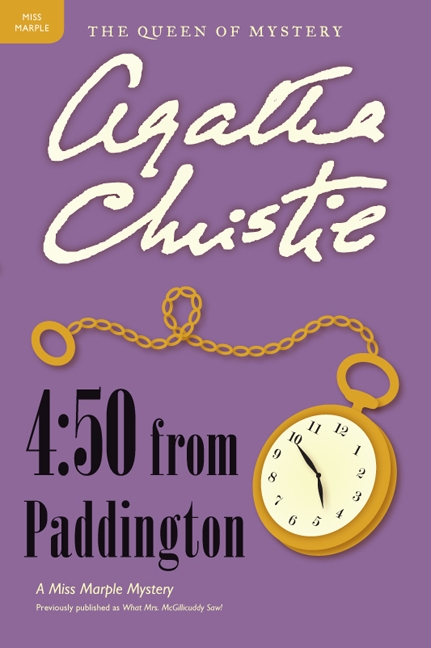
I’ve always been much more of a Poirot than a Marple fan, and to be honest, haven’t even read a Tommy and Tuppence novel yet. What kind of Christie fan am I, eh? New book pledge for 2012: try a Tommy and Tuppence mystery. In the meantime, however, I still have quite a few Marples to catch up on, and one of them is the classic 4:50 from Paddington. As you may already know, I’m a total sucker for book design, and a major, major fan of the new Agatha Christie paperbacks from Harper Collins. Isn’t that cover just beautiful? My bookshelf has a mix of old, practically falling apart Agatha Christies that I couldn’t resist getting at second hand bookshops, and these beautiful Harper Collins paperbacks, which I also can’t resist just because they’re so pretty.

In 4:50 from Paddington, elderly lady Mrs. Elspeth McGillicuddy is on the train from Paddington when another train passes, going in the opposite direction. At one point, Elspeth’s window lines up with one of the windows of the other train, and she witnesses a man strangling a woman. She immediately reports it to the train staff, but when police check the other train, they fail to find a corpse. Who is the victim, who is the killer, and more importantly, where is the body? No one believes that Elspeth has even seen anything at all, except for Miss Marple, who knows that while elderly ladies may have a tendency to imagine things, Elspeth is not that type of elderly lady at all.

“I’m too old for any more adventures,” Miss Marple muses, just as she realizes how the murderer could have gotten rid of the body. It’s a brilliant idea, and in classic Christie fashion, we aren’t treated to it just yet. But we do know that, despite her age and inability to run around interrogating suspects, Miss Marple is definitely on the case! She enlists the help of Lucy Eyelesbarrow, an almost frighteningly efficient housekeeper who is like a younger, feistier version of Hercule Poirot’s secretary Miss Lemon. Upon Miss Marple’s instructions, Lucy finds employment in the Crackenthorpe household, with their house located close to the train’s route. This sets off the wonderfully convoluted, twisty, surprising Christie plot we’ve all come to love.

With all the Christies I’ve read, you’d think I’d have become used to her surprising plot twists by now. Not the case with this book. I literally gasped out loud at a startling revelation midway through the story. I was also a hundred percent sure I knew who the murderer was by the halfway point, only to be completely proven wrong in the final pages. So much for my detective skills. And bravo to Agatha Christie, for keeping even an avid fan in the dark.

One of my favourite things about Agatha Christie mysteries, other than the actual mystery, of course, is the characterization. So many Christie mysteries are also comedies of manner, and the Crackenthorpe drama in 4:50 from Paddington totally drew me in. I love seeing Miss Marple play matchmaker — despite never having married, she is clearly a romantic at heart, and her knowing little smiles give her prediction the weight of years of observation. As Lucy exclaims after Miss Marple guesses some men in love with her, at a different time, Miss Marple would have been considered a witch for all the things she knew.

Long-time Christie fans, definitely pick up 4:50 from Paddington, and Christie newbies, this is a great novel to get you into the Marple series. You can check out the beginning of the story here — I hope it hooks you like it did me! Finally, I’d like to end with this fun little passage that, to me, reveals so much about Miss Marple:

“Yes,” said Miss Marple. “I had thought of that.”

“I suppose you think of everything!” said Lucy bitterly.

“Well, dear, one has to really.”
Review | The Devil’s Cinema, Steve Lillebuen

Meet Mark Twitchell. Film maker, Star Wars geek… and a Dexter-obsessed killer. Steve Lillebuen’s The Devil’s Cinema is an absolute page-turner. We begin the book already with an idea of how the story ends. Or, if, like me, you didn’t know about Mark Twitchell, it should be easy enough to google his story. Yet reading The Devil’s Cinema was like reading a really action-packed thriller. I got sucked into Twitchell’s story, the horror of his kill room, the details of his film making dreams, and, above all, the excitement of police officers are they methodically find evidence to build their case.

I recently told someone about all the evidence against Twitchell, most notably the diary where he wrote S.K. Confessions (S.K. stands for serial killer, and is also a nice nod to writer Stephen King) and pretty much recorded all the details of his crime, making only minor changes to the names. When I later mentioned that this was a true story, the person I was talking to looked startled. She admitted that, the whole time she thought it was fiction, she kept thinking the writer was being lazy — how convenient would it be for the murderer to have written everything down? Yet it happened, and in another particularly interesting piece of evidence, Twitchell even left behind a sticky note with a Things to Do list, which included “kill room clean sweep.” One of the detectives on the case even admitted he was 50/50 on Twitchell as a viable suspect — the methodical mind who plotted the murder in S.K. Confessions could not be the same person who left behind so much evidence. That poor detective is teased for his 50/50 remark to this day. Seriously — you can’t make this up.

Part of the reason Twitchell’s story was so enthralling is that it hits so close to home. By all accounts, Twitchell seemed like a nice, harmless, geeky fanboy. He got giddy over winning costume competitions, and he dreamed about completing a 3D Star Wars fan film on a small budget. He does have his non-murderous dark side — he cheats on his wife and lies about having a full-time job. In fact, he has a chronic tendency to lie, even when there’s no need to. Lillebuen is fantastic at forming a complex, multi-faceted portrait, and you can almost feel like you know Twitchell.

I was creeped out that Twitchell used plentyoffish.com to lure his targets. He posed as a young woman and targeted single men. Have you ever tried online dating? Perhaps even at Plenty of Fish? It’s a free online dating site, perfect for people who want to try online dating out without having to pay eHarmony fees. Here’s the lesson: if someone you meet online wants to meet you at their garage — they won’t give you the street address, they tell you to take a circuitous route and park in the nearby woods and enter through the back door — don’t. Seriously creepy.

Lillebuen is a great storyteller, and I love that the book read more like a novel than a journalistic report. Lillebuen includes dialogue that sounds real, and in fact, he claims that they’re all as close to the original dialogue as actual witnesses remember. I also love how much of the material came from the Internet, with Twitchell’s Facebook updates and messages. His email exchanges with an American woman, Twitchell using a fake Dexter Morgan account, are chilling. The woman sounds like she really understands Twitchell and his fantasies, which is creepy on one hand, yet on the other hand, also sad when she distances herself from him later on.

Despite Lillebuen’s insistence that he wants to give a lot of attention to the victim’s life, it’s really Twitchell’s character who shines here — Lillebuen presents a very human side to a murderer. Lillebuen is far from sympathetic towards Twitchell, but his relating of all the facts does humanize him, and make him real. In a weird way, Twitchell’s humanity makes his crime even more chilling. When Twitchell admits to his wife that he can’t feel empathy, when Twitchell himself realizes he meets all the checkbox characteristics of psychopathy, you almost feel sympathy, until you realize that despite his realization, he feels no strong compulsion to seek help.

When we think of serial killers, we imagine truly horrific, larger than life, monstrous figures whose minds we can’t even begin to understand. However, the Twitchell revealed in Devil’s Cinema appears a sad, almost pathetic, figure. He may dream of being the super efficient, Dexter Morgan-level serial killer in S.K. Confessions, but he just couldn’t pull it off as he’d planned. And his career, however horrific his crime, was cut off pretty quickly. His crime is monstrous, yet, given the level of his ambition, he failed as a monster. Devil’s Cinema humanizes Twitchell even as it deflates him — he is, ultimately, just a man.

Review | The Sausage Maker’s Daughters, A.G.S. Johnson

Don’t let the cover fool you. Or the book description that begins with “It’s the end of counterculture and Vietnam. Women’s consciousness is being raised and they’re beginning to find their places outside of the home.” Far from the slow-moving, politically charged literary fiction I expected, A.G.S. Johnson’s The Sausage Maker’s Daughters is a family drama and legal thriller. Kip Czermanski has been arrested for the murder of her brother-in-law, an ex-lover whose body was discovered naked in her bed. She has no memory of what happened, and her family, owners of the Czermanski sausage empire (and therefore socially and politically powerful in her hometown) is more concerned about protecting the family name than in ensuring Kip’s well-being.

The murder case presents an interesting mystery — did Kip really kill her brother-in-law? Because she herself doesn’t remember what happened, we learn the truth along with her, through bits and pieces of evidence the prosecution uncovers. But the really fascinating part of the story is Kip’s family. The youngest of four girls, Kip can’t wait to leave her hometown with its repressive small-town mentality. Her mother died at a young age, the eldest daughter Sarah ran away to join a convent, second sister Sybel faced undue pressure to be the “mother” of the household, and third sister Samantha was left to play peacemaker between Sybel and the rebellious Kip. I know we were meant to feel sorry for Kip, but I felt even more sympathetic for Sybel and Samantha, who seemed to feel more strongly the responsibilities for the family. I enjoyed reading about the Czermanski family dynamic, and I loved that the family saga was told within the framework of a courtroom drama.

The writing falters somewhat whenever Johnson injects politics into the story. Often, despite the date markers citing the present day setting as the 1970s, I would forget that the story was indeed set in a different time. But once in a while, as if to remind us about the political background of the era, Johnson has her characters talking about the feminist movement or women’s rights, and the dialogue just sounds more written than spoken. Characters like Kip’s lawyer Phil sometimes sounded like didactic mouthpieces. Certainly, feminism is an important issue, but I wish the rhetoric had been more seamlessly integrated into the storytelling.

Similarly, when it came to really emotionally charged scenes, the dialogue felt stilted. I actually enjoyed some of the more melodramatic conversations. But, for example, in a particularly emotional confrontation among the Czermanski sisters, some of the lines just sounded like they were put there to narrate background information rather than express real emotion.

That being said, the story really takes off once the trial begins, and we get into the truth about the killing. The legal battles are fascinating, and I loved watching Phil’s legal strategies to keep the prosecution off balance. Kip is a sympathetic protagonist, though with too large of a chip on her shoulder to be really likable. Phil, both intelligent and brutally honest, is probably my favourite character; Phil’s ability to call Kip on her prejudices are definitely points in Phil’s favour. The book cover promises an ending that we don’t see coming. To be honest, I was more interested in Kip’s family drama and Phil’s legal maneuvers than in the identity of the murderer. That being said, the ending did take me by surprise, and I found it more sad than shocking.