
Review | Insurgent, Veronica Roth

When I read Veronica Roth’s Divergent, I thought it was a good book that had the potential for a great sequel. Insurgent is that sequel, and it is even better than I’d predicted. Now that Roth has established how her world works in Divergent, she gives herself the freedom to rip it apart completely. The book started out really confusing for me, because I hadn’t read Divergent in a year and I was too lazy to  read the Guide to Divergent that the author had very thoughtfully posted on her site. Tip: read that guide. That being said, even though, other than Tris and Four, I had no idea who the other characters were, I got to know them and quickly came to care for them, just from reading Insurgent.

Insurgent is just amazing. I love how real it felt — Tris has been scarred, literally and figuratively, from the events in Divergent. (Warning: Divergent spoilers ahead.) She has been through some horribly traumatic events, and I love that Roth never lets us forget it. We are constantly reminded that Tris doesn’t have time to heal — her shoulder, injured in Divergent, can be used against her in battle. Her shooting of her good friend Will traumatizes her so that she is unable to use a gun, and also too ashamed to explain why. These plot points figure prominently throughout Insurgent, and I love how they are more than just dramatic plot points; they have become integral parts of Tris’ character.

I’d never been a big fan of the physical “courage” of the Dauntless — as revealed in their training sessions, it seemed more reckless adrenaline hunts than actual courage. So I love that Tris reveals her Divergent side in this book. She still has a temper and a tendency to be reckless, but these are more because of her trauma than actual recklessness. She is tired, guilty over Will, and wanting to be with her parents, so a part of her seeks dangerous situations — this strikes me as a very understandable reaction to all she’s been through, and I love that even with this desire, she still has logical reasons for her actions. I’ve always been a fan of Erudite, even though the villain Jeanine is from that faction, so I love that Tris’ being a Divergent means she has a very strong Erudite side. Tris is just kick-ass, both physically and intellectually, and she really takes charge in this book.

The best part? We find out why Jeanine has acted as she did, and the reason sets us up for what could be a killer finale. It’s a risky revelation, and such a big twist that I wasn’t sure how I felt about it beyond that it reminded me of a plot point from The Hunger Games. (Given how many plot twists there are in The Hunger Games, I think it’s safe to make that comparison without risking any spoilers.) I do know that while Divergent is good, and Insurgent is amazing, the third book has the potential to be even better. After seeing how wonderfully Roth exceeded my expectations and raised the stakes in Insurgent, I can’t wait to see what she’ll come up with next!

Anyone have a betting pool as to what the title of book 3 will be? I’m putting it on record — I’d long predicted it’ll be Convergent, but after reading this book, I now think it’ll be Resurgent. Or, more likely, Roth will decide to surprise us all and choose a different title altogether for book 3, one that doesn’t end in “gent.”
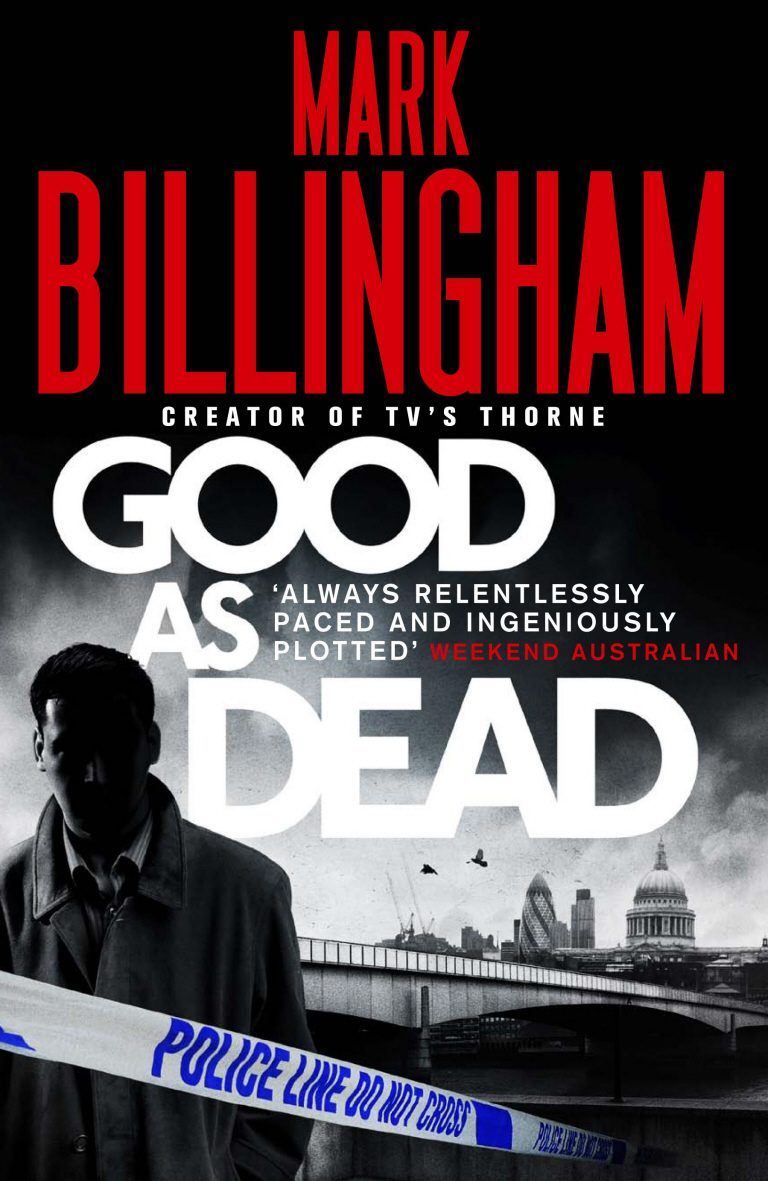
Review | Good as Dead, Mark Billingham

Shop owner Akhtar takes police officer Helen Weeks and a civilian hostage. His demand: that DI Tom Thorne investigate the apparent suicide of his son in prison, which Akhtar believes is a murder. Mark Billingham’s Good as Dead is a fast-paced mystery and an exciting read. It’s my first Tom Thorne book, as well as the first time I’ve heard of the Thorne TV series. I hope the TV show will be aired in Canada; it looks really interesting.

I had zero sympathy for Akhtar. I’m sure that’s partly because I just finished the deeply disturbing Into the Darkest Corner, and because of the recent real-life body parts case and Eaton centre shooting, all of which make me especially angry at people who use violence to ruin the lives of innocents. So Akhtar believes his son was murdered, and that the justice system failed his family. That in no way justifies, to any extent, his threatening the lives of two innocent people. While I understand that Thorne’s race to find out the truth about Akhtar’s son is motivated by his desire to see the hostages safe, a part of me hoped that it would turn out that the son had committed suicide after all, and that Akhtar realizes how pointless his drama is.

To Billingham’s credit, he also holds back on whatever sympathy he has for Akhtar. Rather, he emphasizes Helen’s concern over her one year old son, and the other hostage’s hysterical focus on his missing a meeting regarding his promotion at work. Even when Helen chooses to hide information from the police trying to rescue her, it’s not because of Stockholm syndrome, but rather because she wants to survive to see her baby again. Her decision seemed more like a convenient dramatic device to keep the story going rather than the smart choice, but I like that Billingham explained her reasoning behind it. I also like the scenes where Akhtar’s wife confronts him — Thorne reasons that in any couple in crisis, at least one of them has to remain strong. In the case of Akhtar’s wife, she couldn’t afford to fall apart, because someone has to take care of the other kids in the family. I like her as a character, and felt sorry for what she must be going through, first with her son, and now with her husband.

I have no sympathy for Akhtar, but his son did get a pretty raw deal. Billingham takes us into the son’s life, and the real reasons behind his imprisonment. It’s not a pretty story, and Billingham reveals a harsh, tragic type of party scene, where it’s so easy for boys like Akhtar’s son to get in way over their heads.

Good as Dead is a pretty solid, entertaining thriller. Nothing that particularly made me want to read all the other Tom Thorne novels, but definitely a good read for the weekend or an afternoon at the beach.

Review | Are You My Mother? Alison Bechdel

I loved the sneak peek I got of Alison Bechdel’s graphic memoir Are You My Mother? I was intrigued by the complex relationship between Alison and her mother, moreover, I was intrigued by Alison’s mother herself. A voracious reader and amateur stage actor, Alison’s mother had to deal with an unhappy marriage. Alison struggles to reconcile memories of her mother patiently writing down daily journal entries for her with memories of her mother being distant, no longer kissing her goodnight at a young age.

There are some genuinely touching moments in this book. The nights Alison and her mother spent, for example, writing down detailed accounts of the day in a journal. I also love the parts about Alison’s mother acting, moments of joy that stood in sharp contrast to her weary plea to a young Alison to let her have some private “me time.” The mother’s discomfort with Alison’s homosexuality, and with Alison revealing so much about their private lives in Fun Home struggle with the mother’s reticence in speaking about feelings.

Personally, I would have preferred more scenes of their interaction and a lot less intellectual reflection. This is more a matter of personal preference rather than a commentary on the quality of the book — what the author has set out to do, she does very well. It’s just too detached a treatment for me, and I got bored.

In struggling to understand her relationship with her mother, Bechdel examines the work of psychoanalytic analyst D.W. Winnicott, who studied the relationship between the child and its mother. Bechdel reflects on her relationship with her mother in terms of Winnicott’s work, for example, Winnicott’s play therapy is linked to her own memories of playing with her mother. At one point, she confesses to her therapist that she wishes Winnicott were her mother, which I guess is because she feels Winnicott understands children in a way her mother never did.

Bechdel also writes about Virginia Woolf, particularly about To the Lighthouse, and again, relates her reflections on her relationship with her mother to the Woolf novel. I like how, later on, Bechdel realizes that her mother must have read A Room of One’s Own, and how this is somewhat similar to Bechdel herself being influenced by the words of Adrienne Rich. However, as Bechdel ruminates on To the Lighthouse, I found myself tuning out again. Confession: I also couldn’t stand To the Lighthouse. I know it’s a classic work of literature and full of symbolism and so on, but I found it a boring, frustrating read. Like Woolf, Bechdel’s narrative loops, coming back to the same memories and offering a bit of new insight each time. Also like Woolf, Bechdel examines the tiniest details for significance, and then links it to psychoanalytic theory, or relates it to a dream that she recounts to her therapist. So, if you do like that style, perhaps Bechdel’s endless intellectual ruminations in Mother will also be more to your liking.

Are You My Mother? is a well-written book, and Bechdel’s illustrations are as good as ever. I liked the portrait Bechdel creates of her mother, and their scenes together are touching. I could have done with a lot less of the psychoanalysis and reflections on Woolf and Winnicott, but I can see how other readers may find that fascinating. Overall, well done, but not my kind of thing.

+

Thank you to Thomas Allen Ltd. for a finished copy of this book in exchange for an honest review.