
Review | The Off Season, by Amber Cowie

The Off Season had an interesting hook: documentary filmmaker Jane Duvall moves into a remote hotel during the off season with her new contractor husband, Dom, and his teenage daughter, Sienna. Dom is tasked with doing renovations at the hotel to prepare it for the next tourist season, and Jane is coming off a work-related scandal (the details of which we don’t learn till much, much later than really necessary) and hoping the atmospheric hotel will give her material for her next film. Except odd things start happening at the hotel, and the more Jane digs into its history, the more she learns of mysterious deaths and disappearances linked to the place, most notably Dom’s ex-wife and hotel owner Peter’s son.

So far, so compelling. I love locked room mysteries and thrillers rooted in family secrets, and a remote hotel during the off-season is such a wonderfully atmospheric setting for such a tale. Unfortunately, this book didn’t fully work for me. So much of the success of this kind of story lies in the setting and the main character, and neither really gripped my interest.

I didn’t really understand why Jane was so fascinated by the Venaventura Hotel; apart from her being stuck there for a few months. She was really drawn into the history of the hotel, but from an outsider’s perspective, I didn’t really find the hotel super mysterious beyond Jane’s assertions that it was.

I also didn’t really understand why she was so into Dom at all. There were a couple of steamy scenes, but mostly he seemed like a bit of a jerk, and his secrecy about his wife’s death was such a giant red flag that I wondered why on earth Jane even married him in the first place. His daughter Sienna is a total brat, and honestly, I just felt Jane should leave and both Dom and Sienna should go into family therapy to deal with unresolved feelings over Dom’s ex-wife.

A lot of the issue comes from the fact that Jane has only known Dom for a few short weeks (I think?). So when Dom starts acting shady, and Sienna starts doing cruel things, and Jane literally thinks she’s in danger from one or the other, or both of them, I don’t understand why she still keeps wanting to make it work. I may have understood more if the goings-on at the hotel made her want to escape, and the story turns into a race against time to leave while she still can. But instead, she keeps flip-flopping between wanting to run away and wanting to make things work with Dom and Sienna, and that just gets really frustrating to read after a while.

In terms of thrills, there’s a lot going on: mysterious mean notes scrawled on mirrors, potshots taken at Jane, a trip wire designed to cause serious injury, and a lot of stuff that is unclear if they’re signs of danger or mere coincidences (for example, Jane’s phone falling into a sink full of water so she can no longer use it). There are also elements to enhance the atmosphere of danger, such as the bridge becoming damaged and a storm coming in. And of course, all the mysterious deaths and disappearances.

But to me, these are all elements of a thriller that don’t quite have a compelling enough emotional core to make me care. I see the danger, and I want Jane and the stray cats she took in to be safe. (Good news: the cats remain alive and unharmed till the end.) But since I don’t really understand why Jane cares so much about Dom, Sienna, and their new family in the first place, then whenever something new and dangerous happens, I just wanted her to break up with Dom and take herself and the cats away.

All to say, this book didn’t work for me. But at least the cats survive, and also to the author’s credit, I didn’t guess the big reveals.

+

Thank you to Simon and Schuster Canada for an e-galley of this book in exchange for an honest review.
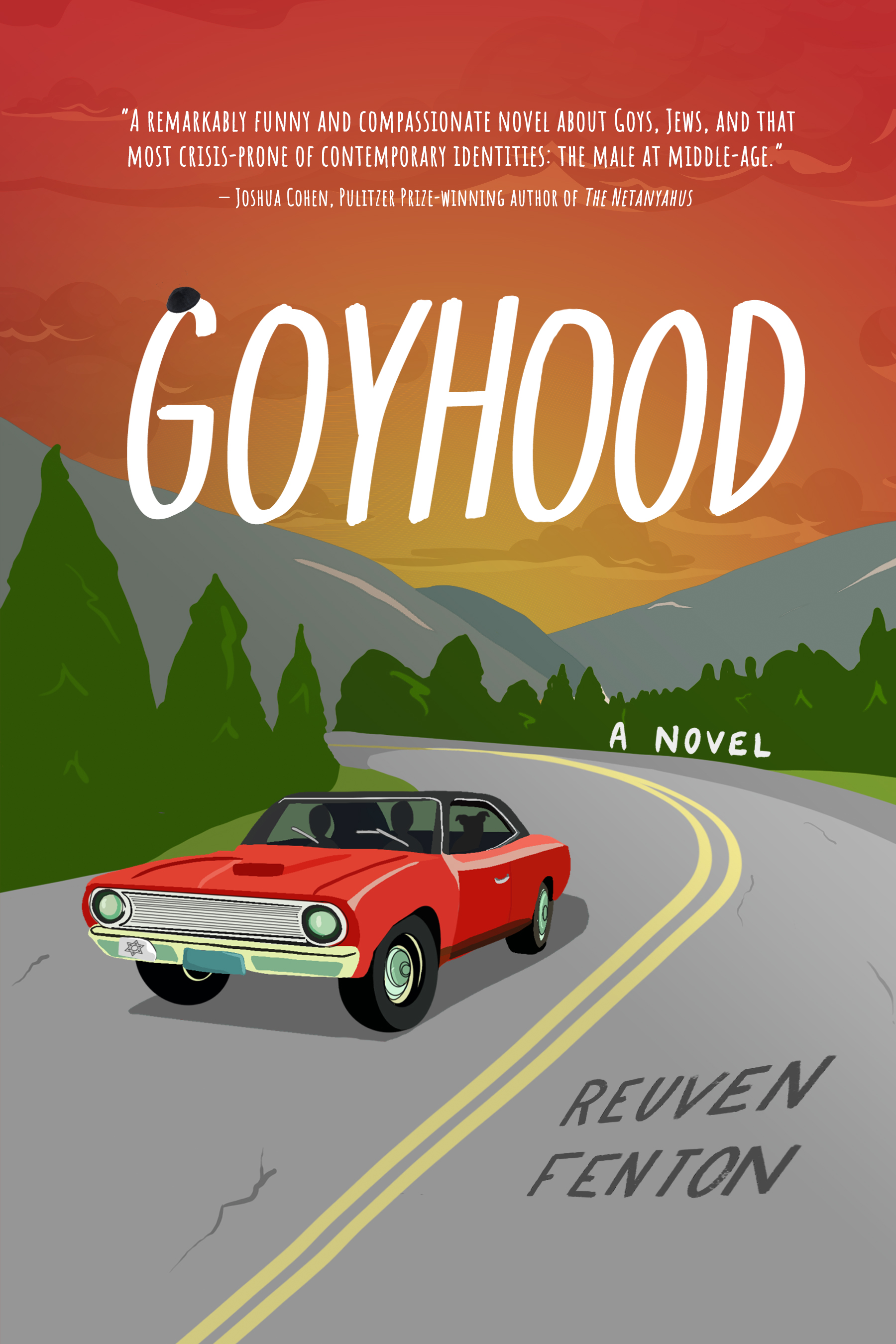
Review | Goyhood, by Reuven Fenton

When their mother dies, estranged twins David and Mayer learn that they’re not actually Jewish as they’d been brought up to believe. Worse, their mother’s grandfather was a Nazi.

The revelation isn’t a huge deal to David, who has lived a fairly secular life, but Mayer has dedicated his entire adult life to studying the Torah. A devout Orthodox Jew for decades, Mayer must come to terms with the revelation about his family’s past, and figure out how to break the news to his equally devout wife, Sarah, who is also the daughter of a very well-respected rabbi.

David suggests a road trip back to Mayer’s home in New York, and since Mayer doesn’t have enough money to pay for a flight home for himself, he is forced to agree. What follows is a light-hearted, sometimes absurd, but always heartwarming road trip novel, as the brothers come to terms with their family history and their long-ruptured relationship with each other.

I really enjoyed this novel. Both David and Marty respond to their non-Jewishness in different ways, but at both their cores is a deeply-rooted desire to figure out who they are exactly, and where they may belong. David’s desire to become better friends with his younger twin is equally obvious; Marty’s a bit too stuck on adhering to strict rules of morality and behaviour to be easily open to friendship with his more free-spirited brother, but it’s good to see him slowly emerging from his shell.

The story is populated with entertaining side characters: Charlayne the social media influencer on a quest of her own, and Popeye the rather mangy stray (read: abandoned) dog whom David convinces Mayer to let him take along. Each has their own role to play in the larger story, but for me, the story is strongest when it focuses on the relationship between the brothers. The story David tells of Marty standing up to a bully when they were younger was so full of brotherly pride that it made my heart burst to hear it. And the moment where David confesses his desire to convert to Judaism, only for Marty to unequivocally shut him down, is heart-breaking.

I’m not Jewish myself, but I imagine that all the little details about the nuances of different approaches to Judaism will resonate even more meaningfully for Jewish readers. As for me, I enjoyed learning about these nuances, such as: the restrictions around gentiles (non-Jewish people) participating in Jewish traditions; the term “Noahide,” which refers to gentiles who abide by seven laws (I looked them up, and it was interesting to me as a Catholic to see where they overlapped and differed with the ten commandments I knew); and processes around Jewish conversion and divorce.

I also really enjoyed this novel’s exploration of questions of identity, and what it’s like to have to redefine yourself after learning that the most essential aspects of yourself aren’t actually true. I also really liked the way the novel explores questions of faith and faith-based identities, and all the different ways one may choose to have a relationship with their god of choice.

Overall, this is a good book, and a fairly lighthearted romp, despite tackling some tough topics.

+

Thank you to the author for an advance reading copy of this book in exchange for an honest review.

I Try to Solve a Dorothy L Sayers Mystery | The Nine Tailors

Hoping Sherlock Holmes tea will help me solve this case!

Ahh… I tried solving this for my blog, but gave up halfway through.

The Nine Tailors is beautifully written. The “tailors” in the title refers not to suit-makers, but rather to the nine bells in a small village church. The story begins with Lord Peter and his trusty valet Bunter getting stranded at a small village on New Year’s Eve, and taken in by the local priest. The church has planned an overnight performance of its bells to ring in the New Year, one of the bellringers has called in sick, and Lord Peter gets a chance to join in the bellringing himself. As the hours pass, he also gets to know more about the people in the village, and all the little bits of local gossip.

Fast forward a few months, and Lord Peter receives a call from the parish: a body has just been discovered in another person’s grave. Could he come over and help them figure out who it is, and how it got there? Lord Peter of course agrees immediately, and I was equally intrigued.

I also have a soft spot for my copy: I found it in a thrift shop, and there’s a lovely handwritten line pencilled in cursive, “from my mother, 2010”, plus an embossed snowflake name, “Natalie Neill.” So I like thinking about Natalie Neill, and her mother, and how they may have shared a love for old British mysteries and maybe even Dorothy Sayers in particular.

But as a mystery for me to solve, it was a bit too dense for me to really sink my teeth into. Who was the dead body in the churchyard? How did they die? Why were they tied up, and why were their hands taken? Parallel to this, and somewhat linked, is the mystery around a jewelry theft at a wealthy woman’s home years ago. How were the jewels actually stolen? Were the right persons charged with the crime? Where did the jewels go? Added to the mix is a whole cast of characters who may or may not be involved, a stranger who visited during New Years and also may or may not be involved, and a potentially coded message whose key may lie amongst the parish bells.

Lord Peter Wimsey does his best to solve the case, in his methodical way, but it seems each new answer only gives rise to more questions. There are also too many characters for me to keep straight, and as much as I tried to stay interested in the whole history behind the jewel theft, I just ended up making my head hurt. Probably around the halfway point, I decided to stop trying to figure things out, and just enjoy the ride.

My enjoyment of the story did increase after that, because then I could just enjoy how wonderfully Sayers crafts the atmosphere for her story. I loved imagining myself in this small village, and hearing the beautiful church bells for myself. Sayers describes the bells’ songs beautifully; I honestly had no idea how much music and harmony were involved in bellringing.

It turns out that letting go of the need to solve the mystery did in fact actually lead me to solving a key component of the case. I managed to guess the cause of death, and I honestly think I was only able to do so because I’d stopped worrying so much about tracking all the little details involved.

The rest of the big reveals were a surprise to me. I thought the story of how the victim ended up dead made sense, and I thought Sayers did such a great job at humanizing the people involved, so that the reveal evoked more of an emotional response beyond just an “aha!” moment. I actually felt for those involved in the death, and for how things turned out in the end.

Overall, a beautifully told story, and like I said, the mother-daughter connection gave me a soft spot for my copy. As a mystery, it wasn’t among my successes, nor, quite frankly, was it all that much fun to try. Possibly others will have more luck / enjoy the attempt more, but for me, I recommend simply sitting back with this, and letting yourself enjoy seeing the story unfold.