
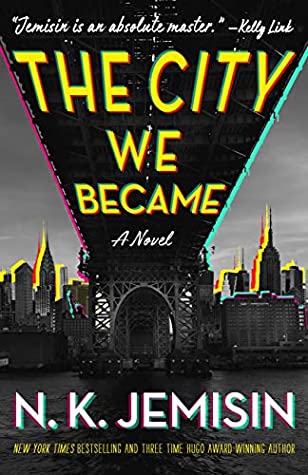
Review | The City We Became, N.K. Jemisin

CityWeBecameCoverThe City We Became is a full-out, unapologetic, in-your-face homage to New York City. In it, five New Yorkers are ‘reborn’ into the living embodiments of the five NYC boroughs. They must band together and find the living embodiment of New York as a single, wholly encompassing city, so that they can defeat the Woman in White, an other-dimensional being determined to stop New York City from being ‘born.’

I’m a huge fan of N.K. Jemisin’s Broken Earth trilogy. I find her books brilliant — they’re multilayered and reveal more with each re-reading. The City We Became is such a book. It made me wish I grew up in New York City, or even that I just lived there now. The characters felt real, but I think they will also resonate much more strongly for those with an emotional connection to NYC.

First, there’s Manny (Manhattan), the brash and charming ethnically ambiguous newcomer who finds power in a cab ride and in dollar bills. There’s Brooklyn, the badass Black city council member who used to be a rapper and who lives in a brownstone with her dad and daughter. There’s Bronca (Bronx), the Lenape arts centre administrator, who’s the only one of the five that was ‘reborn’ knowing the group’s history and purpose. There’s Padmini (Queens), the mathematician from Chennai who is in NYC on a student visa. And finally there’s Aislynn (Staten Island), the timid white woman who is scared to take the ferry into the city, and who grew up with a lot of prejudices about immigrant and persons of colour.

Each of these characters is so vividly drawn, both as human beings and as allegories for the boroughs they represent. I love how each of them draws power from something that’s rooted in the spirit of their respective boroughs (e.g. the brownstone for Brooklyn, the apartment complex of immigrants for Padmini), and how all of these come into play in the story.

I also love how the villainous Woman in White sinks her tentacles into the city both literally and figuratively. Literal tentacles destroy the Williamsburg bridge and cause a traffic jam on FDR Drive, but more significantly, the Woman in White also buys up real estate to turn into condos or coffee shops. In one scene, the heroes recognize the Woman in White’s influence when they see a Starbucks where a beloved community space used to be. The Woman in White also goes after Bronca’s art centre by offering a huge sum of money for the centre to display racist and misogynistic artwork by a group of alt-right white men. The symbolism can feel a bit heavy handed, but on the other hand, everything also somehow works together, and as someone who lives in a city, so many of the story’s touchpoints struck a chord in me.

On one level, The City We Became is a gripping urban fantasy, where the city’s champions/avatars fight to protect their home from an alien invasion. But on another, deeper level, it’s also about the way cities grow and develop identities. Jemisin’s New York City is not a land area with buildings and cars, but rather a living, breathing entity. I love that her vision incorporates the distinct identities of each borough, while still bringing them together into a cohesive, yet never singular, whole. Jemisin’s love for the city shines through with every page. I loved the New York City she portrayed, and I can only imagine how much more powerful this book would be for actual New Yorkers.

+

Thank you to Hachette Book Group Canada for an egalley of this book in exchange for an honest review.
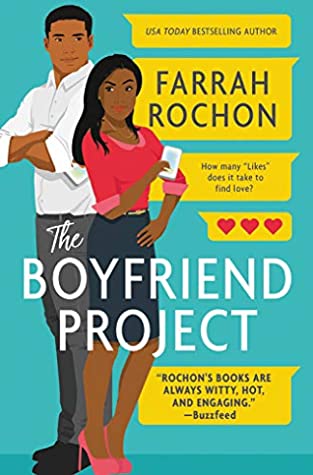


Review | The Boyfriend Project, Farrah Rochon

TheBoyfriendProjectCoverThe Boyfriend Project starts off with the heroine Samiah Brooks, a super smart techie who heads her company’s outreach efforts and dreams of developing her own app, learning through Twitter that the guy she’s dating was also dating two other women. The reveal is hilarious (the jerk took them to the same sushi restaurant!), the confrontation epic. Unfortunately, it also made Samiah go viral, and soured her on letting any man dupe her again.

Enter Daniel Collins, a biracial man (Korean-American and African-American), who investigates financial crimes and has gone undercover in Samiah’s company. The sparks between them are immediate, the flirty banter super cute, and despite Samiah’s initial reservations, she finds herself opening up to Daniel and allowing herself to fall in love with him. Except Daniel’s only in town for his assignment, he can’t tell Samiah the truth about what he does, and he knows that he will inevitably break Samiah’s heart someday.

The Boyfriend Project mixes so much of what I love in romance: fantastic chemistry, nerdy protagonists, kickass female friendships, and a conflict that is inevitable despite being neither character’s fault. I love the way Samiah and Daniel’s relationship developed, how both characters did their best to fight their feelings for each other (Samiah because she’d vowed to take a break from dating, Daniel because he knew he was lying to Samiah about who he was), and how they ended up ultimately being unable to resist each other. Rochon writes chemistry wonderfully, and I was right there with both Samiah and Daniel through their whole roller coaster of emotions.

The conflict was really well done as well. Part of me could see Samiah falling in deeper with Daniel and really wanting Daniel to just tell her the truth already, but another part of me understood why he couldn’t. The whole situation hurtles towards a point where he has to perform an outright betrayal in order to get his job done, and my heart broke right with Samiah’s at the inevitable reveal. The conflict is angsty and emotional and oh-so-absolutely-gripping. I kept wanting to see how the characters could work their way past the situation, and kept longing for the inevitable happily ever after. Part of me did feel that the resolution felt a tad too easy given all the build-up, but I also really liked how reasonable and empathetic both characters were in seeing each other’s positions, and how well they ultimately communicated with each other.

I also like how kickass both Samiah and Daniel were at their jobs. Both are super smart techie developers and great at what they do. There’s a scene where Samiah admits she initially hesitated to tell Daniel about the app she’s developing as a passion project, because she knows he has the skills and technical know-how to steal her idea, and I really liked that, because it shows how well-matched they are on an intellectual level.

There are also moments where Samiah talks about the challenges of being a Black woman in the tech industry, how she has to work harder than her colleagues to get the same level of success, and how her teachers often discouraged her from being too ambitious. She also talks about how she feels the pressure not to screw up any opportunities for other Black women who’ll be coming in after her, and how important it is for her to give young Black girls the opportunity to see her at work and know that they can aspire to something similar. I’m not Black, so I can’t fully understand what she experiences, but I do appreciate how Rochon explores this subject, and I really love this part of the story. There’s a great scene where Daniel admits that being part Asian affords him some privilege in the tech industry — it’s still racism, with the stereotype of Asians being smart in math and tech, but I love how Daniel and Samiah discuss these subjects so openly.

Finally, the friendship between Samiah, Taylor and London — the three women duped by the same man at the beginning of this book — was a major highlight of this book, and a fantastic setup for the series. I love how they initially bonded over the jerk who duped them, and how their friendship developed since then to weekly Friday dates and real, deep conversations about their lives. I love that the three women banded together to encourage each other to pursue their respective dreams beyond romance. I especially love that despite Samiah reneging on their agreed-upon ‘Boyfriend Project’ (a dating hiatus), Taylor and London didn’t make her feel bad about it, and instead were super supportive of her developing feelings for Daniel. I love romances that highlight the strength of friendship between woman, and I’m excited to see how Taylor and London’s stories turn out.

+

Thank you to Forever Romance for an egalley of this book in exchange for an honest review.

Review | Wicked as You Wish, Rin Chupeco

WickedAsYouWishCover“Just because you’ve never been to the Philippines doesn’t mean their rivers don’t course through your blood. It doesn’t mean you don’t have their mountains in your eyes. It’s not where we are, it’s who we are. You’ll always be both a Makiling and a Warnock, and always a Filipina. Never forget that.” [page 46]

I’ve long been wishing for a Filipino-inspired fantasy, and Wicked as You Wish delivered in spades. Not only is the main character Tala Filipino-American, but her family’s magic is steeped in Filipino culture, and all the scenes with Tala’s family are basically a love letter to all things Filipino. To name a few: Tala and her mom’s side of the family, who are the magic users, are called the Makilings, after Maria Makiling, and they call their magic ‘agimat’ (amulet). Tala’s grandmother Lola Urduja and the other kickass adults in her family are called the Katipuneros (a reference to historical Filipino rebels… there’s even a character called Heneral Luna!). There’s a full scene with a Filipino feast, including lechon, adobo and even some ersatz kakanin that Tala’s poor Scottish father bought in a store and Lola Urduja relegated to the trash. Tala fights with arnis sticks, which is an awesome Filipino martial art. There’s even a scene where Alex (the prince that Tala and her family have to protect) asks why they’re helping him, and Tala’s family responds by explaining the concept of bayanihan (community coming together to help each other). The beginning of this novel is very much steeped in Filipino history and culture, and I was hooked.

Unfortunately, overall, I found the world building too convoluted. Beyond the Filipino references, it often felt like Chupeco tried to cram in as many fairy tales as possible into a single world (Cinderella, Sleeping Beauty, Alice in Wonderland, Rapunzel, Hansel and Gretel, the Snow Queen), and except for the Snow Queen (a villain in this story), none of the other fairy tale references were really relevant to the story. Like Sleeping Beauty was actually a fierce warrior whose spindle was a sword? It’s a cool idea in theory, but it never went anywhere, and soon there were just too many references to keep track of.

There are also a lot of different kinds of magic (spell tech, Tala’s agimat, curses, something about ice maidens and shape shifters, and so on), which is likely a callout to the series title A Hundred Names for Magic, and similar to the fairy tales, they never quite pulled together into a single cohesive mythology. The novel’s world straddled a kind of fairy tale land (Avalon) mixed with legends (Excalibur) mixed with our own world (Carlyy Rae Jepsen’s Call Me Maybe in a pretty kickass training scene), and I couldn’t quite get a clear grasp of what the world as a whole was like.

In a way, I see what Chupeco was trying to do: bring all sorts of world mythologies, fairy tales and legends into a single world where all the different approaches to magic intersect. There are some pointed references to America being a melting pot of cultures, and in a way, this book is like a melting pot of a bunch of different fairy tales and magics. But while the book may have managed to stitch these all together, it didn’t quite manage to convey their meaning as a whole. The result feels more like a hodge podge than a fully realized world, and I wish Chupeco had focused a bit more on fleshing out one or two main threads than in trying to cram it all in.

The characters were all right. Tala was incredible, and, unusually for a YA book, I actually found the adult characters (her family) the most compelling. So many YA books keep the adults away from the action, so I love that Tala’s entire family, including her grandmother, were right in there kicking ass with her. It struck me as very much a Filipino style of superheroics, where the extended family is integrated into the the main character’s life and journey.

To be fair, this may be a personal bias, in that I liked them best because of their Filipino mannerisms. But most of the younger characters felt a bit flat to me. Ryker, who is Tala’s love interest, is pretty complex and has a fantastic back story, so I look forward to reading more of him in future books. I also really liked the developing romance between Zoe and Cole, whose dynamic reminded me a bit of Ron and Hermione in the Harry Potter books. I also sympathized with West, a shape shifter whom Alex straight up calls ugly at one point. Most of the team had some pretty cool powers, but I never really got a clear sense of why they had banded together and why they cared about bringing Alex back to Avalon. Chupeco does give us a bit of each character’s back story, but not quite enough for me to connect with them emotionally.

Alex, who was Tala’s BFF and the main impetus for the characters’ quest, turned out to be the most disappointing. Despite being nominally the other main character, he mostly faded into the background. I loved the whole concept of the firebird, and the firebird itself was an awesome character, but Alex, as the heir to throne of Avalon and the Chosen One who can harness the firebird’s powers, barely did anything nor showed any personality apart from a few strong scenes in the beginning and the end.

Still, I loved the Filipino references, and the fact that each character’s magic had some kind of connection to the mythology of their family’s country of origin. Chupeco also explores real world issues like homophobia and racism, and in a fantastic scene where Lola Urduja and the Katipuneros encounter ICE agents, they straight up call out the double standards in how they treat white persons and BIPOC persons.

The series name references one of my favourite passages in the book, which I just found absolutely lovely. I especially love how some of the Tagalog words Tala’s father uses to refer to magic don’t quite transliterate to ‘magic’ exactly, but rather to similar words like serenade and fate. I love how this expands our understanding of what magic is.

“Yer mum’s people have a saying,” her father said quietly. “About there being a hundred names for magic in the Tagalog language. A bit like that old song about native Alaskans having fifty words for snow. Every culture gets to make that claim, but it’s particularly true with Filipinos, I think.”

“Like agimat?” Tala’s Tagalog needed some brushing up, but that’s what they’ve always called their Makiling curse.

“Aye. And kulam, and anting-anting, and some others you don’t expect. Harana, tadhana. Yer mother would know more than me. What I mean is, you’ve got magic in your blood, love. You can’t take it out of you any more than you can will yourself to stop breathing. Y’got a whole language of charms.” [page 46]

+

Thank you to Raincoast Books for an advance reading copy in exchange for an honest review.