
Review | Pup Fiction, by Laurien Berenson

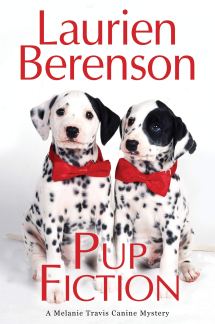
PupFictionOkay, first of all, how adorable is this cover?! One look at those adorable Dalmatian puppy faces, and I knew I had to read this book. And I’m happy to report that Pup Fiction lived up to its promise!

This is the 27th instalment in the Melanie Travis cozy mystery series, but as a total newbie myself to the series, I can attest that you don’t need to read the first 26 volumes to enjoy this mystery. Series lead Melanie raises show dogs for competition, and solves mysteries with her indomitable Aunt Peg, a dog breeder and dog show judge.

In Pup Fiction, Melanie drops off her sons at her friend Emily Grace’s summer camp, only to learn that Emily is being plagued by a mysterious run of mishaps. Fortunately, no one has been hurt so far, but with events like her Dalmatian puppies running into traffic, a truck rolling into a lake, and a kitchen fire, it’s only a matter of time before someone does. And indeed, the body of Emily’s ex-husband — her “biggest mistake” — is soon found in the woods close to camp. Emily is a suspect, and enlists Melanie’s help to prove her innocence.

This was such a fun book to read, and I’m excited about checking out more titles in this series. I love animals, and I absolutely adore mysteries starring animal lovers, so when Emily comments that Melanie talks more to her dog than most people talk to their spouses, I was immediately hooked. I also love how the Dalmatians featured in the mystery — their arrival at Emily’s doorstep a few months ago accompanied her ex-husband’s re-entry into her life, and while the central mystery didn’t revolve around them, they turned out to be a valuable clue.

I also absolutely adore Melanie’s Aunt Peg. She’s hilarious! She gets involved in this story purportedly to help Emily with her money problems, but really, she’s much more interested in Emily’s Dalmatians, which I can totally relate to. There’s also a fun subplot about Melanie’s older son Davey showing one of Aunt Peg’s dogs at competition, where we get a bit of an inside glimpse into the world of dog competitions. I imagine the other books in the series take us even deeper into that world, which makes me even more excited to dive in.

The mystery itself was interesting. Berenson did a good job in setting up a handful of side characters who may have been involved in the murder, and while I guessed the murderer before Melanie did, I admit the book kept me guessing almost all the way through. The ending of the mystery made me a bit sad, because I’d grown to like one of the characters who I think won’t appear in future books.

Overall, this is a fun book, and fantastic introduction to the series!

+

Thank you to Kensington Books for an e-galley in exchange for an honest review.
Review | Not A Happy Family, by Shari Lapena

NotAHappyFamilyI love Shari Lapena’s novels, and I absolutely adore thrillers about dysfunctional families. Bring on the drama, the childhood secrets, the backstabbing over inheritance! Especially in the hands of a writer like Lapena, who crafts vivid, engaging characters, and tosses in a few twists and turns, Not A Happy Family had me flipping through the pages as quickly as I could.

When millionaires Fred and Sheila Merton are found murdered in their stately upstate New York estate, their three adult children quickly become suspects. Prior to the murders, the family had had a rather explosive Easter dinner, where Fred’s cruel remarks sent the children and the long-time family housekeeper walking out early. All the children had motive to want to kill him: oldest child Catherine wants the family home, but learns on Easter that her father plans to sell it. Middle child Dan thought he’d be inheriting the family business, but his father just sold it to someone else. And youngest child Jenna is an artist who lives mostly off her father’s financial support, but he doesn’t seem inclined to keep that going for much longer.

Then there’s their aunt Audrey, who claims Fred had made plans just before he died to leave her half of his wealth, except he was murdered before he could meet with his lawyer to update the will. Pissed that the murder has deprived her of the inheritance, Audrey is convinced one of the children killed their parents, and is determined to find the killer and turn them in. Also on the list of suspects are the housekeeper Irena, who, more loyal to the children than to her employers, is found to have cleaned off the murder weapon. And an unexpected player, who may also benefit from Fred’s death.

It’s a domestic puzzle straight out of Agatha Christie, and I was riveted the entire time! I love the family dynamics. I love how the siblings immediately banded together out of a shared dislike for their father and a shared, illicit happiness at his death… and I especially love how they start turning on each other when the investigation starts narrowing in on each of them. Lapena has done a great job in making all these suspects have believable motives, and also in giving all of them shaky alibis. I didn’t expect the reveal when it came, and to be honest, I didn’t understand why the mother had to die as well when it seemed like most of the siblings’ beef was really with their father.

The epilogue was also *chef’s kiss* masterful. I don’t often pay much attention to the epilogues of these kinds of novels — I think mostly because they’re pretty predictable in that there’ll either be one final twist, or a nice glimpse into a main character’s happy ending. But this epilogue filled me with delight. i think it’s because the ending felt so unjust, and, well, kinda mean, and the epilogue was like a sly little wink that things will turn out as they should. I loved it.

+

Thank you to Penguin Random House Canada for an e-galley of this book in exchange for an honest review.

Review | An Old, Cold Grave (Lane Winslow 3), by Iona Whishaw

OldColdGrave

“Please don’t tell me where to barge. We can never be friends if you think you can.” [Lane Winslow to Inspector Darling, page 265]

A major highlight of any Lane Winslow mystery is the respectful and oh-so-restrained relationship between Lane and Inspector Darling. Especially, of course, when punctuated by the reactions of Constable Ames, who is the reader stand-in in just begging Lane and Darling to get their act together already! To Ames’, and my, delight, An Old, Cold Grave features a couple steps forward in the romance subplot, and, like Ames, I have my popcorn ready for the next instalment in this relationship.

The dynamic in the dialogue above is fairly common in cozy mystery series, but I think Iona Whishaw handles it particularly well. In this book, as in the first two, she does three things I love:

  1. Lane is as much a factor in her own rescue as Darling is, to the point that there’s little doubt she’ll save herself even if Darling never comes along.
  2. Darling acknowledges her competence in this area, his role in providing a supporting hand, and the role his emotions play in his reaction to her “barging off.”
  3. Lane acknowledges how much his support does help, how “insufferable” she sometimes was with “her constant fits of pique at Darling,” which his behaviour doesn’t merit, and which are at least partially caused by her own frustrations about the limitations society imposes upon women.

The combination of all three leads to some measured and nuanced conversations between the two, which I don’t always see with this dynamic, and just makes me root for them more.

The mystery in this novel is probably my favourite of the three Lane Winslow novels I’ve read so far. It’s a cold case, a death from about 30 years ago, discovered when the Hughes family (sisters Gwen and Mabel, and their octogenarian mother Gladys) find a child’s skeleton in their root cellar. As somber as their discovery is, I have to admit this novel has the funniest opening I’ve ever read in this series, with Gwen and Mabel, both women in their 50s, arguing over chores. I absolutely adore Gwen, Mabel, and Gladys, and their family dynamic, and I’m so glad this mystery gave us a deeper dive into their lives! This mystery also led Gwen to learning quite a bit more about her sister’s past, and while the denouement was handled with great restraint, I like to think that the sisters became a lot closer because of it. And if they ever appear again in future books, I know I’ll look upon them very differently!

Another feature I love in the Lane Winslow mysteries is how much I learn about Canadian history. This investigation into the child’s identity and the circumstances around their death led to some flashback scenes about Home Children. These are orphans in England (or poor children whom police found on the streets without parents) who are sent to Canada presumably to be adopted into better lives. But many were abused, or adopted primarily to be used as cheap / free labour, and this novel interweaves the story of a family of Home Children with the mystery. (The British PM made an official apology to Home Children in 2010.)

The novel fell short for me in two ways. First, the Lane-in-peril subplot, while it was resolved well, felt completely random and unnecessary. Part of it may be how it was handled — we see the situation first from Darling’s perspective, and then get a flurry of backstory from Lane later, which reduces the sense of urgency. But also, I don’t get why the perpetrator would have done it in the first place — they seem to get no benefit from it, and when they speak, even they don’t seem to have their heart in what they’re doing. As a result, this subplot seemed shoehorned in only to deepen the Lane and Darling relationship, and as much as I love the relationship subplot, I dislike how forced this subplot felt. Iona Whishaw could do — and has done — better in making dangerous situations feel organic.

Another, minor, snag for me is the subplot about the runaway teen, which had nothing to do with the central mystery. It was an interesting commentary on the limitations society imposes on women, and a way to show how even the usually-perfect Darling can subconsciously falter in his progressiveness. There was also a scene that somewhat tangentially connected it to the main mystery. But overall, I wish that it had either been integrated more fully into the main mystery, or that this subplot had been more fully integrated with the series characters. As it was, it felt fairly tangential, and while I agree with its main points, it ultimately fell flat for me.

Overall, however, this is by far my favourite of the Lane Winslow series so far. (I’ve also reviewed Book 1 and Book 2.) The Hughes sisters and their mom are fantastic, and I’d love to see more of them. The big reveal was, ultimately, more sad than anything, and while part of me wishes it was happier, I love how complex and human so many of these characters are, and how much Whishaw managed to make me care for them within a single book. And, as always, I’m excited to see Lane and Darling’s relationship progress, and I can’t wait to see what happens next for them!

+

Thank you to TouchWood Editions for a copy of this book in exchange for an honest review.