
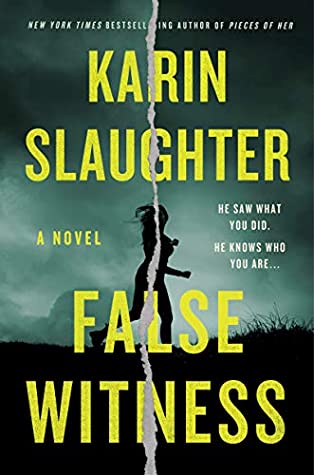
 Defense attorney Leigh Collier is hired to defend an alleged rapist. Andrew is white, wealthy, and arrogant that he will be set free despite the overwhelming amount of evidence against him. Worst of all, it turns out that he’s linked to Leigh’s past, and that he may have information about a terrible secret that Leigh and her younger sister Callie have worked their entire adult lives to escape.
False Witness is the kind of thriller you wouldn’t want to put down. It’s tightly plotted, with compelling characters, dark secrets, and a truly heinous villain you wish would get what he deserved.
It also features wonderfully complex heroines who exist in a murky, grey zone of morality. Leigh is a tough, ambitious career woman and fiercely protective mother, and, from the surface, appears to have the perfect life. However, we learn that this perfection is hard-won, and part of it was attained due to a horrific act she did as a teenager. Whether or not her actions were justified is matter for discussion, but it definitely shows a dark side within her, that seems to only be waiting to be unleashed.
In contrast, Callie’s life seems to be falling apart. She’s a drug addict with track marks visible on her arms and legs, and she steals drugs from her kind, elderly veterinarian boss, to sell for profit. But then she’s also clearly very kindhearted. She engages in conversation with people living on the street who say nonsensical things, she cares for the animals at the veterinary clinic, and she’s super sweet with her cat Binx. In many ways, Leigh and Callie’s adult lives seem to be two sides of the same coin, and the novel drew me deep into their stories, and made me wish for them both to just be happy.
Unfortunately, their happiness is endangered by Andrew’s court case, and the hints he drops at how much he knows about their pasts. As Leigh examines the evidence against him, she realizes how tough her job will be. All rape is violent, but the one in this book is especially so — when Leigh asks if the victim was unconscious during the rape, her colleague’s response was that they hoped so, given what was done to her. And when Leigh advises Andrew not to take the stand, it’s easy to see why — even on the page, Andrew gives me the creeps. The lead-up to the court case is both thrilling and maddening, and the ending takes a somewhat darker, and sadder, turn than I anticipated. Part of me wishes that the ending had been more rainbows-and-sunshine happily ever after, but mostly, I thought the ending felt right, and gave closure to the various plot threads.
I also think that False Witness may be the first novel I’ve read that actually talks about life during the COVID-19 era. I’ve read a pandemic thriller, Lost Immunity by Daniel Kalla, but that was a fictionalized pandemic in a post-COVID world. Most novels I’ve read recently seem to take place in a vague present-day or an alternate reality where the pandemic isn’t a factor, and to be honest, during most of the past year and a half, that was exactly the kind of literary escape I wanted.
But then False Witness begins in the spring of 2021, where Leigh and her estranged husband are at their teenage daughter’s drama production, and everyone’s wearing masks. There are the now-common observations about men who keep their masks dangling on their chins and how they’re probably equally lax about condom use, the somewhat wistful comments about how intermission used to mean going out into the lobby to chat over snacks, and the somewhat throwaway detail about ‘non-compliant’ parents who refused to wear masks being given the option to watch the performance over Zoom. Leigh also makes a wry comment about how the school put on the performance over five Sunday evenings, to give all the parents a chance to attend. It’s a minor joke about how that measure just took away parents’ excuse to get out of having to attend, but it’s also a somewhat sad reminder of how much live theatre and other similar venues have had to adapt during the pandemic.
Perhaps it’s because I’m fortunate enough to be in a country where vaccinations are now easily accessed, but I actually liked these little details about pandemic life. So much of the past year and a half has been about changes to the way we live that it’s almost a comfort to read about how a regular thriller, with all the usual conventions of the genre, can still play out within the restrictions of pandemic life. Slaughter even uses the pandemic to deepen the relationship between the sisters, with Leigh having contracted COVID in 2020, and feeling guilty about infecting her sister to the point that Callie still seems to sometimes have difficulty breathing. It’s both a jarring reminder of how much COVID has impacted people’s lives, and an oddly comforting assurance that real life does continue around and alongside the pandemic.
I don’t think I’ll quite go around looking for stories set in contemporary pandemic times, but, at least for this novel, Slaughter shows how to do it well.
+
Thank you to Harper Collins Canada for an egalley in exchange for an honest review.
 Filled with guilt over the argument they’d had on the night of his brother’s death, Dan is determined to fill the hole left by Patrick’s absence. He helps his sister-in-law Zoe with childcare and chores, drops by his parents’ home more often, and takes over the management of Patrick’s finances and rental properties. Doing so reveals a secret that Patrick’s kept from his loved ones for years, and Dan is torn. How can he best honour his brother’s legacy and care for the family he left behind, while still pursuing his own chance at happiness?
 The mystery in
  Literary Treats