
Review | Even So, by Lauren B. Davis

Cover of Even So, with a white and pink flower against a background of blue-green leaves.Even So is more a spiritual novel than a religious one, by which I mean that it tackles themes of sin, guilt, and redemption, but there are no overt demands to turn to God, nor pray in a different way, nor even convert to a particular religion. I personally liked this approach — I grew up Catholic, and a lot of the language in the book resonated with me on a nostalgic level, as it reminded me of the guided meditations and silent retreats we did at school. And I was glad that the book stopped short of actually proselytizing, and was broader and more inclusive in its approach to its themes.

will add the caveat that the way Davis treats the themes leaves much room for interpretation. The above is how the book struck me, but I can also very easily imagine other readers who will experience the book otherwise, and possibly read it as super religious in tone. I can also imagine readers — on both ends of the religiosity spectrum — who may dislike how this book chose to tackle its themes, and feel that it was either too heavy-handed or too subtle. My experience of the book is very much tied into my personal history, and my personal relationships with faith and spirituality, and I think your own experiences will colour how you end up viewing this novel.

Even So tells the story of two women: Angela Morrison, who is unhappily married to a wealthy older man, and wishing to rekindle passion in her life; and Sister Eileen, who runs the Our Daily Bread Food Pantry where Angela volunteers. Sister Eileen is dealing with a crisis of faith — she longs to deepen her relationship with God, yet is haunted by something she did when she was much younger that she fears is unforgivable. Angela — self-centred and snobby — is someone Sister Eileen automatically dislikes, and learning to love her regardless is part of her redemption. For her part, Angela’s passion is rekindled when she meets Carsten, the handsome gardener at Daily Bread, who is young, free, and basically everything her husband isn’t. Her decision to have an affair leads to her causing a terrible tragedy that unites both women in a journey towards redemption.

There were times when I found the moralizing to be too heavy-handed. Though Davis does a good job in setting up her characters, so that the moralizing feels organic to who they are, and to where their stories are headed, it got a bit much at times, and made me just want to tell everyone in the story to chill already. Despite Angela’s clear unhappiness in her marriage, her affair with Carsten is depicted as sordid, even shameful. The novel does display sympathy for her during the fallout from the tragedy, but it’s a sympathy that felt contingent on her repentance, not just for the tragedy itself, but for embarking on the affair in the first place.

Angela did make some poor choices, but where I consider those choices to be naive errors in judgement (seriously, IMHO, Carsten was never much of a prize), the novel presents them as sinful. There was such an undercurrent of judgment through the chapters on the affair, with Angela getting passive-aggressive comments from other characters, that I just wanted to tell her to find better friends already. Not necessarily friends who’ll condone the affair, but at least friends who won’t make her feel like she was on a one-way ticket to hell. And while Sister Eileen plays coy about how Angela should respond to the tragedy, the framing makes clear that punishment is the best way to cleanse the guilt, and move towards forgiveness.

Despite that, I ultimately found the book a comfort to read. I’d mentioned that it reminded me of some of the spiritual practices and events from my youth, and that’s because, equally embedded with all the shame and guilt, was the desire to love and to be loved. Davis writes beautifully, and Sister Eileen’s reflections on the nature of love, and what it means to love even when you don’t feel like it, can at times feel like a warm hug. There’s transcendence in forgiveness, particularly when turned towards oneself, and this novel explores that theme beautifully.

And despite the heavy-handedness of the moralizing at times, I think that overall, Angela isn’t presented so much as a sinner as a human being, with all the foibles and heart that entails. Her sense of despair, as she looks on her marriage, and realizes how trapped she feels in her own life, feels very real. And when she decides to have an affair with Carsten, we are pulled right into the relief she feels, as she finally indulges in something that makes her happy. There was also catharsis in how her story turns out, and a clear sense that she’s, if not happy, at least well on her way towards happiness.

Ultimately, I found Even So to be a moving tale of sin, guilt, and redemption. I don’t think it’s for everyone, but I do think there are readers who’ll find it uplifting, maybe even transcendent. Angela and Sister Eileen are both archetypes and very much human — I think some readers may be able to recognize themselves in these characters, and find succour in how their stories turn out.

+

Thank you to Dundurn Press for a copy of this book in exchange for an honest review.

Review | Murder in an English Glade (Beryl and Edwina Mystery 5), by Jessica Ellicott

MurderInAnEnglishGladeMurder in an English Glade is a charming historical mystery featuring an Odd Couple-type pair of private investigators: British socialite/aspiring novelist Edwina Davenport and American adventuress Beryl Helliwell. In this instalment, the investigators are hired to run a fake undercover investigation at an artists’ retreat — their client’s cousin is accusing their client’s sister-in-law of having an affair with one of the artists, and the client believes the appearance of an investigation will quell her cousin’s doubts before the accusations erupt into a full-blown scandal. Except that shortly after Beryl and Edwina arrive, the artist turns up murdered, and the fake investigation turns real.

It’s a charming premise. I’m a huge fan of genteel British small town mysteries, and I loved the chance to delve into a world where there’s an estate large enough to host a group of artists and a group of Girl Guides, and art has such cultural cache that such goings-on are simply par for the course for the ultra elite. The beginning also totally won me over, with Beryl blundering into an argument with Edwina’s housekeeper — being unused to servants, Beryl thinks she’s being helpful, but Edwina’s gardener is quick to point out her faux pas. I love that contrast between both the lead characters, and how they responded to the situation.

The mystery, as well, hooked me at first. I loved the subplot about a potential romance for Edwina, and the comedy around Edwina learning what going undercover as an artist’s model may actually require her to do. I also hadn’t realized cigarette cases were designed by painters working with models, so that was an interesting bit of history. The big reveal came as a surprise to me, and I like how all the various disparate elements came together at the end.

That being said, the novel fizzled out for me partway through. Possibly, it’s just that I had to be in a certain mood to really get into it, but the latter half felt slow to me. The mystery surrounding Beryl’s history with one of the guests didn’t really interest me much, and I wanted to see a lot more of Edwina’s potential romance. The way the reveal was structured also felt a bit confusing — there’s a major clue near the end that points to a particular suspect, but then much ado is made over figuring out the involvement of a character who turned out to be irrelevant to the reveal. And the villain’s motivation was only hinted at on-page — there were some clues leading up to it, but the key part of information behind their motivation was only brought up in the big exposition scene, which I felt took away some of the “Aha!” feeling of all the pieces clicking into place.

Overall, it’s a pretty good mystery. I found the characters of Beryl and Edwina to be interesting, and I love the set-up of the faux investigation. The second half was a bit of a letdown, but overall, the mystery was solid, and had some good red herrings and clues.

+

Thank you to Kensington Books for an e-galley of this book in exchange for an honest review.
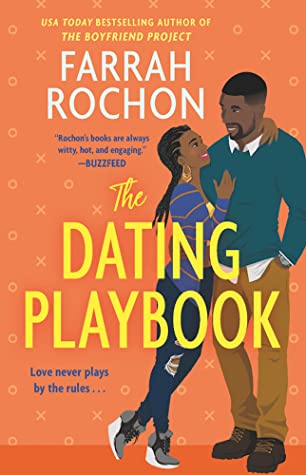
Review | The Dating Playbook, by Farrah Rochon

DatingPlaybookCoverFarrah Rochon’s The Boyfriend Project was one of my favourite books the year it came out, so in fairness to The Dating Playbook, my hopes and expectations coming in were sky-high. And The Dating Playbook is a good novel — Rochon has a gift for sizzling chemistry, complex characters, and emotions that’ll rip your heart apart before putting it back together again. But mostly… it was okay, and after The Boyfriend Project, that was a bit of a letdown.

Admittedly, part of it is that nerds just grab me more than athletes do, and sports romances aren’t usually my thing. So the story of Taylor, a personal trainer who’s hired to get Jamar back into NFL-ready shape after an injury, isn’t usually a romance I’d pick up unless I loved the author. I did like how Taylor and Jamar pushed each other physically — Rochon does a great job in the training scenes of ramping up the sparks as each main character notices new things they like about each other — but all the stuff about proper nutrition and buying healthy groceries weren’t all that interesting to me.

Beyond that, though, the romantic conflict fell a bit flat for me. I’m usually a huge fan of the fake dating trope, but in this case, the premise felt thin, and I found myself having to continuously suspend my disbelief about why they had to continue the illusion that it wasn’t real. Part of it was that I found the initial premise more believable — Taylor raises a valid concern that dating Jamar would hurt her professionally, because it would make any future endorsement from him suspect. That made a lot of sense to me; women are so often accused of using our sexuality to advance in our careers that I can see why Taylor would want to keep things strictly professional.

So when Taylor does a complete 180 and decides that pretending to date Jamar would actually help her career instead of harming it, I found it a hard sell. I recognize the value of social media publicity, but I found it hard to believe that the benefits of publicity would outweigh the compromising of Jamar’s objectivity in endorsing her. It was especially frustrating because the novel included an easy out for the fake dating plot — the journalist who ‘broke the story’ is presented as super ethical, and would have been amenable to a correction.

The fake dating plot felt artificial to me from the start, and as the story progressed, the insistence on keeping the relationship fake felt even more forced. One of the reasons I’d loved The Boyfriend Project so much is that the conflict felt inescapable — both main characters’ professional interests were directly at odds with each other, and the big secret between them was necessary for reasons beyond the characters themselves. In contrast, the way the conflict played out here barely had teeth, and was a disappointment.

That being said, Rochon delivered on showing us how much Taylor and Jamar care for each other. A scene involving oral sex is emotionally-charged and beautifully written, and I love how it ties in the love between the leads and the various emotions playing out in their lives beyond the romance.

I also loved the non-romantic conflicts that Rochon set up for both leads. Taylor’s coming to terms with her learning disability is wonderfully done — I love how she starts off masking her fear of school with the pretense of finding it useless, and I also love how she gradually comes to terms with the realization of how much a college degree will help her career. I’ve read other novels that treat this subject with less depth, often just accepting as given that a college degree is important. So I very much appreciate how Taylor begins with a genuine belief that a college degree isn’t necessary, and how she actually does manage to garner some success without one, until circumstances show her how much more a college degree will help her achieve. I also appreciate how Rochon treats Taylor’s goal as not centered on the college degree itself, but rather on her broader vision for Taylor’d Conditioning. And I love how the novel delves into Taylor’s decision-making processes, and shows concrete examples of how going to college will help her achieve that vision.

Jamar’s personal growth is even more emotionally-charged — I love how his despair over a potentially career-ending injury and desire to get back into NFL-ready shape are tied both to his personal dreams, and to his deathbed promise to his best friend Silas. I love the history of friendly rivalry, mutual admiration, and yes, professional jealousy between the two men, and how that colours Jamar’s determination in training. And I especially love how his growth arc plays out, how his decisions are based on a whole range of factors, including his pride, mercurial public perceptions, his love for Silas, and his continuing relationships with Silas’ family and with Taylor. It’s such a complex hodgepodge of elements that add nuance to his training, and Rochon handles it beautifully.

Overall, it’s a good book, just not a great one, and after The Boyfriend Project, that was disappointing. Independent of the comparison, I found the first half slow, and may have DNF’d if it were another author, but I’m glad I kept reading, as the emotional payoff in the second half made up for it. The third book, London’s story, which seems to be about her class reunion and the guy hired to organize it, will be out in Summer 2022.

+

Thank you to Forever Romance for an e-galley of this book in exchange for an honest review.