
Review | My Darling Husband, by Kimberly Belle

DarlingHusbandCoverMy Darling Husband is a taut, fast-paced domestic thriller. Start reading it on a weekend, because once you start, it’s hard to put down. The story begins with one of anyone’s worst nightmares: Jade Lasky comes home with her two young kids to find a masked man with a gun. Her husband Cam has only hours to pull together the oddly specific sum of $734,296, or Jade and the kids are dead.

The problem is that Cam has nowhere near that amount of money. A successful chef and owner of high-end steak restaurants, Cam is heavily in debt to his investors, and the day of the hostage-taking, his most successful restaurant has just gone up in flames. The novel alternates between Jade and Cam’s perspectives, and occasionally the masked man’s, whose name is Sebastian. And the result is a tightly woven plot, as Jade and her kids fight to survive, and Cam pulls on all available strings to raise the cash. 

Surprisingly, the star of the show turns out to be nine-year-old Beatrix, who is an even bigger thorn in Sebastian’s side than Jade is. I’m not often a fan of overly precocious kids, but even I had to admire Beatrix’s cleverness. Watching her and Jade work together to try to outwit Sebastian and protect the younger, more naive, Baxter, was a pure delight.

Interspersed throughout the novel are snippets of an interview Cam gives after the incident, which helps fill in some of the blanks, for the reader if not for Jade. We learn that he’s had some shady business dealings, and been involved with illegal activities, all in pursuit of his ambition. We also learn his own family history, and how his father’s choices have shaped the person he is today. The book blurb makes a big deal of this aspect of the plot, promising family secrets and public scandals, and to me, the book itself never quite lived up to that promise.

The truth behind Cam’s actions and the links to the motives behind Sebastian’s actions, turns out to be much more prosaic that the blurb suggests, and I actually think the book is better for it. Rather than a dramatic, big gasp reveal, we get a rather ordinary story, and two complex and flawed men. Their decisions may be questionable, and at times, downright wrong, but their motives are somewhat understandable, and ultimately human. This isn’t to say that they’re wholly sympathetic — Sebastian’s hostage taking is undeniably wrong, and some of the things Cam does is downright callous. But the author has created some interesting character studies that unfold as she keeps us on the edge of our seat watching all the thriller aspects play out. 

Overall, this is an exciting, fast-paced read, and a lot of fun for a weekend.

+

Thank you to Park Row Books for an e-galley in exchange for an honest review.
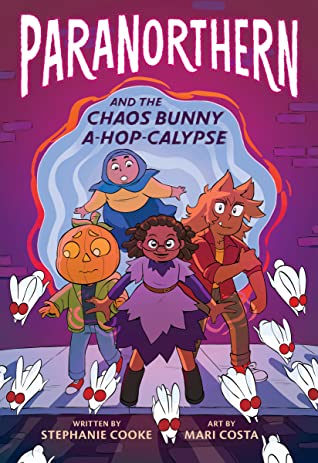
 

Review | ParaNorthern: And the Chaos Bunny A-hop-calypse, by Stephanie Cooke and Mari Costa

ParaNorthernCoverThis graphic novel is just adorable! Abby’s a young witch who, when saving her younger sister from bullies, accidentally opens a portal to the realm of chaos bunnies. Now she and her friends — a wolf girl, a pumpkinhead, and a ghost — must find a way to close the portal before the bunnies wreak any more havoc on their town.

The story is simply a delight from start to finish. I love how strong and supportive the friendships amongst the main characters are — Abby and her friends are all ride-or-die for each other, even when they don’t necessarily know how to handle something as, well, chaotic as a chaos bunny invasion, and seeing them work together to figure stuff out is really heartwarming. I also love the strong relationships Abby has with her mom and sister — even as she decides to keep her mom in the dark about the chaos bunnies, you can tell how close they are as a family, and how much they care for each other’s welfare. There’s a lighthearted jokiness in the dialogue amongst many of the characters that just makes you want to be a part of their world, and be amongst their circle of loved ones.

I also like how the story focuses on the friendships and on Abby grappling with her insecurities rather than revert to a Chosen One narrative. Abby does turn out to be a more powerful witch than she realized, and much of the story is about her struggling to understand her powers without being overwhelmed by them. As she tells her friends, closing a chaos bunny portal is advanced magic far beyond the lessons she’s currently taking in her spell-casting classes. While most readers will likely never face the situation of opening a portal to a chaos bunny dimension, I think many will relate to Abby’s feelings of being overwhelmed by a situation she unwittingly caused.

There’s a fun scene involving a seance where Abby tries to connect with a long-dead ancestor for answers, but the scene that strikes a chord for me is one where her wolf-girl friend, whose parents are psychotherapists, invites Abby to try out a psychotherapy session of her own. The friend helps Abby work through her feelings of insecurity, and in doing so, helps Abby gain the clarity she needs to face the chaos bunny situation head-on. It’s a wonderfully relatable, real-world solution to a magical problem, and the climactic scene, where all of Abby’s friends, along with Abby’s sister, help the young witch send the chaos bunnies back to their dimension, sends a similarly wonderful message: not just that you don’t have to face overwhelming situations alone, but that you shouldn’t. As powerful a witch as Abby is, she needed her friends to fix the chaos bunny situation, and as trite as it may sound, it’s a good lesson to remember, no matter how old you are.

The characters are drawn with such complexity and texture, and all of Abby’s friends are given some pretty rich backstories of their own, that I’m fairly certain this is only the first instalment of more stories with this group of friends. And I, for one, am excited to read more about these characters, and spend more time in their world.

+

Thank you to the publisher for an e-galley in exchange for an honest review.
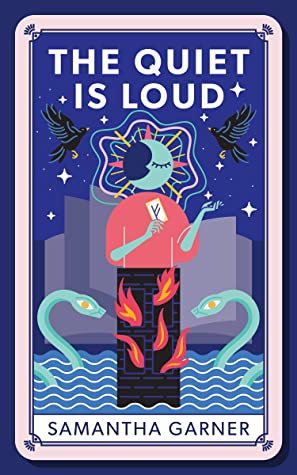
Review | The Quiet is Loud, by Samantha Garner

QuietIsLoudCoverSometimes, I come across a novel that just hits several of my reader sweet spots during a particular point in time, and I just fall absolutely in love with it. The Quiet is Loud hits a few of my sweet spots right off the bat — it’s speculative fiction with angsty X-Men vibes, and it explores themes of identity, family, and belonging from the perspective of a Filipino-Canadian main character. Even better, I came across this book when I started becoming interested in reading tarot cards myself, so I super nerded out over all the scenes where the heroine interprets tarot cards.

The Quiet is Loud tells the story of Freya Tanangco, a Canadian of Filipino and Norwegian heritage, and a tarot card reader blessed/cursed with visions of the future. She keeps this ability under wraps, partly because people with special abilities, called vekers, are considered dangerous and ostracized (hello, X-Men vibes!), but also partly because she’s dealing with the trauma of having predicted her own mom’s death at the age of 10 (hello, angsty superhero origin story!). An online tarot reading leads Freya to connect with a group of other vekers, and the story unfurls in complex layers that explore themes of identity, heritage, family, and community. The novel contains compelling characters, an engrossing story, lots of stuff to unpack and lots of Filipino food descriptions to enjoy, and I absolutely loved it.

Strongly interwoven into Freya’s journey of self-discovery is the complicated relationship she has with her father, a literary fiction writer most famous for his novel about growing up Filipino in a mostly white community. Entitled Kuya (older brother), the novel thoroughly mines his younger sister’s history of alcoholism for trauma material, and given how much hate vekers face in society, Freya is understandably wary about her own experiences being exploited for a future novel. Veker abilities are a springboard into themes of family and belonging — Freya balances her human concerns with the complexities of being a veker, much as she embodies multiple lived identities as Filipino, Norwegian, and Canadian, and also much as her own father struggles between telling the stories he knows as a Filipino in Canada, and not being pigeonholed into telling only Filipino stories.

Freya’s father, while in many ways the villain, and more a spectre than an active actor in many of the scenes, is a fascinating character. He’s fiercely proud of his Filipino heritage, but there’s almost a sense of desperation in his fervour. There’s a great scene, somewhat late in the book, where Freya and her father are in a Filipino restaurant, and he has to admit his Tagalog is limited, as is his knowledge of some of the dishes on display. Up until that point, Freya’s father was portrayed as being super enthusiastic about Filipino food and stories from Philippine mythology, but it didn’t really twig for me what had felt off about his enthusiasm until that restaurant scene.

As someone who grew up in the Philippines, when I read the restaurant scene, I found myself shifting from Freya’s perspective to the restaurant owner’s, with the stark recognition, “He’s from here (Canada).” It cast the earlier scenes where he spoke of his love for Filipino food and stories in a new light for me, and even though I technically always knew he’d grown up in Canada, that restaurant scene made palpable for me all the various complexities of ‘Filipino’-ness that Garner explores in her novel. There’s Freya herself, who’s biracial and Canadian from birth, and engages with bits of her Filipino heritage almost at a distance — they’re there, and part of who she is, but not necessarily things she thinks about often. There’s her father, who grew up with immigrant parents in a mostly white community, dealing with hyper-visibility due to the colour of his skin, and grappling with the fierce desire to claim both Filipino-ness and Canadian-ness as his own. And then there’s the reader — my ‘Filipino’-ness is different from both Freya and her father, in a way I feel but can’t quite define, and I imagine other readers, whether or not they’re Filipino, will respond in different ways as well to these aspects of the story. It’s all subtly done, but wonderfully complex.

The rest of the story is just as rich, and I’m sure that, depending on readers’ own interests and life experiences, likely other readers will find other aspects of the plot that’ll resonate with them. There’s the complicated relationship between Freya’s aunt and cousin, the somewhat complex relationships amongst the vekers in the support group, the debate about whether or not vekers should be more visible in society and share their stories more openly, and so on. The big climactic moment fell a bit flat to me, and I honestly felt the veker cast in the villain role for this part of the plot was treated too harshly. But I also thought the set-up was well-done, and while I wasn’t too in love with how that part of the plot was resolved, I can see why it kinda makes sense. Overall, though, I came out of this book still thinking about that restaurant scene, as well as other scenes that resonated with me, and realizing that there’s no way I’ll be able to contain all the thoughts I had about this book into a single review.

+

Thank you to Invisible Publishing for an e-galley of this book in exchange for an honest review.