
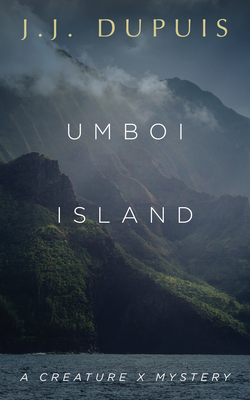
Review | Umboi Island (Creature X Mystery # 3), by J.J. Dupuis

UmboiIslandCoverUmboi Island is probably the most action-packed of the Creature X series, and also the one most likely to translate well to a screen adaptation. In this instalment, Laura Reagan and her team fly to Papua New Guinea to investigate reports of the ropen, a bioluminescent pterosaur. Added to their crew is a creationist, whom the producer brings on board to spark debate about evolution. And also on the island is a team of scientists from the UK, who are there to investigate plant and animal life of the non-cryptozoological kind.

The murder mystery takes a while to set up; it’s not until about a third of the way through that a body is discovered. But Dupuis does a good job keeping the pace quick before that point: beyond reports of a mysterious glowing light in the sky, Laura and her crew deal with reports of drug smugglers in the area, and Laura’s colleague Lindsey has to deal with encountering a very unwelcome blast from her past. Like many good mystery writers, Dupuis both expands the scope of his plot, and raises the stakes for his series characters. The victim and circumstances behind the murder hit close to home for the film crew, and the investigation leads to a much larger and more complex story than Laura ever have guessed. The best part for me is that Dupuis ends the novel with some loose threads about a mystery surrounding one of the villains, and it’ll be interesting to see if Laura and her crew encounter that villain again in a future instalment.

Umboi Island is a good novel, with a solid mystery, rich setting, and lots of action. I personally preferred the second book, Lake Crescent, but I think that’s because I’m more a fan of cozy mysteries than action-adventure stories in general. I loved the intimate scope of Lake Crescent‘s mystery, and how very personal the murder and the villain’s motives felt. Umboi Island, with its core cast of about a dozen characters and all the talk about possible drug smugglers and organized crime, is just less my cup of tea.

I also wish we’d spent more time with the pterosaur mythos. While Lake Crescent took its time introducing us to Cressie and all sorts of stories around her, I felt like the pterosaur subplot was treated almost perfunctorily here. The ropen got the characters gathered together, but even with the quotes from scientific journals and a couple of potential sightings, I didn’t quite feel as immersed in its story.

That being said, if Roanoke Ridge felt like a fun Scooby-Doo romp, and Lake Crescent felt like an Agatha Christie tale in a small town bar where a grizzled old bartender delights in spinning tales, Umboi Island felt most like a Nancy Drew / Hardy Boys mystery adventure for grown-ups. There’s a lot of Nancy Drew’s intrepidness and daring in Laura, and the mystery itself felt a lot like something Frank and Joe Hardy would have tackled. Dupuis also deepens Laura’s and our relationships with his characters; I especially love how Saad becomes less a sidekick in this novel and more an action hero in his own right.

Dupuis’ love for martial arts comes through in his fight scenes; the sequences are choreographed with such care and precision that you (or at least I, with my rusty karate memories) can imagine the moves working in real life. As a former karate student, it’s a pleasure to see how Dupuis takes us through his characters’ thought processes during the fight sequences — within seconds, Laura analyzes her opponent’s position, determines their next move, and strategizes how best to respond. It’s the chess mode of self-defence, and a great way to leverage the medium of a novel to show a side of fights we don’t get to see on screen.

Overall, while Lake Crescent is still my personal favourite in the series, Umboi Island is a strong entry in the series, and in some ways, possibly even the best entry. Certainly, it feels the most bold and confident, narrative-wise, and It’ll be interesting to see where Dupuis takes the series and its style from here. The ending of the novel also hints at a change-up in some of the series regulars, and a pivotal turn for Laura’ herself, so whether Dupuis continues in this action-adventure vein or takes us back to the more intimate feel of his earlier work, the next instalment promises to be big.

+

Thank you to Dundurn Press for a copy of this book in exchange for an honest review.
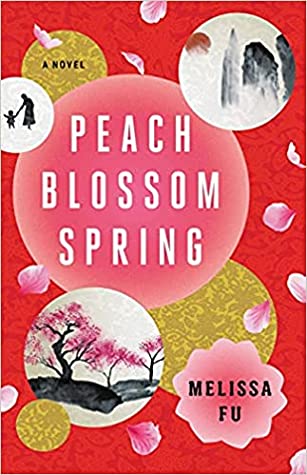
Review | Peach Blossom Spring, by Melissa Fu

PeachBlossomSpringPeach Blossom Spring is a moving and evocative family saga that spans the stories of three generations. It begins in 1938 with Meilin, a young widow who escapes to Taiwan with her son Renshu when Japan invades their village in China. Renshu eventually goes to America for university, and the story picks up there, where he changes his name to Henry Dao.

His early attempts to make friends with fellow Chinese students take a scary turn when he realizes student activities are being reported back to the Chinese government, with some real and drastic consequences for their families still with ties to the mainland. For his mother’s sake, Henry keeps a low profile on his Chinese heritage, and by the time he gets married to a white woman, and has a daughter Lily, he barely ever talks about his past anymore. And when Lily takes Chinese language classes and tries to learn more about her heritage, she finds the topic completely shuts her father down.

The title of the novel comes from an old Chinese story, one of many illustrated on a scroll that Meilin’s husband gives her, and that she takes when she and Renshu flee China. The stories on the scroll keep Meilin and Renshu’s spirits high during the scariest and most dangerous parts of their journey, and ‘Peach Blossom Spring’ in particular is a lovely narrative about a man who leaves home and comes upon a magical place.

An older man overhears Meilin read the story to Renshu for the first time, and observes that Meilin stopped before she got to the ending. The moment, decades later, when Renshu learns the way the story really ended was probably one of the most heart-wrenching scenes in the novel for me. I’m usually a bit leery when a writer gets a bit too heavy-handed with the symbolisms of an object, particularly when it’s such an obvious metaphor as a scroll of ancient stories. But in this case, Melissa Fu makes it work. Both the stories in the scroll and the story of the scroll itself are rich with meaning, emotion, and resonance, and just utterly wrecked me.

Meilin’s story covered an area of history I’m not too familiar with, so I’m really glad that this piece of Chinese history is being told to a wide audience in an English language book. That being said, I found it to be a slow start, and while aspects of Meilin’s story were very striking and moving, it wasn’t until Renshu came to America that I felt the story really pulled me in. I think part of it is that the author begins with a very distant tone, listing the Daos and their relationships to each other. The approach makes sense for a family saga, but it also made the first few pages feel somewhat perfunctory, like, here’s all the backstory before we get to the real focus.

Another part I think is that Meilin just had a LOT more going on in her life, events-wise, than Henry and Lily later would. So while Henry’s story could take its time focusing on his gradual distancing from his heritage, and Lily’s story could take its time focusing on her gradual return to it, Meilin’s story was a lot more plot-driven. Her section felt like a rapid-fire series of events, and while Fu does show us Meilin’s thoughts and emotions, the overall tone still felt a bit more distant to me than it did with Henry and Lily’s stories.

Part of me wishes we could have stayed with Meilin throughout the entire novel, and given her story more room to breathe. But then Henry and Lily’s stories were so strong, and Fu ties them back so beautifully to Meilin’s tale that overall, I think the novel does work. It’s a lovely book.

+

Thank you to Little, Brown, and Company for an e-galley of this book in exchange for an honest review.

Review | Autonomy, by Victoria Hetherington

AutonomyThe year is 2037. Canada has been annexed by the US because of conflict with Russia. Abortion has been declared illegal, and electronic devices record our every move. Climate change has gone to crisis levels, and people in the Arctic are dying of heat. AI technology is developing sentience. And a deadly Illness (capitalization from the novel) is spreading across the world, transmittable by eye contact.

Amongst all this is a university therapist, Slaton, and an AI, Julian, who develop feelings of love for each other. They meet when Slaton is detained at the US border for encouraging a student to have an abortion (she was framed). Julian follows her home via a subdural earpiece she got at the border hospital (creepy). They talk, get to know each other, and eventually, Julian gives her advice on how to survive the Illness.

Autonomy by Victoria Hetherington is the kind of book I had to sit with for a while after reading, just to process what I just read. I started out not liking the book very much — it was well-written and it touched on important contemporary topics. But, in the first half at least, it lacked bite. The issues Hetherington explores aren’t really anything new. As terrible as it may be to feel desensitized about serious topics like women’s reproductive health and Big Brother technology, the world of the novel didn’t feel very special, and I wasn’t quite getting immersed in it.

Worse, for the first half, the narrative deals with its themes with such a gentle, almost perfunctory, touch that the book didn’t really grab me. One example I found particularly egregious was how the novel treats Slaton being framed for encouraging abortion. Much fuss is made over how Slaton needs to protect both herself and the student who framed her from police, because abortion is such a heinous crime in this world, and the potential consequences are terrifying. There’s even a frantic dash to the US-Canada border, and a random encounter with a drug dealer.

Except then the consequences do come, and… they were pretty meh. Slaton needs to spend a week in a detention centre, do talk therapy with an AI… and that’s it. After that week, she’s free to go. The food is crappy, and there’s a minor subplot with.a creepy cellmate, but for the most part, those scenes play out more like pleasant conversations than Orange is the New Black.

So up until the halfway mark, I was ready to write a blog post about how this was a book I’d imagine would be nominated for a Giller and may even win. It was a book I’d imagine being taught in university English classes, and being discussed by some book clubs. But it wasn’t a book that was going to stay with me. It’s a good book, but ultimately just okay.

And then Slaton meets Peter. Slaton rightly points out that one’s odds of surviving the global Illness will likely align with the level of one’s wealth. She has only $112 left in her bank account, so on Julian’s advice, she goes to find a sugar daddy. And in the world of sugar daddies, Peter is a pretty good catch. He’s kind, the sex (at the start at least) is pretty good, and his expectations for a wife are pretty reasonable. Their relationship isn’t quite the stuff of romance, but on the whole, Slaton pretty much got what she was looking for when she married him. 

And this is when I found the novel got interesting. Because of course, the rather mundane comfort of Slaton and Peter’s lives is far from perfect. There’s problems you may expect: Julian gets jealous (in an AI way) and leaves; Slaton gets lonely and starts to realize Peter’s flaws. Her thoughts turn downright cruel, though thankfully (for Peter’s sake), she never voices these thoughts out loud. She thinks of how Peter smells like old age and diabetes, notices the effects of aging on his body (he’s mid-50s, she’s mid-30s), and in a moment even she is ashamed of, imagines him getting cancer. She gets lost in the ennui of the wealthy, and ensconced within a gated community outside Toronto, she misses her friends and city life. It’s all a bit “poor little rich girl” at times, but also an intriguing contemplation on how much one is willing to give up to ensure one’s own safety.

But where I find the novel really hits its stride is when tendrils of the Illness begin to make their way into the bubble of their gated community. I absolutely love how Hetherington handles this part of the story. Far from turning into the usual plague dystopian novel, Autonomy maintains its contemplative, philosophical core. Hetherington doles out moments of harsh reality very sparingly, and the novel becomes all the richer for it. Because suddenly, all the quiet, contemplative conversations leading up to this point coalesce into a broader, deeper philosophical discourse about human existence. What is our role as a human being? What are our responsibilities? What privileges come with having a body, and what experiences does our body allow us to have?

So much of these are questions that come in many other stories about AI sentience, but by framing them within a global pandemic, and within more pointed observations around financial and class inequities, Hetherington adds several new layers to the conversation. And by having their protagonist experience the stark contrast between her life in a gated community basically burying its head in the sand about the Illness, and the lives of people in a city that’s been dealing with the day-to-day realities of the Illness, Hetherington explores even more complexities around these questions about being human.

Part of me wishes the story had been this powerful from the very beginning; another part of me appreciates the author’s sleight of hand. Autonomy underwhelmed me until it didn’t. I can’t quite fully grasp all the thoughts and questions I have after reading this novel, but I admit it’s given me pause. It’s a good novel — not quite a gut punch, but deliberately so. Autonomy invites you to look deeper, and perhaps give it a re-read.

+

Thank you to Dundurn Press for a copy of this book in exchange for an honest review.