Review | Dad Bod, by Cian Cruise

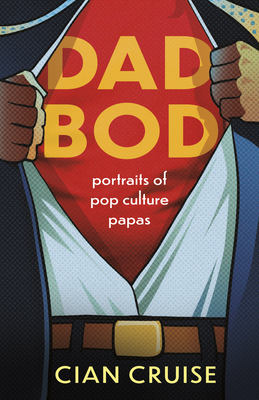
DadBodIn Dad Bod, Cian Cruise dives deep into various social notions of fatherhood by examining tropes and archetypes in pop culture father figures (the titular ‘dad bods’). His essays are all framed within the experiences of being a new father himself, which adds a lovely sense of personal stakes to his ideas.

When for example he complains about the bumbling sitcom dad trope (Homer Simpson from The Simpsons, Al Bundy from Married…with Children), his language may be somewhat detached, a professional arts critic commentating on an artistic trend. But his concern isn’t just academic, it’s personal. His perspective is that of a new father trying to figure out how to be a good father to his own son, and frustrated by the dearth of good role models in popular media.

Thus, it’s fitting that for each trope Cruise critiques, he also includes a character he considers an exemplar of that archetype. A bumbling sitcom dad, for example, or an adventure dad, who embodies all the core traits of that persona while still demonstrating how to be a good — never perfect, but good — parent to their kids. I find that these examples helped me tremendously in understanding how a sometimes-harmful trope about dads can actually become aspirational.

For example, Cruise posits Johnny Rose from Schitt’s Creek is an example of who the bumbling sitcom dad could be. Like Homer Simpson or Al Bundy, Johnny often gets things wrong. His good intentions often land him and his family in hilarious predicaments. Yet unlike Homer Simpson or Al Bundy, Johnny isn’t a total incompetent man child whom his wife has to care for; rather, he’s a complex, textured individual who genuinely cares for his family, tries his very best to care for them, and, most importantly, actually succeeds as often as he fails. In other words, he’s a real person, and his character shows how one can be hapless without being helpless. As Cruise describes Johnny Rose, it’s easy to imagine Cruise, and fathers like him who read his book, feeling solace in Johnny’s character, in knowing they can often feel totally out of their depth, yet still pull through for their loved ones when it matters.

There have been so many think pieces about the limitations of the bumbling sitcom dad trope, that I’m glad to see Cruise explore many other tropes in this book. I hadn’t really considered the implications of The Distant Driven Dad (think Indiana Jones’ father), or The Dads of Destiny (think Gandalf and Obi Wan Kenobi). I was also unfamiliar with some of the references Cruise used, and I loved reading Cruise’s thoughts about the archetypes they represented. One example is the character of Pappas, whose story, told in the prologue of the video game Dragon Quest V, is heartbreaking in its impact on the main character. On one hand, it’s a fairly standard vengeance story arc, but on the other hand, I love how Cruise shows how Pappas’ story turns the main character’s story full circle, from being a child who sees his father Pappas as larger than life, to a father himself, growing to be larger-than-life for his own children. I also love learning about Bandit, the father character in the children’s show Bluey, and how he goes all in when playing imaginative games with his children.

Dad Bod is a quick, interesting read, and, I imagine, a comforting one for many parents out there. It doesn’t quite show a road map of how to be a good parent, but it does give some examples of good parenting one may want to emulate. And particularly for new fathers, it gives some fictional role models they may want to view themselves on media. Whether readers see themselves as an adventuring dad, a driven dad, or a playful dad, Cruise has a pop culture character for you, and some thoughts of how to channel your own interests towards being a good parent.

+

Thank you to Dundurn Press for a copy of this book in exchange for an honest review.

Review | If You Could See the Sun, by Ann Liang

IfYouCouldThis book has an interesting premise. Alice’s power of invisibility is a fitting metaphor for her feeling unseen by her peers. (I feel like Buffy did an episode around this too, so it’s definitely a relatable theme for teens.)

I like the class struggle stuff, and how much Alice’s ambition and anti-heroic actions are tied to the unfortunate reality that she’s just starting with a lot less than her classmates and has to do a million times more work just to keep up. There’s a great moment where she remembers getting second place to Henry in a contest and cried, coz she’d worked really hard to win the RMB500 prize while Henry just entered the contest last-minute on a whim. The win also didn’t mean as much to him, and he barely even remembered the contest at all. I like how Henry always viewed their rivalry as friendly while Alice saw it as much more serious, because she had so much more at stake with winning.

There’s some sadly realistic scenes depicting racism, mostly from a white teacher at the school. In one scene, she calls Alice by another student’s name, even though they look nothing alike.

The concept of Beijing Ghost is compelling. The author did a good job of showing the escalation of the tasks students hired Alice to do, from rather sordid but standard spy jobs that gradually intensify towards outright criminal acts.

The romance between Alice and Henry is sweet, but mostly meh. Alice never really seemed too much into Henry at all, so the random flirty scenes didn’t really do much for me. I do like how Alice’s developing friendships with Henry and Chanel helped her integrate a bit more deeply into the school social life. The author does a good job in showing just how much privilege wealthy students with powerful parents can have.

The book falls short for me on two fronts:

First, the task that eventually leads to the novel’s climax and denouement requires Alice to perform a criminal act. I sympathize with her desperation to earn enough money to stay in school, and I agree that any penalties should be meted out fairly. But the fallout from her actions did not at all feel satisfactory. I expected there to be more consequence, or at least more character development as a result of this experience. Instead, the main message seems to be that her actions were totally understandable and justifiable, and the blame really lies within the classist school system. Which is far too simplistic and totally overlooks Alice’s complicity in her own actions.

The big confrontation was a total non-event. The other party involved, the ‘evil mastermind’, so to speak, was barely even a force to be reckoned with. Alice’s big gesture to reclaim power didn’t seem anywhere near as much a death blow as the scene made it seem, and the way ‘good’ characters just seemed to get off unscathed bothered me. As terrible as the ‘evil mastermind’ was, I actually found myself wishing he got off as lightly as the main characters did, because the whole resolution just felt too neat and perfect.

The other big snag for me was that Alice’s invisibility was a convenient tool yet never quite fully delved into. And on one hand, that’s fine — I like magical realism as much as the next person, and think magical elements should exist in fiction without being explained to death. But there was a scene with Alice’s aunt that made me think the aunt had personal knowledge of Alice’s superpower, like maybe invisibility or various superpowers ran in their family under certain circumstances. That thread intrigued me, yet it was dropped completely. Even a bit of added insight from the aunt would have helped enrich the mythos of Alice’s invisibility; instead, it exists mostly as just a convenient plot tool.

Overall, this is a good book. The beginning was slow, and the book never really super hooked me. But I like the class stuff tackled in the story, and I just wish the ending had packed a bit more punch.

+

Thanks to Inkyard Press for an e-galley of the book in exchange for an honest review.
Review | Tarot of Dragons, by Shawn MacKenzie (illus. by Firat Solhan)

20220615_134326

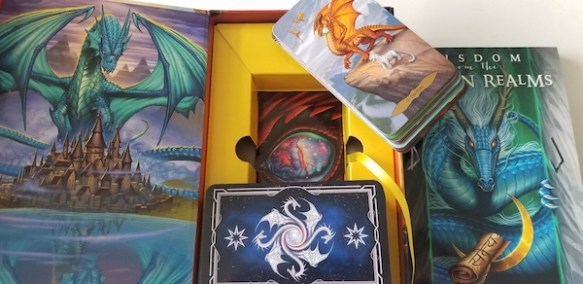
Oh my gosh, this deck! I think dragons are awesome, and I thought the images of the deck online look good. But even I wasn’t prepared at how absolutely blown away I was when I opened it.

First of all, look at how gorgeous that box is! I don’t usually pay attention to boxes — a lot of my recent tarot purchases are by indie creators, and I usually buy the most affordable version of the deck (the only way I can continue to do this!). That often means getting a standard tuck box with a basic key word guide. I was fortunate enough to be sent this deck for review, and oh my gosh, even if I did purchase it myself, the extra cost is definitely worth it. The box is itself a work of art; illustrations from the cards wrap around it. It’s also sturdy, with a magnetic closure.

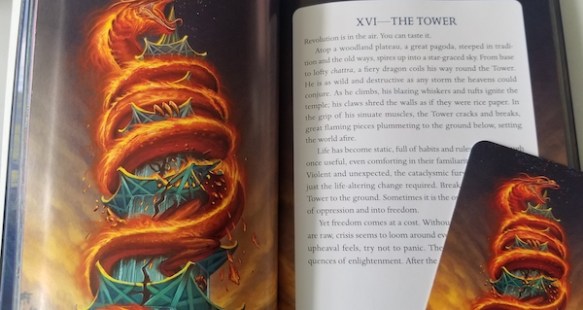
And the guidebook is absolutely magical. It’s full colour, with gorgeously enlarged illustrations from the cards that extend across the spread.

20220615_135345

20220615_135425

I love the way Shawn MacKenzie writes. I tend to flip through new decks and jump right into a test reading to see how the cards feel, and to get a sense of the energy they give off. But with this guidebook, I felt compelled to go through each card one by one, and actually read through each card’s meanings within this deck. (I ended up tapping out after the major arcana, but honestly, there were moments I thought I’d end up reading this book from cover to cover.) The descriptions invite you to savour the cards, and reflect on how these meanings can apply to you.

The guidebook makes this a good deck for learning tarot, as each card write-up describes the symbology in the images. Some of the write-ups do tend to focus on the description, leaving the reader to interpret the meaning in their own readings; some beginners may prefer to start with a more direct explanation of each card’s message. For me at least, having been reading tarot cards for about half a year so far, I found that the explanations of the illustrations helped deepen my understanding of some of the cards.

The book doesn’t include reversals, which is usually a snag for me since I use reversals in my own readings, but I think the descriptive approach to the card write-ups helps provide a depth of nuance to figure out multiple meanings of each card. The author also recommends Mary K Greer’s The Complete Book of Tarot Reversals for anyone who wishes to do a deeper dive into that aspect of tarot readings.

MacKenzie’s love and respect for dragons comes through strong in the chapters about the deck more broadly. Her writing invites us to connect beyond this deck and towards the broader mythologies surrounding dragons.

20220615_13541120220615_135400

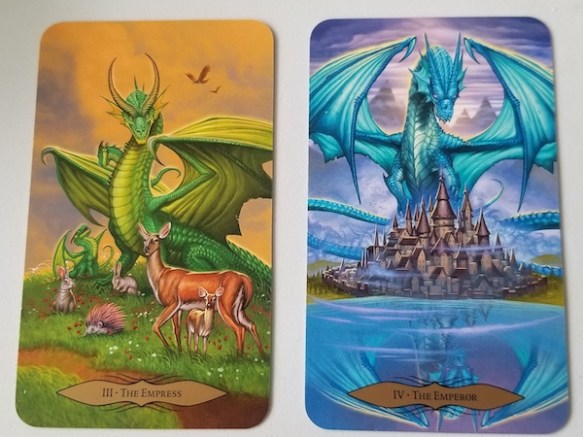
And the artwork. How gorgeous is Firat Solhan’s artwork here? I love how the cards feature not just dragons, but also the worlds they inhabit, with other creatures that have their own layers of symbolism and meaning. Here are some of my favourites:

20220616_195723

I love the joyful exuberance of The Sun, the symbolism of the domestic cat and the tiger in The Moon, the fluidity of the 3 of Cups, the playfulness of the little jaguar in The Hanged Dragon, the curiosity of The Fool, and just the sheer emotion in the Queen of Swords.

I also absolutely love the contrast between, and the majesty of, the feminine and masculine energies of The Empress and The Emperor:

20220615_135314

And the ‘tougher’ cards, like The Devil, The Tower, and the 10 of Swords, are downright impressive and larger than life:

20220615_135301

All absolutely gorgeous and majestic, and I can’t wait to really dive deep into these cards!

CARD PULL FOR THE DAY

20220615_135248

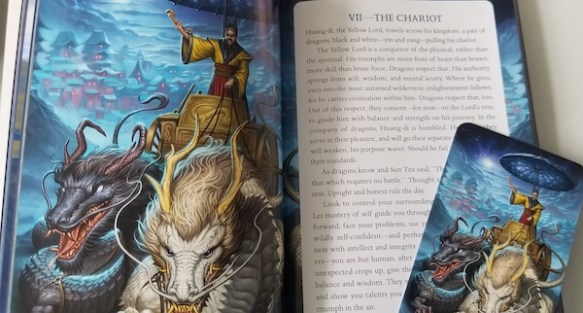
To give you an idea of the writing style, here’s an excerpt from the page:

VII – The Chariot

Huang-di, the Yellow Lord, travels across his kingdom, a pair of dragons, black and white–yin and yang–pulling his chariot.

The Yellow Lord is a conqueror of the physical, rather than the spiritual. His triumphs are more feats of brain than brawn, more skill than brute force. Dragons respect that. Out of this respect, they consent–for now–to the Lord’s rein, to guide him with balance and strength on his journey. In the company of dragons, Huang-di is humbled. He knows they serve at their pleasure, and will go their separate ways should his will weaken, his purpose waver. Should he fail to measure up to their standards…

Look to control your surroundings with will and reason. Let mastery of self guide you through the world. Move steadily forward; face your problems, use your head.

+

Thank you to Thomas Allen Ltd for a copy of this tarot deck in exchange for an honest review.