Review | The Productivity Project, Chris Bailey

25733994Many of us have likely been there: we have too much to do and not enough time to do it all. Every New Year, there is a new slate of books promising to help us improve our productivity and learn to get more done in a limited amount of time. Author Chris Bailey geeks out over productivity, and dedicated an entire year of his life in testing out various productivity techniques in order to weed out the useless ones and find the nuggets of gold. The result is The Productivity Project.

The book is full of useful tips, such as the following:

  1. Find out your personal periods of peak performance and schedule your tasks accordingly. For example, the standard work day may be from 9 – 5, but if you find you work best between 10 – 12 and 3 – 5, then schedule your most important work for those hours.
  2. Set aside a Maintenance Day. Rather than try to do chores like groceries and laundry intermittently throughout the week, push off all that you can until a Maintenance Day, when you can tackle them all at once. This will free up your concentration during the rest of the week to focus on more important things.
  3. Externalize your work by making notes on all the things you have to do in both your professional and personal lives. In this, Bailey imagines the brain much like Sherlock Holmes’ mind palace and the tasks we need to accomplish as clutter that needs to be put away for us to focus. By writing our entire to-do list down, we eliminate the need to think and worry about it, and can then focus on actually getting things done.

All of this and more are very useful techniques, and Bailey has a very practical, straightforward style that makes this book an easy read. I also appreciate the estimated reading time at the beginning of each chapter, as well as how he ends each chapter with a suggested exercise, including estimated usefulness, degree of difficulty and time commitment. Both his tone and the way the chapters are set up convey a respect for the limitations on his readers’ time, and helps us break up the reading into manageable chunks throughout our week.

One concern I had, I suppose, is that I didn’t really feel like I learned much that is new. In contrast to another book on productivity I read recently, Brian Tracy’s Eat that Frog!, which I found so useful that I actually noted my key takeaways from that book on Post-its in my workspace, I’m not sure what, if anything, so struck me when reading this book that I would post it at my desk.

I also found the book to be vague when it comes to explaining some of the techniques and more importantly, how exactly Bailey measured his success. Partly this may be because he was being productive about researching productivity, so I suppose the book itself is a measure of success. But, for example, in the chapter on procrastination, Bailey experiments with techniques to not procrastinate, and then compares his “before and after” time breakdown:

(BEFORE)

  • 19 hours on reading and research
  • 16.5 hours writing
  • 4 hours conducting and participating in interviews
  • 8.5 hours doing maintenance-type tasks
  • 6 hours procrastinating (page 56)

(AFTER)

  • 17.5 hours reading and research
  • 15 hours writing
  • 5.5 hours conducting and participating in interviews
  • 2.5 hours doing maintenance-type tasks
  • 1 hour procrastinating (page 67)

Here’s the thing: he never explains where those extra five hours go. The time spent on most of the other tasks also decreased, so it’s not like giving up the five hours of procrastination gave him more energy to work more on various tasks. It’s possible that not procrastinating meant he was able to get more done in a shorter amount of time, and the extra five hours from procrastinating and extra nine or so hours from other tasks went to having fun instead. But as it is, I don’t know how this time tracking comparison proves that not procrastinating makes you more productive.

I also don’t quite understand how Bailey defines or measures productivity. Partly, it’s because his project is so meta — he’s being productive in researching and writing about productivity, so unless he provides his entire resume and bibliography, this book is the single quantifiable marker of his productivity. But also because he simply asserts that he is more productive, without quite explaining what he means by that.

For example, in the chapter on productivity peak periods, he tells us he’s discovered that he is most productive at two particular periods in the day. How does he know that? Did he measure how many pages he was able to write per hour? Did he have an external consultant rate the quality of his work on an hourly basis? Or is it simply a generic feeling of when he felt most productive? Which I must clarify is nothing to sneeze at; we all know the feeling of being “in the zone.” But again, I wish Bailey made this clearer, so I wouldn’t have to infer it myself.

Overall, it’s not a bad book, and Bailey does have some good advice for being productive. This book also provided a pleasant distraction from my morning and afternoon commutes, as I ended up reading most of it on the subway.

+

Thank you to Penguin Random House Canada for a copy of this book in exchange for an honest review.

Books, Be Mine: Valentine’s Day 2016

SimonSchusterValentines2016

Here’s a pretty awesome campaign by Simon and Schuster Canada for Valentine’s Day 2016. Valentine’s Day is for spending with your true love, so what better way to spend the day than with a book?

Every day leading up to Valentine’s Day, Simon and Schuster Canada will be sharing excerpts, quotes and other bookish fun on their Facebook event leading up to February 14th, so check it out if you’re looking for ideas on which books to spend the big day with.

Some ideas they’ve suggested include:

SimonSchusterCALookBook

And if you’re looking for a bit of a longer term love affair with books this year, check out the Simon and Schuster Canada Look Book, filled with samples of their Spring 2016 Fiction catalogue! It’s free to download on several ebook formats.

My personal Look Book highlights? I love Iain Reid’s memoir The Truth About Luck, and his upcoming I’m Thinking of Ending Things has been listed by the Globe and Mail as one of the most anticipated Canadian books in 2016. I’m also a big fan of Peggy Blair’s work, and am pretty excited to find out what happens next to Inspector Ramirez and his team. Keep an eye out as well on my blog for forthcoming reviews of Glory Over Everything and Kay’s Lucky Coin Variety, both of which have caught my eye and are currently on my TBR.

Thanks to Simon and Schuster Canada for this fun idea, and may you all have a bookish Valentine’s Day!

VDay2016_I'mAttedning

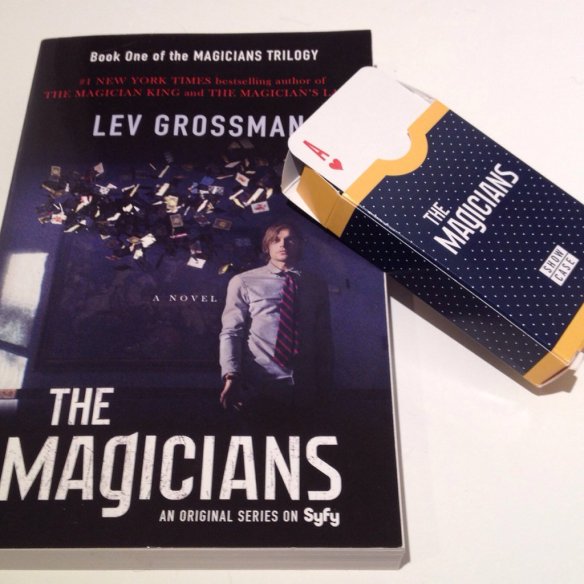
Review | The Magicians, Lev Grossman

TheMagicians

In Lev Grossman’s The Magicians, Quentin Coldwater, a nerdy and melancholy eighteen year old, is recruited to join a magic university in upstate New York called Brakebills. Quentin is obsessed with a children’s fantasy series about a magical land called Fillory, and real life just cannot compare, particularly when he sees himself as both sidekick and jilted suitor in his trio of friends. When invited to study at Brakebills, he hopes he has finally found his meaning in life, his place of belonging, and the thing that will finally bring him happiness.

Grossman riffs off the Harry Potter and Chronicles of Narnia traditions, and presents a rather more sardonic view of magic. As an older student, Eliot, tells Quentin, most people can’t do magic because “it’s very hard, and they’re not obsessive and miserable enough to do all the work you have to do to do it right.” Indeed, unlike Hogwarts which felt wondrous and, well, magical, Brakebills makes magic feel like a particularly rigorous college major, like pre-law or pre-med. During one term for example, students had to study in isolation all the different ways circumstances can change the makeup of a single spell. As Quentin observed, he knew more about that particular spell than he’d ever wanted to know, including how to cast it if he were a woman.

The book continues to follow the characters after graduation, when they struggle to find their place in a world where most people are unaware that magic exists. One of them discovers a portal to Fillory, and, having not quite found the happiness he sought in Brakebills, Quentin turns his attention into possibly finding happiness in the fantasy land of his youth. However, just like Brakebills isn’t quite as wondrous as Hogwarts, nor is Fillory anywhere near as magical as Narnia. The residents in Fillory appear to be in need of something, and while Quentin and his friends decide to go on a quest to become kings and queens of Fillory, the decision resulted more from an understanding of fantasy tropes and classic quest stories than from any real understanding of how the quest’s success will solve Fillory’s troubles.

I liked the story. I hesitate to call it more realistic than traditional magical stories because I like to think real-life magic would still be more exciting and wondrous than Grossman presents. As well, Grossman pulls short of delving deep into realism — while his characters drink a lot and face ennui upon graduation, they also lead charmed lives, with a magical network of corporations guaranteeing magical graduates a comfortable lifetime income for shell corporate jobs. I also hesitate to call it more adult than traditional magical stories, because while there is sex and drugs and certainly less wide-eyed innocence, there is also a naivete about Quentin and his friends’ approach to life, a sort of languorous privileged view that still makes me want to tell some of them to grow up. Still, in a way, both descriptors are accurate. Grossman does raise some interesting complications that could occur if magic and magical lands did exist. I can imagine mastery at magic requiring a lot more tedious memorization than fun tricks, and I can also imagine a magical fantasy land not quite living up to childhood expectations.

Among the characters, I absolutely loved Quentin’s classmates Eliot, a fashionable gourmet, and Alice, a brilliant, talented magician. In contrast, Quentin is not at all a likeable character, at least for me. It’s hard to root for someone who is so consumed by his own ennui and lack of self-worth that he is unable to see that other people around him have problems of their own and that he externalizes blame for his mistakes onto “the sick, empty world they were all in together.” (p. 263)

His attitude towards their quest in Fillory annoys me as well. When Alice points out that people could get hurt, he responds:

“If I die doing this, at least I’ll have done something. Maybe you’ll do something one of these days instead of being such a pathetic little mouse all the time.” (p. 332)

The problem is that they don’t really have a goal or stated need for that quest in the first place. Quentin is just bored with life and decides to find meaning by visiting Fillory, and then literally for lack of anything else to do, decides to go on a quest to become king.

Possibly one of the reasons I love Alice so much is that she calls Quentin out on his behaviour:

“If you will, for just one second, look at your life and see how perfect it is. Stop looking for the next secret door that is going to lead you to your real life. Stop waiting. This is it: there’s nothing else. It’s here, and you’d better decide to enjoy it or your going to be miserable wherever you go, for the rest of your life, forever.”

“You can’t just decide to be happy.”

“No, you can’t. But you can sure as hell decide to be miserable. Is that what you want? Do you want to be the asshole who went to Fillory and was miserable there? Even in Fillory? Because that’s who you are right now.” (p. 333)

The end of the book promises further adventure in the sequel, this time involving Quentin’s childhood friend Julia, who was not accepted into Brakebills and therefore taught herself magic. From what I hear, she is a much more interesting character than Quentin, and the TV show version somewhat conflates both books so that, on the screen, we get her story alongside Quentin’s.

The Magicians TV Adaptation on Showcase

Having read the book, I’m much more excited to see how it translates on the screen, and to see the actors who will bring the characters to life. I also can’t wait to find out more about Julia’s story, as the glimpse I’ve seen of her in the book seems intriguing.

The Magicians premiered last January 25, and airs on Showcase Mondays at 9. Catch up on previous episodes at www.showcase.ca/themagicians and check out a brand-new episode tonight on TV and tomorrow online.

+

Thanks to Showcase.ca for a copy of this book (and awesome card deck!) in exchange for an honest review.