
Review | The Couple Next Door, Shari Lapena

The advance reading copy of The Couple Next Door began with an editor’s note that set up pretty high expectations:

CoupleNextDoor

Did it meet the expectations? Not quite, but to be fair, it’s still a good, solid mystery with multiple twists. I just wasn’t blown away, but to be fair, I was expecting the unreliability and twists of Gone Girlthe emotional resonance of The Girl on the Train and a big reveal to rival The Murder of Roger Ackroydso to be fair, my expectations were really high.

28815474The story begins with every parent’s worst nightmare: Anne and Marco Conti return home from a dinner party to find their six month old daughter Cora missing. As the search for Cora continues, we learn that not all about Anne and Marco are as they seem, and in both cases their secrets raise the suspicions of Detective Rasbach, who is investigating Cora’s disappearance. Other characters include Anne’s multi-millionaire parents who hate Marco, and Anne and Marco’s flirty next door neighbour who may or may not be interested in an affair with Marco. All of the characters are compromised in some way, and red herrings abound as Detective Rasbach tries to figure out what really happened to Cora.

Like I said, it’s a good, solid mystery, and even when we think we have it figured out, Lapena brings out another twist that complicates the case and keeps Cora from safety. I was curious about the kidnapper’s identity, but not as emotionally caught up as I wanted to be, especially considering that a six month old baby was missing. There was something workmanlike about the reveals; we often found out about intriguing wrinkles only shortly before they are resolved, and suspects are suggested only to be summarily dismissed fairly quickly. The kidnapper’s identity is kept hidden throughout, but the most intriguing possibilities are revealed and/or debunked fairly quickly and the eventual reveal is unexpected but not that surprising. Despite their secrets and their clearly heightened emotions, Anne and Marco weren’t really unreliable as narrators, and both kept the reader fairly well grounded in what really was happening. The descriptions of emotions were perhaps realistic, but also a bit melodramatic, with Anne’s repeated screaming, for example, reminding me more of the damsel in classic detective movies than a real mother in distress. Finally, the twist at the end felt unnecessary, and while the elements for this were well set up in advance, the emotional build up could have been better laid out.

The Couple Next Door is not a bad book, but I caution against high expectations coming in. It’s a good, solid mystery and a quick entertaining read, and will keep you guessing.

+

Thank you to Penguin Random House Canada for an advance reading copy of this book in exchange for an honest review.
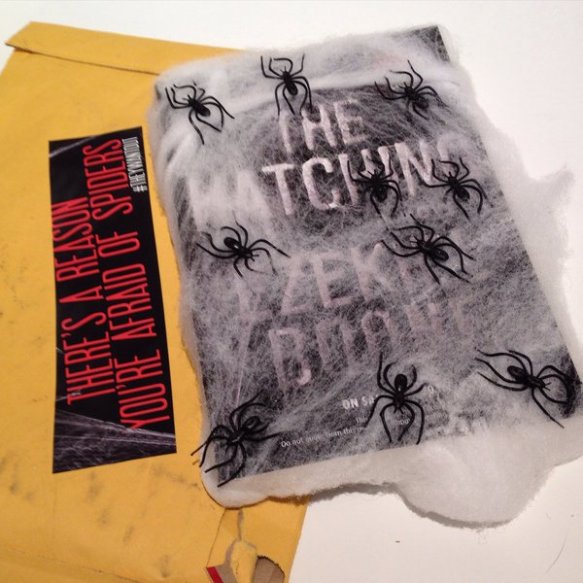
Review | The Hatching, Ezekiel Boone

Hatching

I think spiders are gross and scary, so the story Ezekiel Boone tells in The Hatching can pretty much count as one of my top ten nightmares. Prehistoric spiders begin appearing all over the world and all they seem to want to do is feed on humans. Blood drives them wild, and there are scenes where they literally chew their way out of a person.

The novel begins with a tour group in Peru, where the tour guide notices what looks like a black liquid stream engulfs a man nearby and makes him disappear. (Yeah, ew.) There are quite a few more, much gorier, details on what happens when one of the tour group members returns home, but you can probably imagine.

The spiders get US President Stephanie Pilgrim’s attention when China “accidentally” drops a nuclear bomb on one of their own remote provinces in order to stop the spread. Her Chief of Staff Manny’s ex-wife, Melanie Guyer, is a scientist who specializes in spiders. Guyer’s students have discovered an ancient egg sac that they bring to her lab for research, and it’s around this point in the story that you just want to tell the characters on a page that this is a really bad idea. FBI Agent Mike Rich rounds off the core team of protagonists when he is pulled in to investigate a mysterious plane crash involving the spiders.

There isn’t much to say about the story other than it’s exactly what you’d expect in a story about killer spiders. It’s scary and gross, and Boone has a penchant for describing the spiders’ eating habits in great detail, which is a fair warning to any readers with weak stomachs. The characters are also straight out of a potential Hollywood adaptation of this story — the brilliant and ambitious scientist, the detective who just wants to be a good dad, the no-nonsense president, and so on. That being said, I’m glad that the scientist and president were both women, and I especially liked that the National Security Advisor, Alexandra Harris, was a 73 year old woman who looked like a grandmother but was often the most badass person in the room.

I also liked that Boone calls out systemic sexism several times in the story. For example, when Mike asks a uniformed policewoman to watch his daughter while he investigated the plane crash, the policewoman doesn’t let him get away with it.

“Sorry, man. I’m on the clock and can’t play babysitter, especially for a suit.”

Mike shrugged. “Can’t blame a guy for trying.”

“Actually, it’s some kind of sexist bullshit.”

…He looked back at the cop. “And you’re right. I probably wouldn’t have asked a man. Not cool.” [p.94]

Good on the cop for calling him out, and good on Mike for acknowledging it, though ironically, the cop then recommends that Mike leave his daughter with the only female EMT on the scene.

Later, in the White House, when Alexandra disagrees with something that Ben, the chairman of the Joint Chiefs, recommends, Manny notices that Ben “didn’t look pissed. He looked furious.” Manny attributes Ben’s overreaction to his discomfort with a woman in power. Manny observes,

Billy Cannon, the secretary of defense, didn’t react like that when Alex challenged him, but that’s probably because Billy looked at Alexandra Harris and saw the national security advisor, while Ben looked at Alex and saw a woman. [p. 116]

It’s an attitude that likely does exist even in such a high echelon of power, and good on Boone for calling it out.

Overall, if you like spiders or enjoy getting scared about spiders, The Hatching is for you. Fair warning: this appears to be the first book of a trilogy or series, and the story ends with Melanie making the kind of announcement that’s usually timed right before a commercial break or the end of a season. It’s designed to whet our appetites for more, and while I don’t know if I’ll keep reading (because the story really is gross), I am definitely curious to find out how humanity eventually defeats the spiders. (And I’m assuming they do, because that’s the type of story this feels like, and also because I really, really don’t want to imagine a spider version of Planet of the Apes in humanity’s future.)


+

Thanks to Penguin Random House Canada for an advance reading copy of this book in exchange for an honest review.


Review | The Wonder Trail, Steve Hely

27069094I thought Steve Hely’s previous novel How I Became a Famous Novelist was one of the funniest books I’ve ever read, bar none, and I’m a huge fan of his work on The Office, so I was really excited to read his travel memoir The Wonder Trail. In this book, he heads south from Los Angeles, and just keeps heading south until he hits Patagonia.

The book is structured as a series of anecdotes about his travels. The tone is one of irreverent but ultimately gentle humour, somewhat akin to a dorky but loveable uncle making side comments with a wicked grin and you laugh partly because his comments are amusing but also partly because he seems like he’s having such a good time doing it. Whether Hely is relating an amusing anecdote or sharing a bit of history, his enthusiasm shines through, and it’s easy to be caught up in that.

The key highlight for me are the people he meets: Guatemala Pam, Kelly Slater (not his real name, but he looks like a “Kelly Slater” would look), and the Australian “A-team,” among others. Hely meets up with quite a cast of characters throughout the trip, all colourful and interesting in their own way, but also quite ordinary, by which I mean you can easily imagine bumping into such characters yourself on a trip, without having to go on a major grand adventure. At one point, he comments that travellers tend to find each other and tend to want to share their stories. He then follows it up with a warning not to exaggerate your adventures too much lest the person you’re speaking with can top you, and it’s amusing to imagine seasoned travellers trying to one-up each other, but on a more serious note, I really like this idea of a community of travellers who somehow fall in together and manage to connect.

One of my personal favourites among the people Hely encounters is Alan Tang, who always travels in style. As a taste of Hely’s humour in this book, a footnote says Alan Tang is a fake name, so the real person can deny the stories are about them, and that his real name is actually Alan Yang. As a taste of Healy’s humour and Alan Tang’s style, in a chapter about getting to Machu Picchu, Hely notes that hard core travellers can walk the “something like 25,000 miles of remnant Inca roads and trails,” and agrees that Machu Picchu is “like the epic goal of a quest, like a place of pilgrimage.” But because he was with Alan Tang, they instead rode a train and a bus to the edge of the cliff and saw the amazing view without having to walk for days. All respect to hard core adventurers, but I think I’d like travelling the Alan Tang way myself.

My favourite passage in the book comes from Hely’s friend Professor McHugh, who compares some travellers’ behaviour to “Oompa Loompa hunting.” He’s referring to the hipster type of traveller, the ones who want nothing short of the “authentic” experience, and when that experience feels too familiar, it isn’t “authentic” enough. Professor McHugh compares it to looking for Oompa Loompas (characters from Charlie and the Chocolate Factory) because they’re looking for something “exotic” and out of the ordinary. Professor McHugh says:

People say they hate Bangkok because it looks like LA. “Get out of Bangkok,” they tell each other. Well, sure, on the surface, Bangkok looks like on LA. But then in some strip mall you can find a temple where people worship the embalmed corpse of a middle-aged woman who died in, like, 1998. Why do you have you go out to the jungle looking for people in funny costumes? [p. 244]

Wonder Trail is nowhere near as gut-splittingly hilarious as I remember Famous Novelist to be, but, like both Famous Novelist and The Office, it works because it has heart. Because the people Hely met were so interesting, part of me wishes we could have spent a bit more time with each of them and learned more of their stories, but on the other hand, I like how each new place brought a new encounter, and so meeting new people became as core of a feature of his trip as his geographical movement was. Wonder Trail is an entertaining travelogue, a bit uneven in terms of pace and humour, but overall, the stories of the people he meets and the insights on connecting with fellow travellers and on looking beyond the immediate familiarity make it worth a read.

And if you were an English major or are otherwise embroiled in the publishing industry, particularly around “literary” fiction, I highly recommend How I Became A Famous Novelist. It was published in 2009 (i.e. pre-social media, during the Dan Brown Da Vinci Code era) so some of the humour may seem dated, but its skewering of the literary ivory tower is still worth checking out.

+

Thank you to Penguin Random House Canada for an advance reading copy of this book in exchange for an honest review.