
Top 10 Books of 2016

I read some pretty fantastic books this year. Below, in no particular order, are some of my favourites, in case you’re in the mood to discover a new read:

1. Year of Yes by Shonda Rhimes

25690958

One of the most inspiring books I’ve ever read, this chronicles Shonda Rhimes’ decision to spend a year saying “yes” to invitations and challenges she would have previously turned down due to fear. See my gushing commentary throughout the audiobook on Goodreads, and I highly recommend checking out the title for yourself. I highly recommend this to anyone, particularly women, who may want just that extra nudge to get out there and pursue your dreams.

2. Hag-seed by Margaret Atwood

29245653

Margaret Atwood is clearly having the time of her life with Shakespeare’s The Tempest, and I had just as much fun delving into her modern re-telling. This re-telling features a theatre director who seeks revenge twelve years after being fired from a thinly veiled Stratford Festival, a group of prisoners who swear using only Shakespearean insults and who adapt Shakespeare into gems such as the song and dance number “Evil Bro Antonio,” and a play within the play that I personally would love to see on-stage. See my full review.

3. Here I Am by Jonathan Safran Foer

hereiam

A thought-provoking exploration on what it means to be Jewish in America, Here I Am is a monster of a book that takes a while to digest. The dissolution of a Jewish American man’s marriage, his eldest son’s decision not to have a Bar Mitzvah, and a geopolitical situation in the Middle East that calls for Jews from around the world to return to Israel, the multiple threads create a complex tangle that compels the reader to tease the strands apart. I’m not sure I completely understand what this book is about, I just know that I’m glad I read it.

4. The Translation of Love by Lynne Kutsukake

25893533

This is a beautifully told tale of post-World War II Japan, and the various women and men dealing with the aftermath. I was struck by the heartbreaking irony of Japanese people looking for hope from the American general, Douglas MacArthur, a figure instrumental in their country’s downfall in the first place. I was moved by the futile hope inherent in the love letters Japanese woman asked to be translated for American soldiers they know only as “Joe.” And I absolutely loved the fragility and strength of Kutsukake’s characters, who are, each in their own way trying to rebuild their lives in the aftermath of war.

5. The Underground Railroad by Colson Whitehead

30555488

A powerful and moving tale that re-imagines the underground railroad as a literal railroad taking escaped slaves to freedom, the story of Cora and Caesar’s escape is a harrowing read and a brilliant piece of writing.

6. Sarong Party Girls by Cheryl Lu-Lien Tan

27213248

Told in Sing-lish, the story of Jazzy’s search for the perfect rich ang moh (Western expat) husband is much more cutting and emotionally devastating than the narrator’s breezy tone suggests.

7. The Lion in the Living Room by Abigail Tucker

29430840

A scientific and historical geekfest into the rise of the common house cat, this book fascinated this particular cat lady to no end. See the full review on my blog and some of my favourite passages highlighted on Goodreads.

8. Laughing All the Way to the Mosque by Zarqa Nawaz

LaughingMosque

This collection of cross-cultural anecdotes about growing up Muslim in Canada made me laugh throughout and wish that I’d watched the author’s hit TV show Little Mosque on the Prairie. See my longer review.

9. The Hundred Names of Darkness by Nilanjana Roy

27245872

I loved the first book in this duology The Wildlings, and enjoyed reading about the further adventures of Mara and the rest of her clan in the Nizamuddin neighbourhood in Delhi, India. Similar to the latter books in the Harry Potter series, Hundred Names deepens the mythology around these cats and takes these characters to a whole other level in their adventure. See my full review.

10. The Parcel by Anosh Irani

28185967

A complex, disturbing story of a hijra (neither male nor female, but a third gender) former prostitute in Bombay, India who must prepare a young girl (the “parcel” in the title) for life as a sex worker. Nothing in this story is simply good nor evil; morality is in shades of grey throughout, and the story’s power lies in its ability to make the reader sympathize with a character who is responsible for doing what is, objectively, a despicable act. See my full review.

Special Mention:

11. Pachinko by Min Jin Lee

29983711

I’m cheating with an 11th book, simply because this sprawling epic, set in Korea and Japan, about multiple generations of a Korean family, is a fantastic story to lose oneself in. My review will be posted closer to its release date in February 2017, but I highly recommend you add this title to your TBR pile.

+

Thanks to Penguin Random House Canada, Simon and Schuster Canada, Hachette Book Group Canada, and all the wonderful publishers who’ve sent me review copies this past year. Thanks as well to the Toronto Public Library, The FOLD Festival for Literary Diversity, and the International Festival of Authors for the non-review titles I discovered, enjoyed and added to this list.


Review | Hag-seed, Margaret Atwood

29245653My Goodreads review for Margaret Atwood’s Hag-seed states simply: “Oh wow oh wow oh wow. Standing O.” One of, if not the best book I’ve read all year.

I should have known that if any Hogarth Shakespeare author were to surpass Jeanette Winterson’s impressive Gap of Timeit would be Margaret Atwood. Like Winterson, Atwood takes a very playful approach to adapting The Tempest, but while the genius of Gap of Time was in its linguistic virtuosity, the beauty of Hag-seed is in its sheer sense of FUN. Margaret Atwood at play is the best kind of Margaret Atwood, and I love how she’s so clearly having a ball with this material. Her playfulness and humour are out in full force, making it by far my new favourite of the Hogarth Shakespeare series.

Atwood’s Prospero is theatre director Felix, who teaches Shakespeare to prison inmates. Twelve years ago, he’d been the Artistic Director of the Makeshiweg Festival until he was betrayed by his protege and fired. When he learns that his former protege and other theatre colleagues, who are now politicians, would be visiting the prison before shutting down its Shakespeare program, he sees his opportunity for revenge.

Atwood sets the comedic tone early, with this gem on page 1 from the inmates’ production of The Tempest:

ANNOUNCER: What you’re gonna see, is a storm at sea:

Winds are howlin’, sailors yowlin’,

Passengers cursin’ ’em, ’cause it gettin’ worse:

Gonna hear screams, just like a ba-a-d dream,

But not all here is what it seem,

Just sayin’.

Grins.

Now we gonna start the playin’. [p. 1]

There’s an irreverence to the language, and a hard rhythm in its tone that makes it such a joy to hear and I like to think is probably similar to how Shakespeare’s audiences responded to his own rhythms. To be honest, throughout most of the excerpts from the inmates’ Tempest throughout the story, all I could think of was how much I’d love to see it on-stage myself. I watched The Tempest in Stratford Festival, starring Christopher Plummer, and it was fantastic, but there’s a rough-hewn charm to Atwood’s prisoners’ version that totally gives a fresh take to the story.

Felix’s approach to teaching Shakespeare is to let his students re-write the Bard for their own productions, as long as it stays true to the story and the only cuss words they can use in class are the ones already in the play. You can imagine the hilarious potential in even the everyday dialogue of this story:

“You’re such a poxy communist,” says SnakeEye.

“Shove it, freckled whelp,” says Red Coyote.

“No whorseson dissin’, we’re a team,” says Leggs. [p. 127]

My inner English major geek also loved the deeper conversations within the humour, such as the close reading the inmates gave The Tempest, including some discussions around the racist overtones in Shakespeare’s unjust treatment of Caliban. I particularly loved how each Shakespeare character (the actor and the production team behind them) was given a chance to envision how their story turns out beyond what Shakespeare had written. Not only does this deepen our insight into who they are as characters, but it also reveals to us who the actors are, who brought them to life on stage.

There is an added layer of tragedy as well that I loved in Felix’s production of The Tempest. Originally envisioned as a tribute to his deceased daughter Miranda, Felix was robbed of the chance to put on the production of his dreams at Makeshiweg Festival, and so the play became a sort of magnum opus in his own mind. His staging of it at the prison, while the setting of his revenge on those who betrayed him twelve years ago, is also cathartic, a culmination as it were of his life’s work, and like the magic scheme that Shakespeare’s Prospero unveils on his island, Felix’s staging of The Tempest also appears as the key to his own psychic freedom. In Felix’s mind, Miranda has lived on as a Muse, aging in real-time and fuelling his artistic vision and desire for revenge; the scene where she speaks to him during the prisoners’ production of The Tempest is eerily arresting and simply beautiful.

Hag-seed is such a fantastic, absolutely brilliant book that retells The Tempest with such verve and joie de vivre that it’s best just to sit back and enjoy the ride. I had the privilege of attending an author reading and interview at the International Festival of Authors, and Margaret Atwood read from one of the my absolute favourite parts of Hag-seed: a song and dance routine the inmates came up with called “Evil Bro Antonio.” I’m afraid I don’t have a video of Atwood’s rhyming (a once-in-a-lifetime lit nerd experience!) to share, but here’s an excerpt where Antonio’s character speaks of his brother:

It was my bro called Prospero,

He was the real man,

He was the Duke, he was the Duke, he was the Duke of Milan.

Ooh-ah hah! Ooo-ah hah! Stamp clap, clap stamp, snapsnap stamp.

…He was stuck in his book, doin’ his magic,

Wavin’ his wand around and all that shit,

I took what I like, and that was fine,

Whatever I wanted, it was mind,

I got so used to it.

But he didn’t look, he was slack, didn’t watch his back,

What a fool, not cool, laid out the temptation.

I was bossin’ around the whole Milan nation,

He didn’t see what I took, it turned me into a crook,

Turned me into his evil twin, I went the way of sin,

Only way I could win.

Ooo-ah hah! Ooo-ah hah! Stamp clap, clap stamp, snapsnap stamp. [p. 156-157]

Standing O, Ms. Atwood. Brava!

+

Thank you to Penguin Random House Canada for an advance reading copy of this book in exchange for an honest review.

Review | Fate of Flames (Effigies # 1), Sarah Raughley

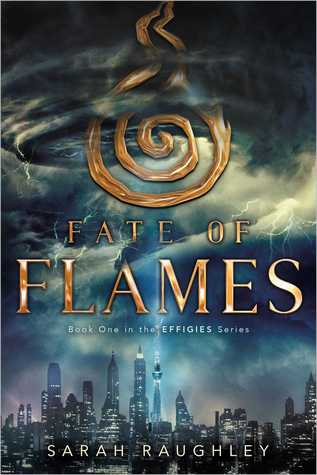
28954021Touted as Pacific Rim meets Avengers with a Sailor Moon cast,” Sarah Raughley’s Fate of Flames was simply irresistible to this geek girl. Having read it, the book felt more like Captain Planet meets Buffy the Vampire Slayer, but that just be my age talking. The Effigies are a group of four girls, each with the power to control an element (earth, air, water, fire), who are tasked to protect the world from Phantoms. When one girl dies, another is chosen to take her place. Fate of Flames is the story of one such girl, Maia, a lifelong Effigy fangirl who is chosen to become the next Fire Effigy. Not only does she have to live up to the legacy of her legendary predecessor Natalya, whose fourteen years as Effigy is double the expected lifespan, but Maia also has to deal with having power over an element that took the lives of her parents and twin sister June. Added to that are the other three Effigies who can’t stand each other, and the Sect, an agency that manages the Effigies and may have a hidden agenda.

Fate of Flames is an entertaining fantasy adventure that feels very much like the first book of a series. It does a good job in creating its main characters, the four Effigies, as vulnerable superheroes. I like that Raughley makes them all celebrities, and highlights the challenges of living as a superhero under the spotlight. Early on, Maia is afraid of coming out as the new Effigy because she knows people will expect her to save them, whether or not she is ready to do so. The Air Effigy, Lake, is an especially interesting character in this regard, as a singer-supermodel by day. Many people (including Maia before she was chosen) criticize her online for her lack of commitment to being an Effigy, while many other people (her “Swans”) defend her actions and argue for some compassion. This mix of censure and defense is such a true representation of how I can imagine being a public superhero will be in the Twitter age that I can actually imagine Lake in our real world today.

I also like how Raughley makes each of the Effigies vulnerably human. Lake’s perceived lack of commitment to being an Effigy is rooted in her fear of the role. The Water Effigy, Belle, who is perceived by most as the most badass heroine in the group, doesn’t see herself as a hero, and instead is all too aware of the tragic fate that awaits all Effigies. And my personal favourite, Chae Rin the Earth Effigy, is like the Raphael (from Ninja Turtles) of the group, tough and with a violent temper. But her work as an Effigy has distanced her from her family, and a scene at a Montreal circus hints at how much she is affected by this distance. I love this, because in some ways, the Effigies are all badasses who can create fault lines in the ground or create a big enough wind gust to keep a train from falling. But these little notes remind us that they’re all teenage girls, who are trying to work out what being an Effigy means for their real lives.

With this being the first book in a series, Raughley is very clearly trying to build a mythology and to craft a world that will give rise to a much longer story arc. The good news is that there’s a lot of richness to be mined in future books. Unfortunately, somewhat similar to the movie adaptation of Cassie Clare’s Mortal Instruments, there are a lot of elements that end up being juggled and some of it ends up feeling muddled. For example, when one of the characters says that the villain’s actions are unlike anything that the Effigies have ever faced before, the drama of this moment is undercut by the fact that I’m still unclear on what it is that Effigies usually face, so I just have to accept the character’s word that this is momentous and unusual.

In another example, an early scene shows a single Effigy fighting a Phantom, which made me wonder where the other Effigies were. It isn’t until much later that we learn that with a notable exception decades ago, Effigies don’t usually work as a team, but then pretty soon after, we also learn that Maia’s generation of Effigies will be working together and that this makes them unusual. Again, having assumed throughout that Effigies usually fought as a team, I was pretty meh over Maia’s batch uniting as a team. Raughley seems to assume that we know as much about Effigies as Maia does, and while I wouldn’t necessarily have wanted a full chapter detailing the history, a little more background on Effigies up front would have helped.

One particularly frustrating logical hole is a revelation about the villain, which calls into question one of the basic tenets about Effigies. It was presented for dramatic effect and the characters do react with surprise, but none of them appears bothered by a logical inconsistency with the Effigy mythology, and it just irritated me for the rest of the story.

All that being said, Fate of Flames was an entertaining read that sets up some interesting threads to be picked up in future books. There is lots more to be revealed about the Effigies and the Phantoms in the next book, which should be interesting to learn about. I’d especially love to learn more about Rhys, the cute, dorky agent who clearly has a secret but whom I hope turns out to be a good guy.

+

Thank you to Simon and Schuster Canada for an advance reading copy of this book in exchange for an honest review.