Review | Crosstalk, Connie Willis

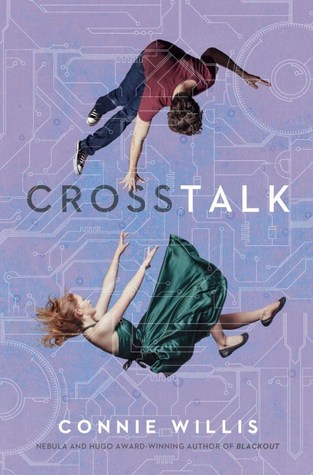
25430248In our hyper-connected world, where our deepest, darkest feelings are a tweet away, what’s the next step in deepening our connection to people we love? In CrosstalkConnie Willis imagines something called an EED (“Empathy Enhancing Device”?), a surgical procedure that enhances your empathic link to your partner. When Briddey Flannigan’s partner Trent suggests they undergo the procedure so that she may feel the depth of his love when he proposes, she sees it mostly as a minor hurdle that she’ll need to hide from her nosy and intrusive family. Unfortunately, the side effect is much worse than even her family imagines. Rather than connecting emotionally to Trent, Briddey seems to have developed a telepathic link to C.B. Schwartz, a nerdy and reclusive co-worker who stays mostly in his basement office and away from other people. Not only can they sense each other’s emotions, they can also hear each other’s thoughts, and Briddey worries about what this may do to her and Trent’s relationship.

Willis does a great job of setting up a world that’s basically like a jacked up version of ours. I’m on social media often and have a bad habit of checking and answering emails on my mobile during my lunch break, but even I was overwhelmed by the hyper-connectivity of Briddey’s world. She seems to get thousands of text messages, calls, emails and social media alerts every minute, and her family members panic if she doesn’t respond to their (non-emergency) crises immediately. Briddey, Trent and C.B. all work for a technology company racing against the clock to develop something that will rival the next generation iPhone. Tech giants trying to find a way to increase communication, while all too easy to imagine in the real world, seemed a nightmare scenario in Crosstalk. The first few chapters of this book felt almost claustrophobic with the incessant barrage of electronic chatter, and I almost wanted to run to C.B.’s basement office myself, since it apparently is impossible to get a signal there.

Given this kind of world, the EED does seem like a logical next step for romantic partners, and I laughed at Willis’ recounting of how various celebrity couples responded to the procedure. It’s not necessarily something I’d do myself, but it seems almost tame compared to the telepathy that Briddey ends up having. Telepathy can seem like an awesome superpower, but only if you can choose when to tune in. Willis does a great job in showing how nightmarish it can be to hear someone’s unfiltered thoughts, and I loved the part where Briddey trains herself to control her telepathy by imagining a radio where she can switch between stations.

The story flags in its pacing, particularly in the first half of the book. Despite conversations flying at the speed of thought, the book felt repetitive at times, and I was really frustrated by Briddey’s unwillingness to act. For example, she hesitates from telling her doctor or Trent about what went wrong, instead pretending that the surgery had no effect on her. C.B. is even more annoying; every time Briddey considered telling the truth, he’d intrude on her thoughts and scare her out of it. There was a point where if C.B. had turned out to be an evil mastermind stalker who sabotaged Briddey’s surgery, I wouldn’t have been surprised; he was that intrusive and controlling. Worse, at least from a storytelling standpoint, he was also a one-note messenger, which just really boring after a while, and I wanted Briddey to just blurt out the secret despite him. Trent was no better. He was so distressed about the EED not working, and refusing to propose marriage until it did, that I began to wonder if he even loved her, and I also wondered why Briddey hasn’t just dumped him already. All of this annoying behaviour does make more sense as the story goes on, but you have to get to the 30% or so mark before something finally happens to move things along.

The final 70% of the book is a lot more fast-paced and entertaining. It veers away somewhat from the satirical edge of the first third of the book, and its science seems a bit more tenuous, but it makes up for this in sheer entertainment value. Relationships slowly but surely show some development, and some minor characters turn out to have much larger significance. Despite some slow and annoying parts, Crosstalk is a fun read overall, and a rather dire look at where too much connectivity can get us.

+

Thank you to Penguin Random House Canada for an advance reading copy in exchange for an honest review.

Review | Winter of the Gods, Jordanna Max Brodsky

29569660Winter of the Gods picks up shortly after The Immortals leaves off. Selene DiSilva is still a PI in New York City, dating Theo Schultz and protecting the women of New York from abusive men. The Immortals somewhat touched on the decline of the gods as they become increasingly irrelevant to humans; Winter of the Gods takes this a step further and introduces a set of new villains who are actively hunting down the gods and killing them in a seemingly ritualistic manner.

I really enjoyed The Immortals and this sequel is a fantastic follow up that ratchets up the stakes and delves even deeper into the humanity of the gods. Paul (Apollo) in particular became even more fleshed out in this story, as a famous musician haunted by visions of his violent past, and I love how his and Selene’s bond as twins is proven much stronger than their centuries-old estrangement. Selene and the other gods as well in this story face the various atrocities they’ve committed in the past, and I can only imagine how gut wrenching that experience must be, to be faced with the potential loss of one’s immortality and have to deal with centuries of guilty.

Theo and his human friends played a major role in solving this mystery, though admittedly their story pales in comparison to the gods’. The rituals of this cult don’t quite correspond to the Greek and Roman traditions Theo is familiar with, so he has to go a bit beyond his comfort zone and consult some friends to help Selene figure out what’s happening. He’s also clearly in love with her, and (thankfully) understanding of her reluctance to commit to long term relationship. I like how their relationship develops throughout the story, and how they eventually realize how much they mean to each other.

Whereas The Immortals was pure geeky fun, Winter of the Gods is more existential angst. It’s just as exciting a read as The Immortals was, but it’s also a much more emotional one. The ending reminds me how The Empire Strikes Back ended — there’s some happiness and hope, but it’s overcast with everything that’s happened before. I’m invested in this series now, and look forward to seeing how it turns out in the next book.

+

Thank you to Hachette Book Group Canada for an advance reading copy of this book in exchange for an honest review.

(As an aside, isn’t that cover beautiful? Kudos to designer Kirk Benshoff.)

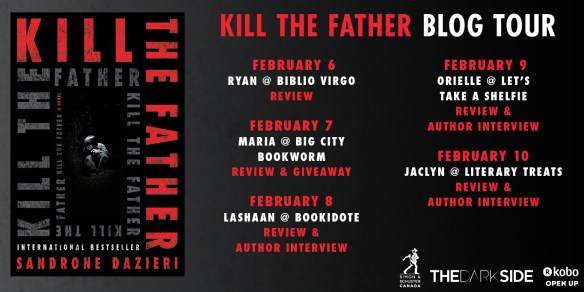
BLOG TOUR: Review | Kill the Father, Sandrone Dazieri

32744042I had just finished the BBC series Luther on Netflix and was very much in the mood for another psychological thriller with a broody and troubled detective, so Sandrone Dazieri’s Kill the Father came at a perfect time. A murder scene with a missing child is potentially the work of The Father, a serial killer who kidnapped and psychologically tortured young boys before killing them. He hadn’t been active for a while, but this crime could signal his return.

A police chief enlists the help of two individuals: Dante Torre, a recluse who had been held captive by The Father as a child and managed to escape, and Deputy Captain Colomba Caselli, a “warrior-like” detective on administrative leave after a police operation she was partly responsible for goes very badly.

Kill the Father is a doorstop of a novel at almost 500 pages, but it doesn’t feel all that long because the story does a great job of propelling you along. The mystery is compelling — the more we learn of what Dante experienced while he was The Father’s captive, the more we want The Father or whomever the kidnapper is in the present-day case, to be brought to justice. Dazieri paints a harrowing picture of what it’s like to be kept captive, without too much detail, and while we never delve deep enough into the characters’ psyches to feel claustrophobic ourselves, we certainly get enough of a picture to sympathize with the victims. A scene where a boy is seen on videotape wiping himself down with a washcloth is particularly heartbreaking when we learn that his movements follow a precise pattern set by his captor.

Dazieri does a great job of making Dante and Colomba’s realities real for us, so that we see Dante’s captivity as a child and Colomba’s experience at work affect them even months or years after. For example, Dante was kept in a silo for about ten years and so is very claustrophic. When he follows Colomba and other police officers down the stairs of his apartment building, it takes him about 45 minutes to reach the first floor, because of how being in a stairwell affects him. Colomba as well has PTSD, and their dynamic as a team is interesting, as they’re both very good at their jobs, but also very vulnerable, and they take turns propping each other up as needed.

The big reveal turns out to be bigger and darker than Dante and Colomba originally thought, and while part of me appreciates Dazieri upping the ante, this reveal also made the story feel more impersonal to me, and detached me somewhat from the experience. Still, overall Kill the Father was a compelling thriller with strong characters, and I look forward to reading future books in this series.

Author Q&A

sandrone-dazieri

Photo by Moris Puccio. Source: simonandschuster.ca

1.       How’d you come up with the idea for this novel? 

One day, walking through the fields around my home town, Cremona (in the north of Italy and famous for violins and nougat) I saw a silo that stood in the middle of nowhere. I thought that whatever happened there, no one would ever know. For example, someone could have been a prisoner in that silo … In that moment the character of Dante Torre was born. 

2.       Both Dante and Colomba have incredibly scarred psyches due to past experiences. What research did you do, if any, in creating these aspects of their characters? 

I am interested in psychological and neurological diseases and I read a lot about that. All my characters  (even in previous novels) are tormented and wounded. I’m fascinated by the different views of the world that other people can judge as “crazy”. Probably because I’m not “neurotypical” too. 

3.       Where do you see the series going next? Will the mysteries be as intensely personal to one or both of the lead characters as this one was?

The second novel of the series (The Angel, published in Italy two months ago)  revolves around an ISIS massacre in Rome. Meanwhile we learn something about Dante’s family. The third and final chapter, that I’m writing now (Brothers), it’s about Dante’s past and a serial killer that is connected to him.

4.       You write both novels and screenplays. Would you be interested in writing the screenplay for Kill the Father if it’s adapted for screen? 

I’d like to be the supervisor of the project and not to write it. It’s very difficult to adapt your novel for another media. It’s easier with the someone else job… 

5.       What was the most recent book you’ve read and absolutely loved? 

Fireman, by Joe Hill.

Book Trailer

Blog Tour Schedule

Check out the other bloggers on the tour!

blogtour_killthefather

Twitter Chat

Mark your calendars! @SimonSchusterCA and @Kobo are hosting a Twitter chat with author @SandroneDazieri on February 22 at 10 am ET. Join in with hashtag #DarkSideReadsChat!

twitterchat_killthefather

+

Thank you to Simon and Schuster Canada for an advance reading copy in exchange for an honest review.