
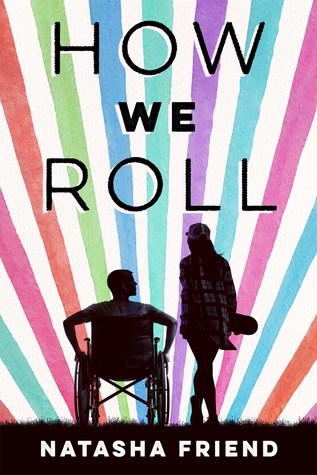
Review | How We Roll, Natasha Friend

35791915How We Roll is really, really well done. Quinn, who has alopecia, and her family move to a new town so that Quinn’s younger brother Julius, who is autistic, can go to a better school. Quinn is mostly relieved to be in a town where no one knows she has alopecia, and she can wear a wig and fit right in. She befriends a group of popular girls at her new school, and a boy Nick, whose legs were amputated after a snowmobile accident caused by his brother Tommy. A former football star, Nick’s still coming to terms with the changes to his life and with his resentment over his brother’s role in the accident, and Quinn’s too afraid of her own reputation to admit to him why she understands what he’s going through so well. I love how thoughtful and intentional this novel is, and how much it subverts expectations and defies the usual tropes we find in young adult fiction.

First, I love how Friend treats her characters’ disabilities / conditions (is alopecia a disability?). Friend is very honest about how autism, amputation and alopecia all impact not just the characters’ lives but also their families. For example, each of Quinn’s wigs costs $2,000, her mom is practically in daily meetings with Julius’ therapy team, her dad keeps trying (and failing) to break Julius from routines, and Nick sleeps in the family den rather than his old bedroom. Moreover, I love how, even though Quinn is super comfortable about how to act around persons with disabilities, she still gets it wrong sometimes. But more importantly, her missteps don’t make her freeze; rather, she deals with them. For example, she invites Nick to her house and it’s only when he shows up in his wheelchair that she realizes her house is up a steep incline and accessible only by steps. Instead of immediately giving up on getting Nick into her house, she asks his permission to have her and her parents carry his chair up the steps. And later, when he visits on his prosthetic legs, she knows she has to resist the temptation to help him up the steps.

There’s also a great scene where she sees him at an event in his wheelchair and is super curious about why he isn’t wearing his prosthetics. She’s literally about to ask him why when she realizes — not that it’s an inappropriate question, even though it is — but that he maybe just felt like using his wheelchair that day, just like she feels like wearing a wig some days and not wearing a wig other days. I love that because so often the question of what is or isn’t appropriate to ask a disabled person is framed as a series of do’s and don’t’s that, quite frankly, can be intimidating and, worse, reductive. So I love that Friend shows how important simple thoughtfulness and empathy can be. It’s not so much that you should never ask a double amputee why they’re using their wheelchair, but that you should consider whether you want someone to ask you why you’re, e.g. wearing your hair a certain way or wearing a particular item of clothing or whatever other visible decision you made that morning.

I also love Friend shows that Quinn’s hesitation to let people know about her alopecia isn’t innate but rather directly linked to how society responds to people with alopecia. There’s a great moment where Quinn goes to a party and feels really cute because of the hat she’s wearing, but then a total jerk makes her baldness the butt of a cruel joke. I think it’s really important because again, so often book and movie characters are portrayed as being very self-conscious about their disability, and while those experiences are equally valid, I love that Friend puts the blame for this self-consciousness squarely on the shoulders of society, which is really where it belongs. I’ve heard that of all the barriers disabled people face, attitudinal barriers are the most difficult to deal with, and I think Friend really brings that point home. And I also love that Quinn can feel absolutely cute while bald, not because it’s inspirational, but because it’s realistic, given the disabled people I’ve met in real life. And again, this type of representation is so rarely seen in media.

Finally, I love that the whole mean girl / mean popular people is turned on its head. Quinn’s friends at her new school are the popular crowd, and so often the It Girls are portrayed as bitchy and the indie / nerdy girls as the only nice ones. Here, there are no immediate villains (even the jerk who bullied Quinn at her old school was obviously ashamed of his behaviour when she confronted him later on, though he was too much of a jerk to apologize). I like that each time Quinn hesitantly reveals a bit more of herself to her new friends, they don’t react the way she expects them to, and instead reveal their own experiences that are somewhat similar. For example, upon learning of Julius’ autism, one of them reveals she has a sister with Down Syndrome. I also love that Nick’s ex-girlfriend (who is one of Quinn’s new friends) handles Quinn and Nick’s friendship with such maturity. To be honest, I don’t think I would have had that level of maturity at her age, and it’s behaviour I aspire to even as an adult. So I really like that Friend deliberately steers away from stereotypes for all the characters.

+

Thank you to Raincoast Books for an advance reading copy in exchange for an honest review.

Review | America is Not the Heart, Elaine Castillo

34939312Elaine Castillo is a fresh and welcome new voice to Filipino immigrant fiction. I loved the Filipino touches throughout America is Not the Heart — the sprinkling of Tagalog and Ilocano, the obsession with pancit and Pinoy-style BBQ, and all the talk about faith healing and the power of brujas to heal things like eczema. There are some great passages about Filipino folklore — the white lady of Balete drive, the consequences of a supernatural being (I can’t remember which one Castillo referenced) falling in love with you and not wanting to let you go. There are also all-too-real depictions of Filipino gatherings, and the oddly instantaneous sense of closeness when Filipinos encounter each other abroad — from a grandmother figure tactlessly discussing Roni’s eczema in front of everyone to a complete stranger asking Hero about the condition of her hand.
Major kudos as well to the audiobook narrator (Donabella Martel), who really brought the story to life. From other Goodreads reviews, I learned the text version of the book doesn’t use quotation marks, which often pulls me from the story and particularly when the story is this long. So I was glad to have her voice clearly distinguishing between characters for me. I’m also often wary of how non-native Filipino speakers pronounce Tagalog words, so I’m really happy that Martel did a good job overall with the accents.

Like many other Goodreads reviewers, I had been captivated by Paz’s story in the beginning, so it was a bit of a disappointment to realize she’s not the actual protagonist of the book. I was glad to see her play a prominent role again near the end, and wish I’d seen more of her throughout. She was probably the most compelling character to me, and so often, like Hero, I wanted so badly for her to fight Pol and win. (No spoilers, but basically he does something I find unforgiveable later in the book, and due to the power of his family, Paz is relatively helpless to fight back.)

Even while I wanted more of Paz, I also found Hero to be a compelling heroine. I loved her love story with Rosalyn, and I also enjoyed reading about her experiences as a doctor with the New People’s Army (NPA), a militant Filipino communist group. I rarely see the NPA featured in Filipino fiction, much less in such a sympathetic light, so it was interesting to read.

Roni, as the American-born daughter of Paz and Pol and cousin of Hero, is fascinating to me mostly because of what she represents. There’s a great line about Roni early in the book (Paz’s section, as she looks at her baby girl) that reads:

She doesn’t have to love America; she’s of it. (7%)

And it’s so incredibly true. For immigrants like Paz, Pol and Hero, who struggle between their longing for home in the Philippines and their desire to make a home in America, there’s almost a requirement to become super-American. To love America so much that no one can question your right to be here. It’s a very familiar feeling to me as an immigrant — much as I sincerely love Canada, there was also a touch of the performative in my love for the country at the beginning, almost like I felt I needed to prove my worth to become Canadian. So that line about Roni being of America and therefore not being required to love it really resonated with me, and so much kudos to Elaine Castillo for capturing this complex feeling so succinctly.

There are so many similarly brilliant gems throughout the book — Hero’s observation that Rosalyn’s world in Milpitas is primarily Asian people and places, Roni’s story of her classmates calling Filipinos “more Mexican than Asian” — that beautifully capture various aspects of Filipino immigrant experiences.

It’s a wonderful book, and I highly recommend it, ideally with a bowl of pancit and a stick of Pinoy BBQ by your side

+

Thank you to the Toronto Public Library for taking my recommendation and acquiring the audiobook of this title. Libraries are amazing, and the Toronto Public Library is (in my admittedly biased opinion) simply the best.

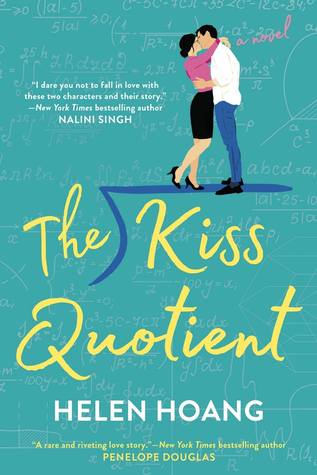
Review | The Kiss Quotient, Helen Hoang

36199084I absolutely, wholeheartedly adored The Kiss Quotient! It’s the first romance I’ve ever read with an autistic heroine (Stella has Asperger’s), and I’m always on the lookout for Asian representation in books (the hero Michael is half Vietnamese, and the author’s surname is Hoang), so this book caught my eye almost immediately as one I wanted to check out.

And I’m incredibly glad I did. From the first few pages where Stella stresses out about dating because she doesn’t enjoy touching, and she really doesn’t enjoy sex, I was intrigued at how Hoang would craft a romance around this. I also loved Stella as a heroine because she’s an econometrist is such a wonderfully nerdy profession I didn’t even know existed. Basically, she analyzes market trends, and there’s a great moment where love literally is a factor in her calculations. (Hoang somehow succeeds in making this not as cheesy as it sounds.)

Then we meet Michael. He works as a male escort to pay off his mother’s medical bills, and he also trains as a martial artist. He also has a day job and career dream that he put on hold to support his family, and I won’t reveal what it is here because the reveal in the book is just too beautifully done to spoil, but seriously, this guy just got me in all the feels. Stella decides to hire Michael to teach her how to have sex, so that she can handle actual relationships and, well, things take off from there.

I absolutely adored Stella and Michael and their love story. They both felt real, and they both had all these vulnerabilities that only the other person truly got. There were misunderstandings that drove them apart, but these never felt manufactured. Rather, they were rooted in insecurities that Hoang did a masterful job in setting up throughout, so that when things came to a head, we could understand why Stella and Michael reacted the way they did, even as we wanted nothing more than for them to move past their issues.

I also loved the secondary characters, particularly Michael’s family. His mom, grandmother and sisters all had such vivid personalities I felt like I was at the family dinner with them, and I could just picture the siblings growing up together. His cousin Quan is awesome with his tattooed, bad boy aura, and I’d personally love to see him star in a romance of his own. I also love how complex Michael’s mom’s feelings still are for the dad who abandoned the family, and I especially love the scene where she confronted Michael with a harsh, much-needed dose of reality about his hang-ups in pursuing a relationship with Stella.

The lovemaking scenes were off-the-charts hot. Part of it is Stella’s initial fear of being touched, and Michael’s incredible gentleness towards her, so that even when things got more intense, lovemaking still feels like the more accurate term than sex. Their first night together, even things like French kissing and opening the top button of her shirt set Stella off. The way Michael eased her into greater intimacy, while still very much respecting her boundaries, was beautifully done, and resulted in an incredibly sensual scene that was ultimately chaste, yet still somehow felt sexier than if they’d gone further. Consent is sexy, and this chapter shows just how sexy it can be.

Finally, I thought Hoang did a good job incorporating Stella’s autism into the story. Apart from her aversion to touch and her sensory sensitivities, Stella also occasionally messes up in social situations and sometimes needs to take a break from public spaces. What I love most is that Stella is never treated as an object of pity because of her autism. Despite her fears to the contrary, Michael’s only response to her autism never feels like pity but simply consideration, for example by toning down sensory stimuli or by giving her plenty of advance warning.

There’s a particularly powerful scene where she first meets Michael’s family, and, overwhelmed by the noise and all the new faces, she inadvertently says some very rude and inappropriate things. I cringed the entire time reading it, mostly feeling sorry for Michael and his mother, who kept trying to smooth things over, but the scene also made me realize how unaware Stella was of how her words were being perceived by others. It’s only later, when the night ends in tears and Stella’s had a moment to remove herself from the situation and reflect, that she realizes she messed up and feels terrible about it. She goes out of her way to apologize to Michael’s mom, and all is well, but this scene stuck with me, and I love how she and Michael are able to work through it.

Overall, this has earned its place as one of my favourite books of all time. I’m a huge fan of Hoang’s writing, and I’m now incredibly excited for The Bride Test to come out in 2019!

+

Thank you to Penguin Random House Canada for an advance reading copy of this book in exchange for an honest review.