
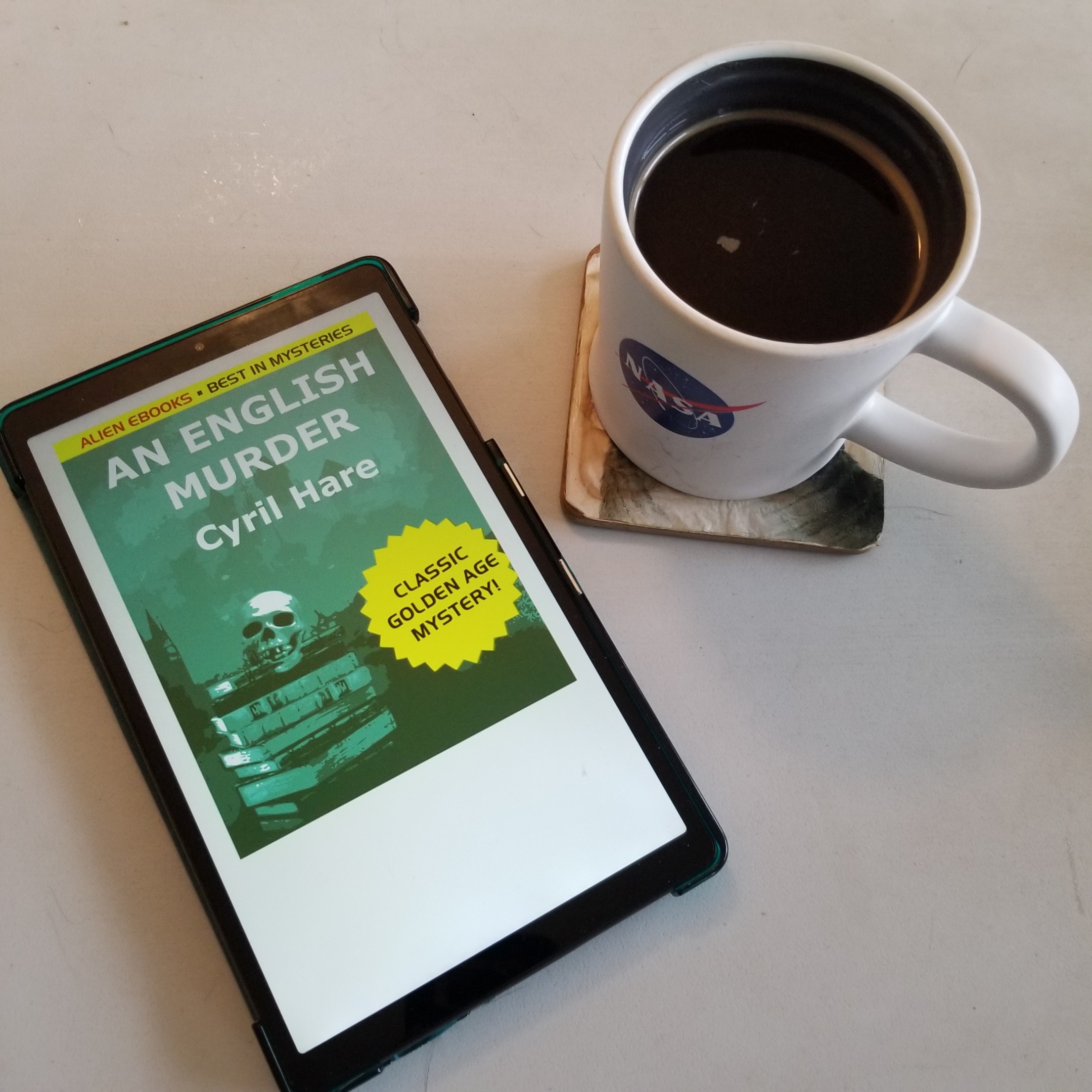
I Try to Solve a Golden Age Mystery | An English Murder, by Cyril Hare

I looked up Cyril Hare’s An English Murder at my local library after seeing it listed in The Guardian as one of the Top 10 Golden Age Detective Novels. I’m always eager to expand my grey cells’ repertoire beyond Agatha Christie (and perhaps even give my inner detective a fighting chance every now and then!), so I decided to give this a go.

First, I’ll say I was almost turned off by the cover design. Having never read this author before, I was too cheap to purchase a copy with a better one, but just for my own satisfaction, here’s the gorgeous cover of the original 1951 mass market paperback edition:
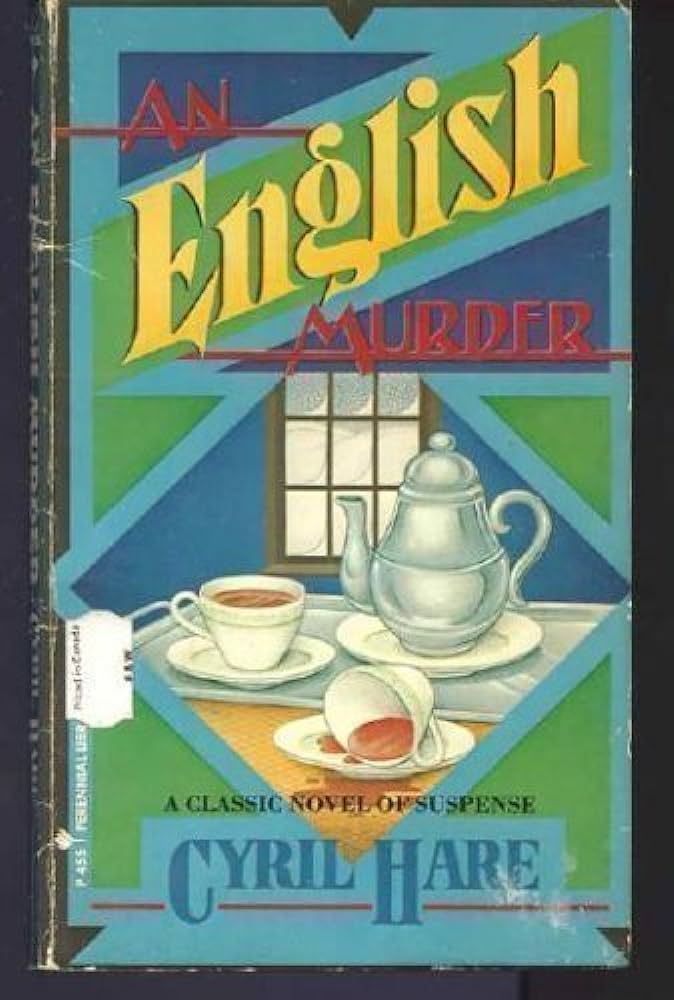
EnglishMurderClassicCover

The set-up is one of my favourites: it’s Christmas at Warbeck Hall, a beautiful and old English country estate, and family and friends have gathered to celebrate the season. On the guest list are: a socialist politician, the leader of a fascist group, an earl’s daughter nursing unrequited love for the fascist, the ambitious wife of a mid-level government worker, and a Jewish history professor and concentration camp survivor who is researching the family’s history. In the servant’s hall are: the family butler, his daughter, and the police officer acting as the politician’s bodyguard. Add in a winter snow storm, a rather juicy secret, and a dying patriarch, and to paraphrase Sherlock Holmes, murder is certainly afoot.

I love how this story touches on the politics and economic realities of post-WWII Britain. Briggs the butler comments on the challenges of putting on a party with such a small household staff. He and his daughter Susan also represent two generations’ approaches to generational wealth, with Briggs being bound by social order and Susan wanting to do away with it. Sir Julius and Robert Warbeck lock horns over competing politics: Sir Julius thinks Robert’s fascism is reprehensible; Robert views Sir Julius’ socialism as being a traitor to their class.

Dr Bottwink’s experiences at a concentration camp are mentioned only in passing, but he isn’t shy to tell Briggs he’d prefer not to eat with Robert. And when Sgt Rogers later comments at how much Dr Bottwink has moved around, the professor corrects him that it’s more accurate to say he was moved, and that this circumstance has turned him leftist — not quite communist, but “anti.” There’s a great moment after the first murder where Dr Bottwink is first to breakfast, and he asks Briggs not to leave the dining room till the next guest arrives. Life experiences have taught him to be cautious: on the off-chance someone dies at this meal, he can’t afford to have been left alone with the food at any time. Neither Briggs, nor Sir Julius who arrives next, both of whom are Englishmen, even realize why that could be a risk.

The mystery itself unfolds at a quick and entertaining pace. Events occur, information is revealed, and tea and champagne are served. I have a feeling that when the big reveal finally unfolds, the killer’s identity and motive will turn out to be so utterly obvious that I’ll hang my head in shame that I didn’t guess it at all.

The thing is, the first murder is easy enough to predict. The victim is someone whom pretty much everyone else at the estate had reason to hate, so when they declare they have a big announcement to make, and then promptly drink a glass of champagne, it’s no big loss when they drop dead. Figuring out whodunnit is trickier, because so many people had motive to.

But then two more deaths follow, and the third death in particular doesn’t fit the pattern at all. Who could have wanted that third person dead? How does their death fit in with the other two? 

I have my theories, and none of them make sense. Alas, I’m reaching the 90% mark of the ebook, and things are beginning to wind down. So I’m going to give this a go, and see how I do!

UPDATE: Some significant new clues in the penultimate chapter! I may need to revise my verdict… Now at the start of the final chapter, and it’s now or never to lock my verdict in!

Did I Solve It?

Ahahahahaha! Absolutely not! Not even close! In my defence, the reveal hinged on a bit of history and law that I knew absolutely nothing about, so despite all my research, all my careful note-taking, and all the workings of my poor little grey cells, there is absolutely no way I would have guessed that motive. Honestly, I had to read the final chapter twice over just to make sense of the key information that formed the motive, and by the second time, I was laughing out loud, because never was any of that even on the horizon of my knowledge.

Would British readers be better equipped to solve this case? Would history buffs? Possibly. I’m sure there are many, much smarter readers out there who could try their hand at this and find the solution super obvious. I didn’t, and in a rare occurrence amongst my many detecting failures, I don’t actually feel like I should have been able to put the clues together. Man, this case was wild! And a lot of fun to try and solve, failure or no!

*** SPOILERS BELOW ***
Continue reading

Review | Don’t Want You Like a Best Friend, by Emma R Alban

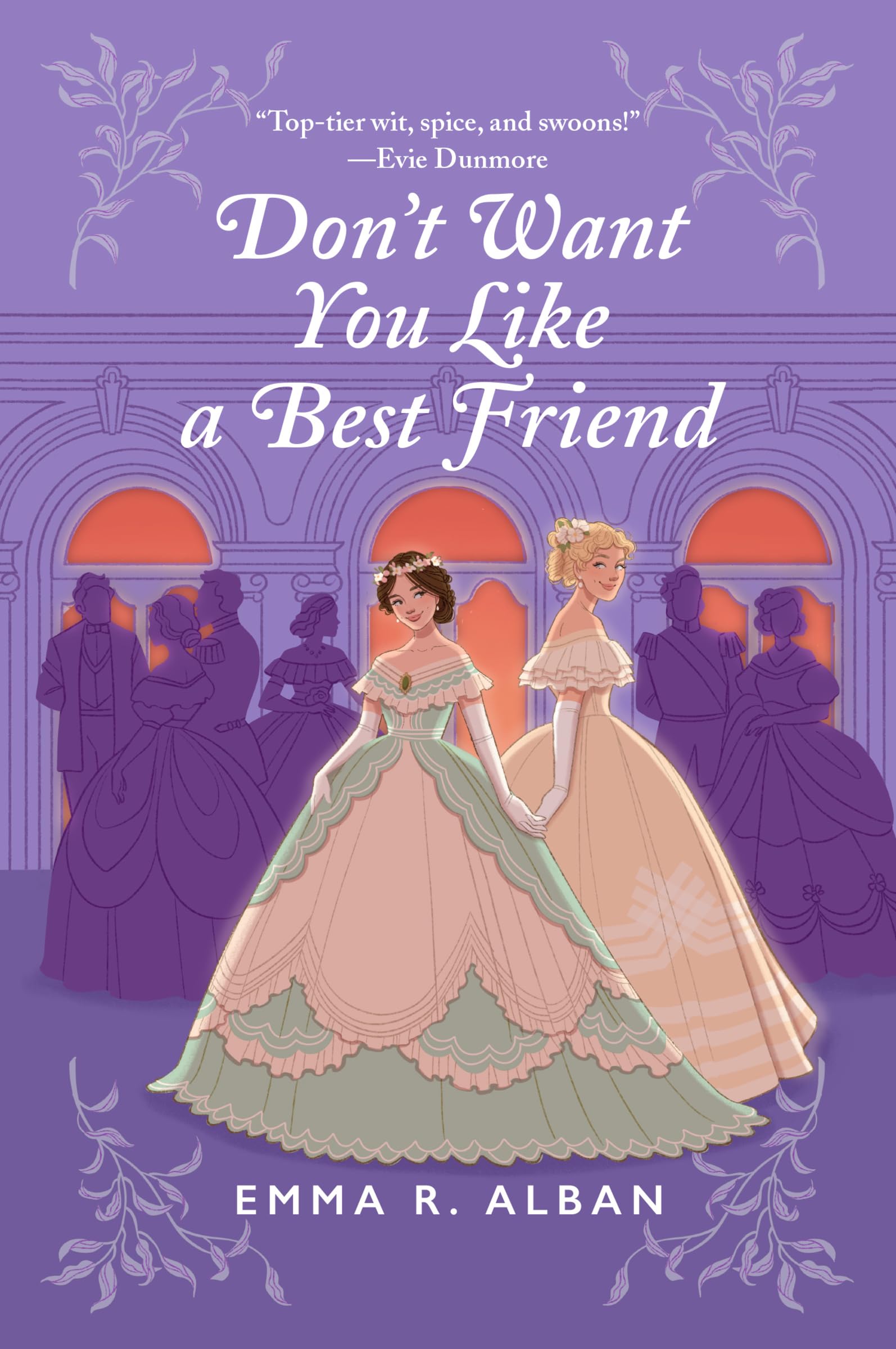
DontWantYouParent Trap meets Bridgerton, and make it sapphic. Don’t Want You Like a Best Friend has a heckuva fun hook, and the story definitely lives up to the hype! It’s charming, heartwarming, and absolutely delightful.

It’s Beth’s first season, and she has just this one shot to snag a wealthy husband or else she and her newly-widowed mother, Lady Cordelia Demeroven, will be out on the streets. This is also Gwen’s fourth season; she’s pretty sure she’s destined for a ‘most seasons without a match’ medal, and mostly amuses herself at parties by challenging friends and cousins to ‘spot the heir and the spare’ games.

When Gwen rescues Beth from an over-eager old man, both young women realize they’d much rather hang out together than deal with all the tediousness and stress of the season’s endless social events. They also realize that their parents seem to be attracted to each other, and scheme to help them along towards their own happily ever after.

Beth and Gwen’s relationship is really sweet. Even more than the physical attraction and the fun sexytime scenes, their friendship and desire for each other’s happiness really shines through. These are characters who genuinely enjoy spending time together, and my favourite parts are when they’re just having fun hanging out together and laughing at silly things going on around them.

For me, though, the main highlight of the book isn’t the main romance, but rather the second-chance romance brewing between Beth’s mother, Lady Cordelia Demeroven, and Gwen’s father, Lord Dashiell Havenfort. When both were in their own seasons, they fell in love, but Lady Demeroven was in a similar situation as Beth, where she needed to marry rich to secure her family’s financial stability. Lord Havenfort was heartbroken, and even though he went on to marry Gwen’s mother, when his wife died, he never bothered finding a new one, and instead chose to remain a perpetual bachelor and lady charmer for the rest of his life.

Their meet-cute at the same ball where Beth and Gwen meet was just sparking with unresolved sexual tension, and their will they/won’t they dance running parallel to Beth and Gwen’s romance just stole the show for me. I absolutely felt for Lady Demeroven’s desire to reunite with Lord Havenfort yet also secure her daughter’s future with a wealthy match to another family. The man who eventually began courting Beth seems sweet enough, but his father is a total ass. Seeing through Beth’s eyes the parallels between this potential future father-in-law and her own abusive father is heartbreaking, especially when she notices how much her mom makes herself small to feed this man’s ego, just so she can secure Beth’s future. I love how Beth pushes her mom to consider how their happiness (Beth’s and her mom’s) is more important than financial security, but I also understand why her mom would be afraid to make that leap.

Lord Havenfort seems like a good man, and I sympathize for how much Lady Demeroven’s fears keep happiness away from both of them. A member of the House of Lords, he’s championing a bill to give women the right to divorce their husbands. This objectively makes him a hero, but on a more visceral level, it also makes him a personal knight in shining armour to Lady Demeroven and women like her, because if such a law had existed earlier, she may not have had to put up with an abusive marriage for so long.

Honestly, their romance just stole the show for me, and the big climactic moment between them just made my heart swell. I am so absolutely fantastically proud of Lady Demeroven, and so happy for them both.

I also really like how the novel explores the ways in which social conventions determine the options available to Beth and Gwen. It’s illegal for two women to marry, and most couples in their situation make do with being friends who visit each other’s estates and steal whatever moments they can for romantic encounters. Both Beth and Gwen struggle to come to terms with that restriction, yet as women, they couldn’t really have careers on their own, and so need husbands for financial stability. This is especially true for Beth who doesn’t have the security of Gwen’s father’s wealth.

The book highlights this theme with the two women servants who both work in the same household under different married surnames, but are actually a couple. Social snobbery works to their advantage, because most members of society don’t bother paying enough attention to the servants to even notice they’re romantically involved. One of them tells Gwen that this is the one time she’ll admit that Gwen’s wealth and social status puts her at a disadvantage, and I like how the story explores these kinds of nuances about privilege.

Overall, this is a fun, lighthearted, and feel-good book. The sequel, You’re the Problem, It’s You, featuring Beth and Gwen’s cousins, also seems like fun. Both cousins’ meet-cute at the end of Don’t Want You Like a Best Friend showed a lot of promise for their chemistry together.

+

Thanks to Harper Collins Canada for an e-galley of this book in exchange for an honest review.

Review | The Escape, by Ruth Kelly

TheEscapeBritish influencer Adele posts a crowdfunding video online asking her followers to help fund her dream to purchase a beautiful old chateau in France. Amidst all the hateful comments about how selfish and deluded she is for the ask, Adele also receives an email: a wealthy and intensely private philanthropist wants to buy the chateau for her and her partner, Jack.

The catch? They cannot bring any furniture of their own, nor make any changes to the building. They cannot have guests over, much less move in Adele’s mom, who has cancer. They must also agree to let the unknown benefactor come over whenever they desire. In return, the deed to the chateau will be in Adele and Jack’s name within the day, the philanthropist will send them cash for living expenses, and they’ll even have a gardener to help with caring for the grounds.

Personally, I couldn’t do it. I would hate for anyone to have that much control over my home and my life. But Jack is unemployed, and Adele’s boss fired her after interpreting the crowdfunding video as Adele intending to leave. So Adele and Jack decide to take the offer and go for their dream life. Four months later, a few days after New Year, Adele’s sister Erin comes to the chateau to tell Adele to come back home; their mom’s condition has worsened, and her dying wish is to see Adele one final time. Except that neither Adele nor Jack is at the chateau, nor answering their phones. And when Erin asks the people in town, no one seems to want to help.

The Escape starts off really strong. I love the dual narrative structure: Erin’s chapters are set in the present day, with Erin trying to retrace events leading up to the last time she heard from Adele, a texted heart emoji on New Year’s Eve. And Adele’s chapters are in the months leading up to New Year’s, detailing the creepy vibes she keeps feeling at the chateau, the overall unfriendliness of the people in the nearby town, and increasing tensions in her and Jack’s relationship. The first half of the book was fantastic! Lots of mystery, lots of spooky vibes, and lots of curiosity about what on earth is actually going on with that chateau.

Unfortunately, the story turned kinda meh for me in the second half. We do find out big reveals about the mysterious benefactor and their interest in the chateau, and it’s ridiculously over-the-top and dramatic. I usually like drama, and I’m not averse to a little pulp in my fiction, but this was just so pulpy yet played so straight that it was a struggle to maintain my suspension of disbelief. It’s tough to describe without going into spoilers, so I’ll just say it gets dark, it involves minors, and based on the descriptions in some scenes, some non-consensual sadism. Torture, conspiracies, and people in power all play a part. And when Erin’s investigation puts her personal safety at risk, voyeurism plays a role in how the story’s denouement eventually plays out.

It’s so utterly over-the-top and ridiculous that I can easily imagine Daniel Craig’s Benoit Blanc’s utterly bewildered expression in trying to make sense of it all. Yet Ruth Kelly writes the whole thing with such earnest seriousness that you can’t quite tell if you’re expected to take this as seriously as she and her characters are.

Still, I had managed to suspend my disbelief to that point, and I was willing to stay with the author all the way to the end. But then came another reveal about Adele’s whereabouts, and honestly, that was just a reveal too many. I’ll acknowledge that the author did set up this reveal earlier in the novel; she was hardly subtle about it, and if I hadn’t been so distracted by all the other stuff going on, I may have critiqued it for being too obvious. But as it is, my response is more one of disbelief that even after everything else, she felt the need to tack on yet another dramatic plot beat to the story.

The epilogue was just full-on evil villain cackle level chef’s kiss of an ending. If this book were adapted for a movie, it will probably become a cult classic with multiple sequels.

That being said, I do think the touch of romance for Erin was cute, and I do find the resolution of the family story to be heartwarming. And as critical as I was of how the story turned out, I was entertained by it, and had a pretty fun time overall in reading it.

+

Thank you to Publishers Group Canada for a copy of this book in exchange for an honest review.