
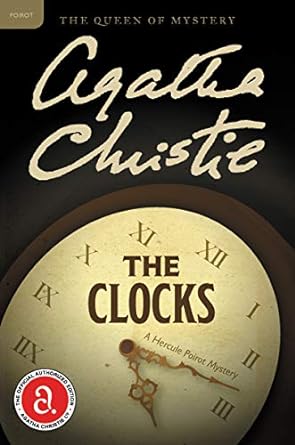
I admit, I didn’t enjoy The Clocks as much as I did Dumb Witness. Nothing against Dame Agatha’s writing; it’s just that this one has elements of espionage in it, and I much prefer domestic crimes rooted in family dramas.
I’m also afraid that my eagerness to try another Agatha Christie over the holidays, I may break my victorious end to the year. I honestly didn’t expect to get through it so quickly, and that may be because, unlike with Dumb Witness, I figured this one had a spy-related solution and so didn’t really bother trying to solve it. At least until just pages before the big reveal, when I realized that, spy elements or no, I simply can’t resist trying to outsmart the Queen of Crime at every turn.
Here’s the set-up: freelance typist Sheila Webb is called to No. 19 Wilbraham Crescent, the home of Miss Pebmarsh, for a last-minute job. The door is unlatched, so even if Miss Pebmarsh isn’t home when Sheila arrives, she should just let herself into the sitting room to the right of the entrance. Sheila does so, and stumbles onto a dead body. As she’s processing the fact, Miss Pebmarsh arrives home. It turns out Miss Pebmarsh is blind, so Sheila warns her about the dead body, and runs out of the house screaming into the arms of Colin Lamb, who happens to be passing by. Colin is “officially” a marine biologist, but is really a spy. He’s friends with Hercule Poirot, who’s retired and kinda depressed, so Colin takes him the case to cheer him up.
Some elements of curiosity:
- Sheila’s boss says that Miss Pebmarsh asked for her specifically, but Sheila doesn’t know why as she hasn’t ever done work with Miss Pebmarsh before. More oddly, Miss Pebmarsh denies making the call in the first place.
- Sheila enters the house at around.3 pm; Miss Pebmarsh’s cuckoo clock chimes the hour. But there are four clocks in the room that are turned to the time 4:13. Miss Pebmarsh denies having those clocks at all. Later, as Inspector Hardcastle is about to take the clocks into evidence, he finds only three.
- Inspector Hardcastle finds a business card on the dead man, but when he investigates, both the man’s name and his company don’t seem to exist.
- During the inquest, Sheila’s co-worker Edna says that something couldn’t have happened the way one of the witnesses says it did. Shortly after, she turns up dead.
Somewhat ancillary to this, but possibly related, Colin is in the area because he’s investigating a person of interest. His only clue is the number 61, the letter W, and a drawing of a crescent. Living at No. 61 Wilbraham Crescent is an engineer who seems shady in that he’s bad at his job, but not necessarily the kind of shady that Colin is looking for.
Through both Colin and Inspector Hardcastle’s investigations, we meet a whole cast of characters in the neighbourhood, including an overworked mom whose husband is away for long stretches of time, a woman with 14 or 19 cats (different characters have different counts), and a few more. Poirot plays armchair detective in this one, literally, relying on Colin to share all possible clues while Poirot’s little grey cells do their work.
And while I didn’t quite put as much effort into solving this case as I usually do with other Agatha Christie cases, I’m somewhat (arrogantly) confident I know what happened. So I’m locking in my guess, with equal confidence that I will be wrong and my lack of interest in spy fiction kept me from picking up most of the relevant clues.
Did I Solve It?
LOL, no not at all. And even when I thought through a significant clue with a 50/50 chance of getting it right, I chose the wrong answer. Ironically, my proposed solution did somewhat touch on the answer to the espionage case Colin was working on, so I guess in this particular story, I turned out to be a better spy than detective!
*** SPOILERS BELOW ***
Continue reading



 Literary Treats