Review | What We Left Unsaid, by Winnie M Li

What We Left Unsaid is a heartwarming family story, about a trio of adult Taiwanese-American siblings driving down Route 66 to visit their parents just before their mother undergoes a major surgery. The Grand Canyon is as much a character as the siblings themselves; they’d taken a trip to the Grand Canyon when they were children, but something happened at a sketchy gas station that made their parents turn back before they reached it. Their mother’s request that they come visit by car on a route that passes by the Grand Canyon is clearly also a request for healing, not just the strained relationships between the siblings themselves, but the unresolved trauma from whatever happened at that gas station all those years ago.

Li gently peels back the siblings’ relationships layer by layer, revealing the sources of the rifts between them as well as the love that keeps going beneath it all. I love how Li pulls back the curtain on the racism and discrimination that Asian-Americans face, from some of the more subtle micro-aggressions that put Bonnie, Kevin, and Alex on their guard, to the flat-out threats that make them and their parents stiffen in fear. Li sets the present-day scenes post-COVID, and so there’s a lot of additional layers to the racism here that are uncomfortably familiar and real.

I also like how Li explores how each sibling’s role in the family helps shape their respective responses to events: Bonnie as the responsible eldest child and eldest daughter, Kevin and Alex both believing they’re the ones their parents see as the screw-up of the family. All these things are shaped by both parental attitudes and societal ones, and I like how their dynamic shifts constantly throughout the story.

Finally, I love the details about the road trip itself. I’m not American and haven’t driven down Route 66 myself, so while I’ve heard of some of the stops, I haven’t ever threaded them all together in the same way an American reader may. I enjoyed learning about the various stops, their characters, and their histories. But more importantly, I love thinking about Asian Americans who’ll read this, and feel connected to their country’s history through the Chu family’s unique lens.

+

Thank you to Simon and Schuster Canada for an e-galley of this book in exchange for an honest review.

Review | With Friends Like These, by Alissa Lee

Alissa Lee’s With Friends Like These is a propulsive thriller. It kept me fliipping pages late into the night and early again the next morning, all because I wanted to find out how things turn out. I also really like how Lee depicts the existential crisis that plagues many of us early 40s millennial women.

The narrator, Sara, and her friends all graduated from Harvard, which should have set them up on a life filled with nothing but success. But reality came to bite each of them in different ways: Sara gives up a high-paying banking job to pursue her dream of becoming a photographer, yet now at 43, money problems have her considering taking on a corporate photography gig instead. Allie has a happy family and a good job in marketing, but she had to give up her dream career as a teacher to get it. Even the friends who seem to have their lives together — Dina, a professor on the tenure track; Bee, a District Attorney running for mayor; and Wesley, a wild child trust fund heiress — seem to have more problems than at first glance. Lee does a fantastic job at revealing details about her characters’ lives layer by layer, and it becomes increasingly clear that none of them have the life they’d really wanted. Speaking as a woman also in my early 40s, that part of the story felt real and raw, and also very relatable.

The mystery part of the story isn’t bad. The five friends are doing one last hurrah of an annual tradition they’d had since college: a “killing” game held the first week of each January. Each woman draws a friend’s name as their first “target.” They “kill” the target by shooting a water pistol, and the person “killed” gives up a medallion with their initials to the “killer,” who then goes on to the next name on the list. Whoever collects all five medallions by the deadline wins that year’s game. Some of the women want to end the game, so they decide to make this their last year, winner take all. And thanks to some savvy investment just after college, the prize is up to almost a million dollars.

Challenge is that Sara starts seeing someone she’d thought long dead: their sixth college roommate, who’d died under mysterious circumstances while playing the game in college. And then some of the women start getting threatening notes telling them to stop the game or else. And for one of the women, the threat turns frighteningly real.

Is one of the players taking the game too far, or is it someone else after them all? The big reveals are easy enough to guess, and the resulting insights about the importance of friendship are just okay. But it’s still a propulsive read; Lee’s writing keeps you turning the pages.

The weak link of the book for me is the hook of the game itself, which required quite a tremendous suspension of disbelief on my part. The trope of a college tradition turned deadly is a fairly common one, and Lee’s version isn’t necessarily more over-the-top than others in this genre. Yet the gameplay itself sounds so miserable that it’s tough to believe this group of friends keeps it going for over two decades in the first place.

The game’s supposed purpose is to make them feel extra-alive, and remind them to live life to the fullest. I can imagine some college kids thinking that will be fun, and maybe even some adrenaline-loving adults. And yes, I can even buy that the real-life consequences (one of them breaks a leg one year, another ends up arrested another year) may be worth the risk of the adrenaline rush.

But the gameplay itself seems so filled with anxiety and so low in high-adrenaline fun that it’s hard to believe they kept it going for so long, especially since most of them didn’t even know about the money until the present-day game. For example, Sara describes herself and her friends as being extra twitchy and with bloodshot eyes, because their “killer” may be hiding behind the corner. Sara hasn’t taken a shower in almost a week, because apparently these friends like “shooting” each other in the shower. They’d even had to set up rules like kids are off-limits (one of the friends went so far as to kidnap another’s children one year) and fake emergencies are off-limits (past games have involved fire alarms and calls about loved ones in hospital). There are more rules created from extreme past behaviour that I can’t remember anymore, but yikes. Without the almost a million dollars cash pot, and with paranoia to the extent that you can’t even feel safe showering in your own bathroom…why would anyone put up with this for so long?

Like I said, it’s a tough sell, but overall a fun read regardless, and a relatable glimpse into some of the struggles of being 40 and realizing you haven’t actually fulfilled all the dreams you’d set out to do.

+

Thank you to Simon and Schuster Canada for an e-galley in exchange for an honest review.

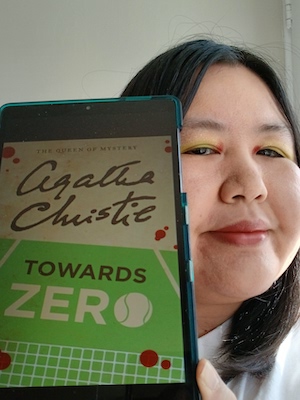
I Try to Solve an Agatha Christie Mystery | Towards Zero (Superintendent Battle)

Okay, I admit it, I’m completely lost. I decided to try solving this mystery because the BBC adaptation was coming to Canada via Britbox this month, and I wanted to try my hand at it before watching the show. I also haven’t written a blog post in a while, and figured that going head-to-head with the Queen of Crime was the perfect way to kick off my blogging year.

Now here I am, 87% in and right before the chapter with the big reveal, and I’m absolutely at a loss. So I’m afraid my 2025 series of Agatha Christie challenges will very much likely kick off with a loss, but on the bright side, I’ve really been enjoying this book, and highly recommend it to any fan of Christie or mysteries in general.

First, it has the elements I love most in Christie’s mysteries: it features a fairly small cast of characters, all of whom have complex relationships with each other, and enough drama amongst them to fuel whatever the motive for murder will turn out to be. At its heart is tennis player Neville Strange, his ex-wife Audrey, and his current, younger wife Kay. From the start, it seems clear that Neville isn’t fully happy with the divorce; he speaks highly of Audrey’s character, expresses guilt over causing her heartbreak, and seems impatient whenever Kay complains about something. The love triangle comes to a head when Neville decides that he and Kay will visit his elderly relative Lady Tressilian (Anjelica Huston in the adaptation!), at the same time as Audrey visits her every year. Instant drama!

Added to the mix are two other men who turn the love triangle into a much more complex polygon: Thomas Royde, a childhood friend of Audrey’s who has been secretly in love with her for years, and Ted Latimer, a dashing young man who is friendly and rather flirty with Kay. Then there’s Mary Aldin, companion and distant cousin to Lady Tressilian, and of course, Lady Tressilian herself, a formidable woman (Anjelica Huston!) who stays in her bed full-time and uses a rope bell to call her maid.

One evening, a visitor, Mr Treves, tells the story about a child he knows who got away with murder (literal, cold-blooded murder) many years ago. That child would now be an adult, and Mr. Treves said they had such a distinctive physical feature that he would surely recognize them even now. Mr. Treves later returns to his hotel, finds a sign saying the lift is broken, and so climbs the stairs to his top floor room. He dies of a heart attack from the climb.

Fast forward a few days (?), and Lady Tressilian is also found dead in her bed, struck in the head with an unknown blunt object. All the evidence points to one of the characters, but of course, the case is never that simple.

I had a vague suspicion of one of the characters from the beginning, honestly for no good reason other than they made the most sense to me for the big reveal. But then they later did something that made me realize they’re actually likely innocent. And then came a flurry of new clues and mini-reveals that seem to make everything clearer to Superintendent Battle, but honestly only made me even more confused than ever. I don’t think that re-reading past chapters, or even my notes and highlights will make anything any clearer for me, mostly because I already did that and I’m still confused, LOL! So, without further ado, I’m going to lock in my answer, and see how I do!

Was I right?

Ahahahaha! No, absolutely not, not even close. I named my choice of murderer below, and a bunch of other suspects I’d discarded as suspects for various reasons. Then I make a joke about how, at this point, I wouldn’t be surprised if it was this one character I never suspected, and of course, that’s who it turned out to be. And of course, their motive makes total sense; I just didn’t see it at all.

So, well played, Dame Agatha Christie. The Queen of Crime has fooled me again. My ego would like to give myself partial credit for at least guessing the motive; I’d just assigned it to the wrong person. But, ultimately, no, I did not figure out whodunnit. So 2025 begins with Agatha Christie 1, Literary Treats 0, and a fun little mystery to kick off spring.

*** SPOILERS BELOW ***

My Verdict

Continue reading