Review | The Fangirl’s Guide to the Galaxy, Sam Maggs

22926684Are you a fangirl? Do you geek out over Star Trek, know every YA novel headed for the big screen, or wish Sherlock and John Watson would just hurry up and get it on already? Let’s be real: when you heard the title of this book, you either squealed with joy or said “meh” and moved on. If you are a fangirl in any way, shape or form, this book is for you.

Here’s a quick proviso: The Fangirl’s Guide to the Galaxy is not an in-depth analysis of all things geeky. Rather, it’s a light-hearted primer into how awesome geekdom can be. Did you know that Disney fans are called “Disnerds”? Me neither, but Maggs’ description of them having “big dreams, big eyes, big hair” made me laugh. I also wish I’d read this book before going to my first convention — the tips on bringing water, a charger, and cash would’ve come in handy. (“Sure, cons have ATMs, but the lines typically stretch all the way back to Narnia.” And worse, by the time you get to the front, the machine may already be out of cash. I’m never making that mistake again.)

I especially love the informal Q&As with celebrity geek girls — and my own fangirly little heart skipped a beat when I saw Kate Beaton was included! Maggs also includes some girl power type chapters on contemporary feminism, which in the light of things like Gamergate, is particularly relevant to any geek girl. Maggs’ message is simple: don’t let anyone ever tell you that you’re not geek enough. And that’s a message worth hearing.

Maggs includes a variety of geeky topics in this book, which is particularly useful for anyone who wants to try out another geekdom. For example, I’ve been intrigued by superhero comic books, but I never knew where to begin. I’ve always found comic book stores pretty intimidating. It’s hard to ask for advice about where to start, when everyone around you appears to know exactly what they’re looking for, and even when you find a series you’d like to try, it’s hard to find a good issue to start with. Fortunately, Maggs includes some book recommendations in her introductions to Marvel and DC fangirls, so maybe I’ll give those a try.

She also includes a chapter on kickass heroines to check out in various media, as well as a list of geek girl-type websites. There are a lot of books, movies, TV shows and websites I haven’t tried out yet, and I can’t wait to get started!

It’s a wide galaxy for fangirls out there, and Maggs provides us with a fun roadmap into what we can do with our fandom.

+

Thank you to Random House Canada for an advance reading copy of this book in exchange for an honest review.
Review | Lost Boi, Sassafras Lowrey

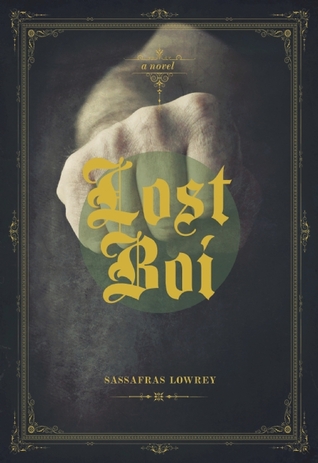
23129755There are books that provide a pleasant way to spend an afternoon. Then there are books that surprise and delight and make you glad you took a chance on it. And then there are books that completely suck you in, plunge you into a world of the author’s making, and refuse to let you go until you turn the last page. Sassafras Lowrey’s Lost Boi is just such a book. Rarely have I been so blown away by an author’s talent, or so immersed in the act of reading that I look up at the real world and have to take a moment to re-orient myself. Much like Lowrey’s lost bois enmeshed in the pirates’ ropes, I found myself held captive by Lowrey’s words, and while it wasn’t necessarily a wholly pleasurable experience, it was certainly a memorable one.

Lost Boi is a queer punk reimagining of Peter Pan, where the choice to never grow up is a choice to adopt a particular kink lifestyle. The conflict between the lost bois and the pirates is a conflict between two particular approaches to kink — the bois rejecting the rigidity of the pirates’ rules and rituals. Battles are consensual play and the enmity between Hook and Pan is much more complex than even they can explain.

Lost Boi contains layers upon layers of metaphor. I love the contrast between the lost bois choosing to live as children, and the pirates adopting an adult lifestyle yet, as Lowrey’s narrator Tootles points out, not quite completely giving up their childhood either. I love how Lowrey translates the various elements of the Neverland mythology into an urban environment, and somehow makes it all seem real. And I love how Lowrey manages the reverse as well — there’s a rough enchantment to the urban landscape and even pigeons can appear to possess some magic.

Kink is a world unfamiliar to me, and to be honest I don’t quite understand the appeal of a D/s lifestyle, especially beyond the bedroom, yet when the bois call Pan “Sir” and agree to wear his cuff, somehow it all just makes sense. And perhaps that’s part of Lowrey’s genius – ze so completely immerses you in Neverland, and is so subtle about explaining the bits and pieces of this world, that you too feel like an insider, like you are just as much part of Neverland as the characters are.

Lost Boi also stands out for me in being possibly the most gender fluid novel I’ve read. It’s tempting to, as I initially did, impose a sense of gender binary on the characters (“bois” are male and “grrls” are female), yet Lowrey’s characters defy such binaries. John Michael is a tomboy who lived with Wendi in a foster home for girls and at least one lost boi is referred to as “she”. Pan himself is referred to as “he” throughout the book but when he meets an adult outside Neverland, the narrator refers to the adult being unsure if he were a man or woman. True to the Neverland ethos, even age is fluid — the bois are referred to as children yet we have no idea how old they really are, and Pan appears a biological adult with muscular forearms, tattoos, and near the end of the story, grey in his hair.

To be honest, I wasn’t sure if I would like this book. It’s described as “punk” and I don’t quite understand what punk is. It’s based on Peter Pan, and while I well understand the desire to remain a child forever, it was never really a childhood favourite for me. Still, I was somewhat intrigued, so I decided to borrow it from the library. I say all this to urge you to give it a chance, even if it isn’t the type of book you usually read. Within the first chapter, I was hooked, and by the end of the book, I was ready to pick up my own copy. It’s that good.

Review | Off the Page, Jodi Picoult and Samantha Van Leer

23278280Off the Page by mother and daughter team Picoult and Van Leer, is a sequel to their earlier collaboration Between the Lines

If, like me, you haven’t read Between the Lines, here’s a quick overview (spoiler warning): shy and bookish Delilah falls in love with a prince, Oliver, in a fairy tale book. It turns out Oliver wants to escape the monotony of fairy tale life himself (he and the other characters have to act out the story each time someone opens the book). They track down the author of the fairy tale, who modelled the character of the prince on her own son Edgar, and by the end of the book, somehow manage to have Oliver and Edgar switch places.

Off the Page takes place a couple of months after. Delilah is thrilled to have her fairy tale prince as a real life boyfriend, until she realizes that the traits she finds so charming about him are also making him the most popular boy in school. The high school queen bee wants him for herself, and Delilah is beginning to wonder if bringing him into her world is worth having to share him with everyone else.

Other complications arise as well. The fairy tale begins sending Oliver messages to return home. Other real life and fairy tale characters accidentally switch places. And Edgar’s mother reveals something that may mean Edgar needs to return to the real world.

This is a fun, lighthearted read. It was entertaining to read about Oliver’s reactions to ordinary things in the real world, and it was easy to see why he was so immediately well-liked. Delilah was a bit more annoying. It seemed selfish of her to be jealous of Oliver’s social success, and her pouty jealousy over an on-stage kiss seemed petty. That being said, I do remember bouts of irrational insecurity as a teenager, so her responses are likely realistic.

What I loved the most was the relationship between Delilah’s best friend Jules and Edgar. They bond over zombies and oddball references, and while Jules’ prickliness could at times be over the top, I did find myself pulling for them even more than I was for Delilah and Oliver.

This is a great book for younger readers. I can imagine myself at ten swooning over the idea of a fairy tale prince coming to life and head over heels in love with me, and then getting all worked up about the circumstances that may keep us apart. The storytelling has a bit of a fairy tale feel as well — a straightforward, simple story line, beautifully illustrated, and featuring a flying dragon, a string of words taking physical form in the air, and a special star you can hold in the palm of your hand. The ending too has a nice, family friendly feel, with a son’s love for his mother being the driving force. There’s an almost Disney-like feel that sets this apart form the grittier, more realistic YA that are very popular these days.

It’s not a Jodi Picoult read by any means — if you’re a fan of her in-depth tearjerkers, this is more an escape from real life than a dive into it. Nor does it completely transport you into the idea of literature as magic — for that, Cornelia Funke’s Inkheart is far more magical.

But it’s a nice read, a great way to spend a lazy afternoon. And if you happen to know a ten or eleven year old bookworm who is a true blue romantic, this would be a great gift.

+

Thanks to Random House Canada for a copy of this book in exchange for an honest review.