
I Try to Solve an Agatha Christie Mystery | Sad Cypress (Hercule Poirot)

Sad Cypress begins with a courtroom scene: Elinor Carlisle is accused of murdering Mary Gerrard. She had several reasons to dislike Mary: first and most hurtful, the man Elinor loves, Roddy, is in love with Mary instead. Then, shortly before her aunt, Mrs. Welman’s, death, Elinor receives an anonymous letter, warning her that Mary, the daughter of Mrs. Welman’s tenants, is after her aunt’s fortune.

Sure enough, one night when Mrs. Welman is seriously ill, she asks Elinor to call her solicitor; she wants to make provisions for Mary in her will. Unfortunately, she dies before the solicitor can be called, and it turns out she never made a will at all. Having died intestate, her entire fortune goes to Elinor, who then honours her aunt’s wishes by giving Mary a generous sum from the estate.

Some weeks later, Elinor is cleaning out her aunt’s estate. She invites Mary and Mary’s friend, Nurse Hopkins, to join her for lunch. And Mary ends up dead, killed by morphine while Elinor and Nurse Hopkins were washing dishes. Elinor is arrested for the death, but fortunately, her aunt’s doctor, Peter Lord, is convinced of her innocence, and enlists the help of Hercule Poirot to prove it.

I loved reading this mystery! I had great fun parsing through the clues, and adding my little kitty sticky notes to pages with clues, ideas, or comments I wanted to mark. Whodunnit feels pretty straightforward; I had a bad guy in mind from the start, and now a few pages from the big reveal, I still think that person’s the most likely culprit.

I admit I was also tempted to let my mind spin out into wild alternative theories. Certainly, there are enough gossipy tidbits and long-ago scandals to throw suspicion on other individuals. But at my last attempt at solving an Agatha Christie mystery, the solution turned out to be simpler than I expected, so I’m going to go against the grain here, and stick with the simplest reveal. I’ll type it below, and then lock it in.

Did I Solve It?

Nope. My other strong suspect turned out to be the killer, but I ultimately ended up accusing someone else. To my credit, I did pick up on a lot of the important clues; I just figured there must have been another reason behind them. Bah, Dame Agatha, you’ve fooled me again!

***SPOILERS BELOW***

Continue reading
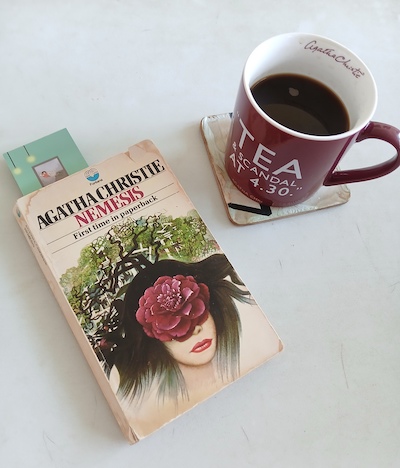
I Try to Solve an Agatha Christie Mystery | Nemesis (Miss Marple)

Mr. Rafiel from A Caribbean Mystery is back, this time with a posthumous mission for Miss Marple: “investigate a certain crime” and after a year, she will be entitled to GBP 20,000 from his estate. “Our code word, my dear lady, is Nemesis,” he writes in his letter. It’s a reference to something she tells him in A Caribbean Mystery and Miss Marple understands it to mean that he’d like her to correct a miscarriage of justice.

Nemesis is only the second-to-the-last Miss Marple novel, but to me, it feels more like her grand finale than Sleeping Murder does. Partly because Miss Marple feels older here. Nemesis has a larger cast of characters than Sleeping Murder, and also involves a physically strenuous walking tour, so there are more people here commenting on Miss Marple’s age and frailty. She plays along with it, as she does to help gather clues, but I also can’t help feeling that she is a bit more physically frail here than usual.

But more importantly, the mystery in Nemesis also feels more grandiose and more of a magnum opus, so to speak, than the one in Sleeping Murder. There are more references to other aspects of Miss Marple’s life: Mr. Rafiel, of course, but also references to her nephew Raymond and her old friend Sir Henry Clithering. And the mystery itself is also such a Mystery. Not just whodunnit and why, but also, what evern was done in the first place?

The journey to get to these answers is wonderfully twisty and complex. And the more I read, the more I realized that the reveal is likely to be really sad, with the kind of insights into human relationships that Agatha Christie is so good at.

First, the cast of suspects is huge. Mr. Rafiel sends Miss Marple on a tour that has fifteen other people on it. Presumably, at least one of those people is involved in the crime Mr. Rafiel wants Miss Marple to solve. Also possibly, could this turn into a Murder on the Orient Express situation, and all of them turn out to be involved?

Just as I was turning over that possibility in my mind (and getting cross-eyed staring at the list of suspects), Christie throws in another twist: Mr. Rafiel has also asked some old friends (a trio of sisters) along the tour route to invite Miss Marple to their home. The official reason is that he wants to give Miss Marple a break from one of the more strenuous days on the tour, but of course, we all know that it’s likely one or more of these sisters is actually involved in the crime.

Gradually, we learn that Mr. Rafiel’s son, Michael, was in prison for murdering a young woman. There were other young women who’d also gone missing and were presumed dead around the same time period, so even though Michael was convicted of one murder, it’s possible he was also responsible for others.

Important context is that Michael was known as a bad guy; he’d also previously been accused of raping another woman. I’ll flag here that characters in this novel express some outdated attitudes around sexual assault and false accusations from victims, which is very much a product of Christie’s time and thankfully no longer widely acceptable. But the basic thrust is that, however spotty Michael’s sexual history is, is he actually guilty of murder? And if he didn’t kill the young woman, who did and why?

And then, while Miss Marple is with the sisters, a member of the tour group is struck by a boulder and sent to hospital in critical condition. Who’s responsible, and is it in any way connected to the young woman’s murder?

Yes! Or at least I mostly did. I thought a second character was involved in the crimes, who turned out to be innocent. But I guessed the killer for the most important crime, and I also picked up on pretty much all the important clues! So I’m going to clock this as practically a win, and laugh at the fact that I actually tried to complicate matters more than Christie herself intended.

Continue reading

Review | The Gallery Assistant, by Kate Belli

Set a couple of months after 9/11, and narrated by a young woman who was actually in one of the towers that fell, The Gallery Assistant is both an art world murder mystery and a novel about navigating a post-traumatic world.

The titular gallery assistant, Chloe Harlow, works for a family-owned art gallery in the Upper East Side. She wakes up one morning with hazy memories of having gone to a party the night before, but no idea how the night ended and how she got home. She learns the answer to the first question when she gets to work: the gallery’s hot new artist Inga Beck has just been found dead, and Chloe may have been the last person to see her alive. As Chloe struggles to piece together what happened that evening, she learns things that makes her wonder who she can trust.

This is a pretty good thriller. I enjoyed getting a glimpse into the fancy art world in NYC, and I was drawn into the mystery of who wanted Inga dead and why. Details like how art auctions work and how much a famous artist’s sketches are worth were fascinating. I also really liked the bit about how anxious the art world was about the state of their market in the wake of 9/11; with everyone so terrified, would they still bid on art? It turns out the answer is yes, which is a relief to the characters, but also could be a commentary on the state of the world. I’m not sure if I’m comforted that rich people can still care about things like art after something like 9/11, or troubled that commercialism can move on so quickly from tragedy.

I also appreciated the little details about what it was like to live in NYC post-9/11. There are a couple of scenes where Chloe’s friend Vik has to deal with racism because of his skin colour. And another scene where a transit delay causes major anxiety for Chloe and other passengers, because, what if it’s another terror attack?

I do feel that a subplot about hidden messages in Inga’s artwork could have been sharpened further. The hidden messages were useful in establishing that Inga knew she was in danger, but I wish the hidden messages actually contained important clues that Chloe had to puzzle out. Apart from one message that put Chloe on the trail of a suspect, the rest were pretty repetitive. Granted, this may be just because I enjoy puzzles in general, so with something as intriguing as hidden messages, I really want more.

The romance also lacked chemistry, and there were references to Chloe sleeping with other characters that just felt kinda random? I’m all for a sex-positive heroine, but this felt more like the literary fiction type of an active sex life, where the encounters feel more empty and perfunctory than pleasurable. The actual romance that develops does play into the plot, but ultimately feels more like a plot device than an actual relationship.

Also, and I admit this is a personal gripe, while I do appreciate the author specifying that Chloe comes home every day to feed the cat even while she’s at her boyfriend’s house for safety reasons, I wish she’d asked the boyfriend earlier on if she could bring the cat over. Being in Chloe’s apartment also puts the cat in danger, and I wish they’d thought more of his safety beyond just being fed.

Overall, this book was pretty good. I appreciated the 9/11 elements, and thought the art world mystery component was interesting. It’s just a quieter, slower-paced novel than I expected, and it quite grip me nor keep me eagerly flipping the pages as much as I’d hoped it would.

+

Thank you to Simon and Schuster Canada for an e-galley of this book in exchange for an honest review.