
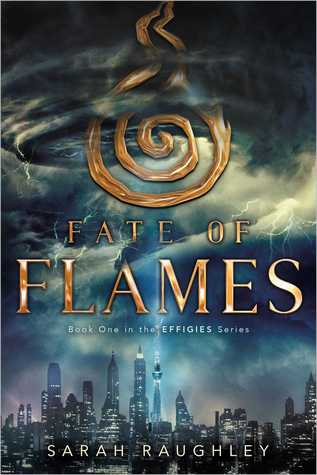
Review | Fate of Flames (Effigies # 1), Sarah Raughley

28954021Touted as Pacific Rim meets Avengers with a Sailor Moon cast,” Sarah Raughley’s Fate of Flames was simply irresistible to this geek girl. Having read it, the book felt more like Captain Planet meets Buffy the Vampire Slayer, but that just be my age talking. The Effigies are a group of four girls, each with the power to control an element (earth, air, water, fire), who are tasked to protect the world from Phantoms. When one girl dies, another is chosen to take her place. Fate of Flames is the story of one such girl, Maia, a lifelong Effigy fangirl who is chosen to become the next Fire Effigy. Not only does she have to live up to the legacy of her legendary predecessor Natalya, whose fourteen years as Effigy is double the expected lifespan, but Maia also has to deal with having power over an element that took the lives of her parents and twin sister June. Added to that are the other three Effigies who can’t stand each other, and the Sect, an agency that manages the Effigies and may have a hidden agenda.

Fate of Flames is an entertaining fantasy adventure that feels very much like the first book of a series. It does a good job in creating its main characters, the four Effigies, as vulnerable superheroes. I like that Raughley makes them all celebrities, and highlights the challenges of living as a superhero under the spotlight. Early on, Maia is afraid of coming out as the new Effigy because she knows people will expect her to save them, whether or not she is ready to do so. The Air Effigy, Lake, is an especially interesting character in this regard, as a singer-supermodel by day. Many people (including Maia before she was chosen) criticize her online for her lack of commitment to being an Effigy, while many other people (her “Swans”) defend her actions and argue for some compassion. This mix of censure and defense is such a true representation of how I can imagine being a public superhero will be in the Twitter age that I can actually imagine Lake in our real world today.

I also like how Raughley makes each of the Effigies vulnerably human. Lake’s perceived lack of commitment to being an Effigy is rooted in her fear of the role. The Water Effigy, Belle, who is perceived by most as the most badass heroine in the group, doesn’t see herself as a hero, and instead is all too aware of the tragic fate that awaits all Effigies. And my personal favourite, Chae Rin the Earth Effigy, is like the Raphael (from Ninja Turtles) of the group, tough and with a violent temper. But her work as an Effigy has distanced her from her family, and a scene at a Montreal circus hints at how much she is affected by this distance. I love this, because in some ways, the Effigies are all badasses who can create fault lines in the ground or create a big enough wind gust to keep a train from falling. But these little notes remind us that they’re all teenage girls, who are trying to work out what being an Effigy means for their real lives.

With this being the first book in a series, Raughley is very clearly trying to build a mythology and to craft a world that will give rise to a much longer story arc. The good news is that there’s a lot of richness to be mined in future books. Unfortunately, somewhat similar to the movie adaptation of Cassie Clare’s Mortal Instruments, there are a lot of elements that end up being juggled and some of it ends up feeling muddled. For example, when one of the characters says that the villain’s actions are unlike anything that the Effigies have ever faced before, the drama of this moment is undercut by the fact that I’m still unclear on what it is that Effigies usually face, so I just have to accept the character’s word that this is momentous and unusual.

In another example, an early scene shows a single Effigy fighting a Phantom, which made me wonder where the other Effigies were. It isn’t until much later that we learn that with a notable exception decades ago, Effigies don’t usually work as a team, but then pretty soon after, we also learn that Maia’s generation of Effigies will be working together and that this makes them unusual. Again, having assumed throughout that Effigies usually fought as a team, I was pretty meh over Maia’s batch uniting as a team. Raughley seems to assume that we know as much about Effigies as Maia does, and while I wouldn’t necessarily have wanted a full chapter detailing the history, a little more background on Effigies up front would have helped.

One particularly frustrating logical hole is a revelation about the villain, which calls into question one of the basic tenets about Effigies. It was presented for dramatic effect and the characters do react with surprise, but none of them appears bothered by a logical inconsistency with the Effigy mythology, and it just irritated me for the rest of the story.

All that being said, Fate of Flames was an entertaining read that sets up some interesting threads to be picked up in future books. There is lots more to be revealed about the Effigies and the Phantoms in the next book, which should be interesting to learn about. I’d especially love to learn more about Rhys, the cute, dorky agent who clearly has a secret but whom I hope turns out to be a good guy.

+

Thank you to Simon and Schuster Canada for an advance reading copy of this book in exchange for an honest review.

Blog Tour Review | Her Nightly Embrace (Ravi, P.I. Book 1), Adi Tantimedh

9781501130571I was excited about Her Nightly Embrace ever since I saw it in the Simon and Schuster Canada blogger email. It’s the first in a new mystery trilogy featuring a protagonist of Indian descent and written by a graphic novelist and screenwriter of Chinese-Thai descent. Even better, it is part of a multimedia approach to storytelling with a TV show and podcast produced by Idris Elba and starring Sendhil Ramamurthy, whom I loved in Heroes. So to be completely honest, I began this book already predisposed to liking it.

And now, having read the book, forget just liking the book. I’m a full-fledged fan girl and am so excited to see how these stories will play out on the screen! Structured to fit the multimedia publication format, Her Nightly Embrace is a collection of four short mysteries, each focusing on a particular case, and all four exploring a larger narrative around protagonist Ravi Chandra Singh’s introduction into life as a private investigator, and in particular a P.I. working at Golden Sentinels, an upmarket London investigations firm staffed by “strays with skills”, “brilliant fuckups with nowhere else to go.”

Indeed, the cast of characters is probably the biggest strength of this series. Ravi is fantastic as the “regular” guy in the group, a failed religious scholar and former high school teacher who sees gods. The very first line of the book reveals his propensity to find gods, usually Hindu, at stressful times, and I love how matter of factly Tantimedh treats this particular skill, simply inserting Kali into a corner tweeting to the other gods about Ravi’s latest exploits. The rest of the staff at Golden Sentinels is even more colourful. My favourite is probably Olivia Wong, a Hong Kong heiress and genius hacker, just because she’s super smart and, yes, an Asian woman, so I’m really excited to see her onscreen. Other memorable characters include: Ken and Clive, a pair of ex-cops who act as the firm’s muscle and who also happen to be a couple; Marcie Holder, an American former publicist; Benjamin Lee, a MacGyver-style techie; Mark Chapman, a stoner; David Okri, a lawyer from a Nigerian immigrant family who often goes with their boss Roger Golden to woo super rich potential clients; and Cheryl Hughes, the office manager and Roger’s right hand woman. With so many characters, it can get a bit difficult to tell them apart in the beginning, but Tantimedh does such a great job in making each of them so vivid that each becomes memorable in their own way.

The cases as well are intriguing. Tantimedh’s writing is funny and fast-paced, and the mysteries suck you in. I particularly love “War of the Sock Puppets,” about a female celebrity who faces online harassment and doxxing for being a feminist, and “The Hideaway Bride,” about a woman from a traditional Pakistani family who goes missing shortly before her arranged marriage. I found both cases particularly relevant, and found myself cheering Ravi and his team on as they investigate. The final case, “The Leaky Banker,” about a banker who fears for her life, had the highest stakes and it was great to see Ravi truly settling into his role and taking charge, but it also had the most traditional feel to it and so didn’t quite stick with me as much.

The titular case “Her Nightly Embrace” had an interesting premise — a politician claims his dead fiancee is haunting him for sex — and I like how the character of the politician evolved over the story, but I admit to being dissatisfied with how something was handled at the end. This is one instance where I thought the episodic format worked against the book, as I felt that in the interest of wrapping things up, the extent of a particular act’s impact in this story wasn’t given due significance for how heinous it really was. That being said, it’s a single glitch in an otherwise enjoyable set of mysteries, and I really like how most of the time, Ravi serves as the voice of conscience to his more experienced colleagues, and in that way probably addresses audience concerns as well.

Overall, Her Nightly Embrace is a fantastic start to this new mystery series. I love Ravi and his co-workers, and I also loved his scenes with his family, which are all hilarious and feel so real. I’m so excited for the next books in the series, and I can’t wait to see how the podcast and TV show turn out! (I have no idea if they’ll be based on the same stories or will have their own, but selfishly, I’m rather hoping for original stories on screen, just so I have more Ravi, P.I. cases to enjoy!)

+

Thank you to Simon and Schuster Canada for an advance reading copy of this book in exchange for an honest review.

Film Review | Effi Briest, dir. Rainer Werner Fassbinder at TIFF Nov 3

effibriest

Image courtesy of the TIFF website

Effi Briest shows at TIFF Bell Lightbox November 3rd at 6:45 pm, as part of Imitations of Life: The Films of Rainer Werner Fassbinder, a retrospective that runs from October 28 – December 3.

Rainer Werner Fassbinder’s Effi Briest, a 1974 film starring Hanna Schygulla, feels very faithful to the format of its source material. While I haven’t read the 1896 novel Effi Briest by Theodor Fontane, Fassbinder’s approach in this film feels so novelistic in its quiet tone that I wouldn’t be surprised to learn that the scenes and dialogue have a one-to-one correlation to the original book. Take for example the opening scene, where the screen shows a still image of a house and a narrator describes the house in great detail and says that across it, “the village street lay still, bathed in the midday sun.” There are also scenes where there is no dialogue, but rather the narrator relays an earlier conversation or the characters’ inner thoughts while the actors move about silently on screen.

This style fits particularly well with the restrictive 19th century social conventions explored in the story, which is about an unhappy marriage told from the perspective of a 19th century woman and has been compared to Anna Karenina and Madame Bovary. Effi Briest’s parents arrange her marriage to Baron Innstetten, a man over twice her age who had courted her mother many years ago. As her mother told her, the marriage would increase her status and let her achieve at 20 what many women do at 40.

Unfortunately, Baron Innstetten is a scary, controlling figure, and rather than comfort Effi when she has trouble sleeping, Innstetten dismisses her fears about a ghost in their home, and worse, Effi later realizes he had been trying to use the ghost to ‘educate’ her. Effi finds a much-needed friend in the handsome and dashing Major Crampas, an acquaintance of the Baron, and as anyone who’s read Anna Karenina or Madame Bovary can predict, this cannot end well.

The main highlight of the movie for me is the performance by Hanna Schygulla, who plays Effi which such lovely innocence that it’s heart-breaking to see her transform from the joyous ‘aerial spirit’ in the first scene to the more restricted, fearful wife and tragic figure that she becomes. I wanted her to find a happy ending with Major Crampas, yet knew she was restricted by the unfortunate reality of her time.

Effi Briest is a beautiful film, and it’s no wonder the book on which it was based was a literary classic.

berlin_alexanderplatz_pts_1-3

Image from Berlin Alexanderplatz courtesy of the TIFF website

About Imitations of Life: The Films of Rainer Werner Fassbinder

Running from October 28 to December 23, Imitations of Life showcases 34 feature films and 2 short films (28 of them presented on 35mm), including several restorations, rarities, and Toronto premieres. From November 22 to January 5 will present Fassbinder’s favourite films in All That Heaven Allows: Fassbinder’s Favourites. This sidebar offers a rich selection of classic films that shaped Fassbinder’s acidulous vision, ranging from Hollywood noirs and melodramas to masterpieces of European cinema. See the TIFF website for a full schedule.

About Rainer Werner Fassbinder

Fassbinder was a German film director, screenwriter, and actor who remains as one of the most controversial, highly praised, and greatly influential directors of postwar cinema. During the 17/18 years of his professional career, he maintained a frenetic pace and completed forty feature length films; two television film series; three short films; four video productions; twenty-four stage plays and four radio plays; and thirty-six acting roles in his own and others’ films. He died in 1982 at 37 from a lethal cocktail of cocaine and barbiturates.

Underlying Fassbinder’s work was a desire to provoke and disturb, he focused on outsiders, his films are populated by misfit characters that often reflected his own fluid sexuality and self-destructive tendencies. His phenomenal creative energy, when working, coexisted with that wild, self-destructive tendency that earned him a reputation as the enfant terrible of the New German Cinema, as well as being its central figure. He had tortured personal relationships with the actors and technicians around him who formed a surrogate family. However, his films demonstrate his deep sensitivity to social outsiders and his hatred of institutionalized violence. He ruthlessly attacked both German bourgeois society and the larger limitations of humanity.

Also at TIFF: Berlin Alexanderplatz : An adaptation of the 1929 novel by Alfred Döblin

In the mountainous ex-con protagonist Franz Biberkopf, Fassbinder found an image of himself, a true alter ego. Fassbinder rarely revealed as much tenderness as he did in his portrayal of Franz’s struggle to go straight after being released from prison, as he is pulled between the embodiments of Good and Evil. Offering some of the most memorable characters and greatest acting in all of cinema, Berlin Alexanderplatz is the summa and summit of Fassbinder’s career.
The first two events in this series will be introduced by Barbara Sukowa, who won the Best Young Actress Award in Germany for her breakthrough role in this wildly controversial and immersive epic.
 +
Thanks to TIFF for a screener of this film in exchange for an honest review.