
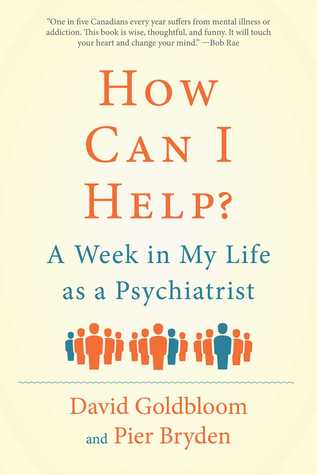
 I’ve long been fascinated by psychiatry, mostly I think because I think people are fascinating and psychiatrists seem to have the uncanny skill of figuring out the workings of people’s minds. Likely, that’s a romanticized notion of the profession, informed by books and movies I enjoy where psychiatrists solve mysteries using their keen insight into the human psyche. The reality is probably less puzzle-cracking and more empathizing with ordinary people who are dealing with difficult conditions. And that’s certainly the impression I get from How Can I Help?, David Goldbloom’s account of a week in his life as a psychiatrist. It’s a compassionate introduction into the world of mental health, and Goldbloom gives us insight into his approaches to treatment as well as debunks some myths around the profession.
I don’t think I’ve ever described a book as compassionate before, but there’s a gentleness in the way Goldbloom relates his encounters with patients that invites the reader to empathize with what they’re going through. Mental health is a challenging subject that still faces a lot of stigma — in one of the chapters, a woman at a conference mentions that she’d survived cancer, then admits she wouldn’t have disclosed a mental health condition quite so easily. There are social media campaigns now (e.g. Bell Let’s Talk) encouraging people to break the silence around their experiences with mental health, and I understand that many mental health conditions are invisible. But I also can’t help but think of people I’ve seen on public transit and the streets, who are acting erratically, and who, I admit, sometimes scare me. How Can I Help? is an important book because Goldbloom speaks about a wide range of patients, from those who keep it hidden to those who become violent, and in each case, he presents the reader with their humanity.
Goldbloom also directly addresses one of the more controversial aspects of psychiatry — electroconvulsive therapy (ECT). He’s a proponent of this treatment and understands that there’s a stigma around it because many people associate it with the version presented in One Flew Over the Cuckoo’s Nest. I happen to be one such person, and this chapter was particularly difficult for me to read. Goldbloom dispels the misconceptions by describing how ECT works and how it helped several of his patients. He also goes into detail about what actually happens during an ECT procedure, which isn’t quite as violent as usually portrayed in on TV. He hasn’t completely convinced me that ECT isn’t a scary procedure, and I couldn’t help but wonder how much pain the patients actually went through or what the long-term effects of this treatment actually are, but the chapter did present a more reassuring depiction of ECT than I imagined and this may reassure some readers. I also wondered if this depiction of ECT only applied to wealthier countries, or if countries like the Philippines, where I grew up, also had access to this technology, and I hope it’s the latter.
I enjoyed the insight he provides into how he approaches each patient, as these broke down their conditions into manageable chunks. Their conditions may never be completely cured, but it was interesting to see how they can be managed on a daily basis. I also really liked the parts where he mentored younger colleagues, as it helped me better understand the reasoning behind some of his decisions.
How Can I Help? is a compassionate introduction into the world of psychiatry that demystifies the profession and addresses issues of stigma around mental health. It focuses on the humans experiencing mental health conditions rather than on the conditions themselves. It also highlights a range of common psychiatric conditions, and notes that approximately one in five Canadians will require psychiatric care in any given year, which is a nice addition to books like Sybil or Silence of the Lambs that focus on more dramatic cases. Finally, it’s about mental health and a psychiatric practice, but it isn’t filled with medical jargon or overly long explanations, so it’s accessible even to readers who aren’t too familiar with psychiatry. It’s a good book and recommended for anyone interested in mental health or in learning more about the daily life of a psychiatrist.
+
Thank you to Simon and Schuster Canada for an advance reading copy of this in exchange for an honest review.

 Lucinda Rosenfeld’s
