 I grew up on Nora Ephron movies. You’ve Got Mail remains one of my favourite romance movies of all time — how often have I dreamed of being Kathleen Kelly, with a charming little bookstore of my own and being swept off my feet by a man who put me out of business but is really the sweetest guy with the biggest heart. (I’m not even being ironic here. Losing a tiny corner bookshop seemed a small price to pay for Tom Hanks falling madly in love with me and giving me a job at his bookstore empire.) Even at the height of instant messaging, however, I could never quite pull off messages like “I love the smell of a bouquet of pencils,” which I figured was the reason the people I spoke to online were never as charming as Tom Hanks.
Nora Ephron defined my idea of romance. Even as my classmates and I swooned over Nicholas Sparks’ stories, it was Joe Fox who remained my ideal man. And if I couldn’t have a bookstore empire, I wanted a man with a son who loved him so much he’d find his father the love of his life over the radio. I wanted this man to love his son back so much, and to be so open to the possibility of love, that he’d meet a complete stranger on top of the Empire State Building for the chance of a fairy tale ending. Even as I grew old enough to realize that romance in real-life doesn’t quite have the soft lighting nor swelling soundtrack these movies promised, these movies continued to tug at my heartstrings, and remain among my notion of romantic ideals.
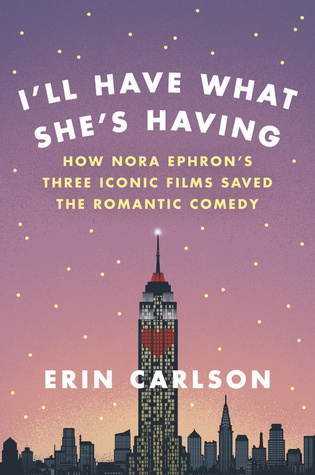
I’ll Have What She’s Having, by arts and entertainment writer Erin Carlson, is about Nora Ephron’s three iconic films (When Harry Met Sally, Sleepless in Seattle and You’ve Got Mail) and how they influenced the romantic comedy genre. Reading this book took me back to my starry-eyed teen years. I loved learning about the stories behind-the-scenes of these three films, and I loved learning more about the life of such a powerful, influential woman in the arts. Carlson writes about the sexism Ephron faced, and the pressures of being one of the few powerful women in Hollywood. She delves into the process by which these films were written and produced; I was fascinated by how the ideas of these films may have come from other writers, but it was Ephron’s comedic genius that elevated them to the classics they’ve become. Carlson also touches on Ephron’s childhood, and how her comedy was influenced by her alcoholic mother’s adage that “everything is copy.”
I particularly love that Carlson delves into how ground-breaking and revolutionary Ephron’s brand of romantic comedy is. Unlike many other movies of the time, which deferred to the preferences of the largely male industry, Ephron’s movies kept female fantasy front and centre. Her movies are defiantly aspirational and tailored for female audiences, and therefore became iconic for generations of women movie goers. For example, in When Harry Met Sally, director Rob Reiner thought he was telling Harry’s story, with Billy Crystal having a bigger role and more lines, but Ephron slyly sneaks in subtle touches that gave Sally a more nuanced character arc, and Meg Ryan picks up on these pieces and steals the show. The movie’s most iconic scene, from which the book takes its title, is all about women’s experience of sex, and the fact that most women have faked orgasms turns out to be as much a revelation to Reiner and the other men on set as it was to Harry.
Even Tom Hanks is very much a woman’s fantasy of the ideal man — caring, sensitive, a single dad who manages to keep a neat houseboat with twinkling fairy lights. Hanks advocated for more traditionally masculine dialogue, and a male production designer stubbornly insisted that a single dad would have a messy houseboat. Ephron fired the production designer and while she incorporated Hanks’ suggestions, her heroes remained highly sensitive and caring versions of the alpha male. Similarly, You’ve Got Mail maintained its Jane Austen view of romance, maintaining its belief in MFEO (made for each other) in a market that included cynical romances like There’s Something About Mary. Carlson’s book details how Ephron championed this brand of romantic comedy, and how her success defied the odds.
The book could have used better editing. The perspective within chapters switched suddenly between Ephron’s life, the behind-the-scenes of her film, and the lives of film stars Meg Ryan and Tom Hanks, and the transitions were random and scattered. At various points, I was just getting into the details of how a film was being developed when the next few paragraph inexplicably talk about an unrelated story like Meg Ryan’s romance with Dennis Quaid before returning to the story about the film. The book seemed a bit unsure throughout about what it wanted to be about, whether its focus was Ephron’s life, the films or their stars. Better editing could have clarified that and pulled the story together more tightly. I read an uncorrected proof, so it’s possible (and I hope this is the case) that the published version has smoother transitions; even section breaks would have helped.
The book also presumes a great deal of knowledge on the reader’s part about the actors’ lives; for example, Carlson writes about Meg Ryan not liking something because it was too much like a character on As the World Turns without explaining Ryan’s connection to the soap opera. It also presumes a great deal of familiarity with the films; I found the chapters about You’ve Got Mail to have the smoothest flow, and I wonder if it’s because I was most familiar with this film and therefore picked up on the various references most easily.
Overall, I absolutely loved this deep dive into the romantic comedies of my childhood. The book gave me a better appreciation for Ephron’s talent and legacy, and made me long to re-watch these classics.
+
Thank you to Hachette Book Group Canada for an advance reading copy in exchange for an honest review.

 Twelve year old Daisy Tanenbaum is sent to live in Paris with her cool code breaker aunt, and gets embroiled in a spy caper involving the Queen’s Diamonds. Daisy in Exile is very much targeted to the middle-grade crowd, and includes an entertaining series of hijinks as Daisy and her Parisian friends — a cat burglar from the wrong side of the tracks named Sief and a beautiful, stylish teen named Nina — race around the city and through the sewers to escape Russian spies.