
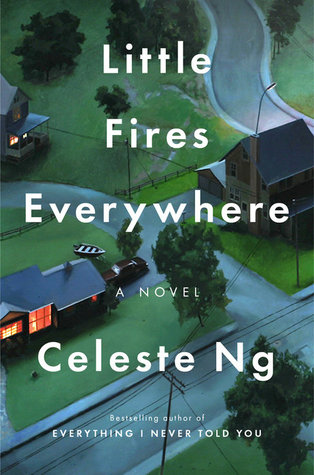
Review | Little Fires Everywhere, Celeste Ng

34273236Celeste Ng is fantastic at nuanced family drama and in Little Fires Everywhere, she gives us a rather intimate glimpse into the lives of two very different families over the course of a summer. First is Elena Richardson and her children, the youngest of whom, Isabelle, burns down the family home in the very first line of the novel. Elena has a second house that she rents out to Mia Warren, an artist and single mother who moves in with her teenage daughter Pearl.

In the Richardsons, Pearl finds the stable, traditional family life she’s always longed for, and in Mia Warren, Isabelle finds the free-thinking open-minded mother figure she’s always wanted. A misunderstanding involving Pearl and the Richardson children leads to a rift between the families, and a custody battle over an adopted Chinese-American baby puts Elena and Mia on opposing sides.

Little Fires Everywhere is such a complex, emotional book that questions what we consider to be family. The custody battle was the crux on which many issues about biology versus stability, and the many different ways we can love, were openly explored, but the same themes were echoed in the Warrens and Richardsons’ stories, as well as in Mia’s past. Ng manages to weave her various storylines together, and while I wasn’t completely satisfied by the ending (I wished for happier closures for some of the storyline), I was satisfied by the story overall. Ng’s characters were well fleshed out, and whatever we felt for their actions, they felt real.

The custody battle is a good example of this complexity. I felt the narrative wanted us to side with the birth mother, particularly as her lawyer waxed eloquent about the adoption essentially divorcing the child from her Chinese heritage. But while I felt for the birth mother and acknowledge her genuine regret at leaving her baby behind at a fire station, I felt even more strongly for the adoptive mother, who clearly also loved the baby and was being raked over the coals in the courtroom for not reading enough good Chinese stories. I think part of me felt the birth mother’s ‘mistake’ (leaving her baby behind because she couldn’t afford milk and diapers) was far more serious than Mia and the lawyer made out, and I’m not fully satisfied with how this storyline turns out, but I like the emotional complexity with which Ng presented this storyline, and how she made it resonate with the Warrens and Richardsons’ stories as well.

Far from its explosive opening sentence, Little Fires Everywhere is a slow burn of a novel, teasing apart layers of its characters’ lives and weaving them together. If you liked the simmering tension and sensitivity of Ng’s earlier book Everything I Never Told You, you should definitely check out Little Fires Everywhere.

+

Thank you to Penguin Random House Canada for a copy of this book in exchange for an honest review.
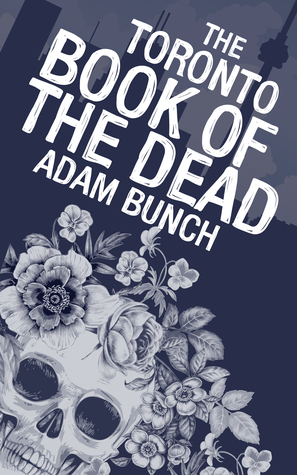
Review | The Toronto Book of the Dead, Adam Bunch

32978831It’s fitting that the foreword to The Toronto Book of the Dead is written by Shawn Micallef, as anyone familiar with Micallef’s books and Toronto Star column can attest to his absolute love of Toronto and its stories. Adam Bunch shares a similar glee at nerding out over Toronto’s history, in this book, a history of stories related to death.

Stories include: the horrific botching of Toronto’s first execution (the city had no professional executioner, so a fellow prisoner volunteered for the deed); the mysterious fate of Peggy Pompadour, an escaped slave, and her family (check out artist Camille Turner’s work for a deeper dive into this story); the refusal of French colonizers for their dead to be honoured with Indigenous burial rites; and many more.

The cover is fantastic, and to be honest, made me expect a collection of horror stories, somewhat of a haunted Toronto walk led by horror writer Andrew Pyper. The reality is a bit more fact-based, a lot more dry and a lot less scary. Bunch is a good writer and clearly very much interested in his subject matter. It’s a great book for history buffs, Toronto buffs, and tourism professionals looking for a quirky tale to keep in their back pocket for tourists. Or perhaps horror writers looking for inspiration for their next Toronto-themed novel?

The stories themselves are fairly introductory; the book’s strength is in breadth rather than depth. History buffs will likely learn little new about people and time periods they’ve already studied, but they may be entertained by the range of other stories covered. Reading the book feels somewhat like taking a tour of Toronto, with a very knowledgeable tour guide who knows the more somber parts of the city’s past.

This book wasn’t quite for me, though that’s likely more because of my own expectations than the quality of the book itself. I can imagine myself nerding out over this book years ago, when I was fairly new to Toronto and eager to devour all knowledge about the city, or when I was a university student and just generally nerding out about all things historical. So I can imagine it appealing to other readers; it just didn’t quite hold my interest.

+

Thank you to Dundurn Press for a copy of this book in exchange for an honest review.

Review | The Shoe on the Roof, Will Ferguson

35619568The Shoe of the Roof is a thought-provoking read about faith and the thin line between madness and reality. It begins with med student Thomas Rosanoff’s plan to win back his girlfriend. His girlfriend’s brother Sebastian is confined to a psychiatric institution because he believes he is the son of God, and Thomas decides that if he cures Sebastian, his girlfriend will fall back in love with him.


How does one go about convincing someone that he isn’t actually Jesus? Thomas’ hypothesis is that if he introduces Sebastian to two other men who claim to be Jesus, they will sort out among themselves that three Jesuses can’t exist all at once, and so at least two of them will have to cure themselves of their delusion.

It makes an odd kind of sense, and as I learn from one of the characters in the book, there’s precedence for this kind of cure, as it worked in the past for two women who both believed they were the Virgin Mary (the older one eventually acquiesced to the younger one’s claim). However, things don’t quite go as planned, and Thomas ends up with all three men claiming to be Jesus — Sebastian, a screaming patient named Eli and a homeless man who did street magic — living in his apartment. Things escalate further when Thomas’ father, a psychiatrist who conducted psychiatric experiments on Thomas as a child, gets involved with a much more heavy-handed approach at a cure.

The title is taken from an anecdote cited in the book, where a person claims to have had an out of body experience, and mentions seeing a shoe on the roof, which doctors realize wasn’t at all visible from the vantage point of their physical body. It is this interplay of faith and reality that makes Shoe on the Roof so powerful a read. We know none of the three men claiming to be Jesus actually are Jesus, but that doesn’t automatically mean they should all be dismissed as madmen. The ethics of Thomas’ experiment are questionable, but it’s nothing compared to the cruelty of his father’s cure.

Thomas’ approach is to reason with all three men, for example, arguing that Eli couldn’t be Jesus because he was born in Connecticut, which wasn’t at all mentioned in the Bible. (The way the three men prove him wrong on this is probably the funniest part of the novel.) It’s an approach that in turn allows us to hear the men’s perspectives, and why they’re convinced that they are Jesus. I admit that my Catholic background played some part in my reading of this book, as a part of me wondered if any of the men (likely the street magician) would end up being, if not Jesus himself, at least a Jesus figure who opens Thomas’ eyes to the possibility of faith.

While this didn’t quite happen, I think Ferguson’s more secular take actually formed a much more compelling argument than I had expected. It’s not so much that their belief in their being Jesus is harmless as that it is actually harm reducing. There’s a heartbreaking moment where one of the men observes that without this delusion, the others would be left with nothing to live for. Ultimately, we almost want them to have the freedom to hold on to this delusion, if indeed their madness is so much more compelling than their reality.

This becomes especially true with Thomas’ father comes on board, and deploys torture techniques (starvation, sleep deprivation, videos with disturbing content on loop) to get the three men to recant their claim. His assertion that behaviour will lead to belief has merit, but his methods are seriously messed up, and these chapters are actually difficult to read as I wanted nothing more than for Thomas to break the men free.

The flashbacks about Thomas’ childhood are equally disturbing, and I can’t believe his father wasn’t arrested for how he treated his child. There’s a memory that teases at the edges of Thomas’ mind, of a piece of choral music that he feels is linked to his mother but isn’t quite sure how. The moment where he learns the truth is utterly heartbreaking.

Overall, this is a powerful and compelling book that forces you to reconsider what madness is, and how a insidious a ‘cure’ can be.

+

Thank you to Simon and Schuster Canada for an advance reading copy in exchange for an honest review.