
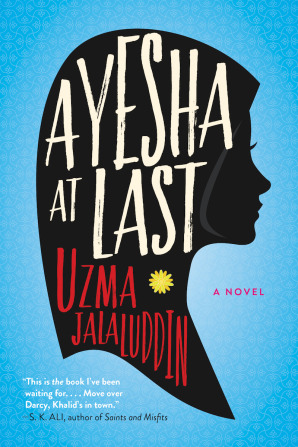
Review | Ayesha at Last, Uzma Jalaluddin

36099237
Oh. My. God. This book. I zipped through it in a day, fell completely in love with all the characters, and already I want to read it again and tell all my friends to read it to. (Read this book!)

Ayesha at Last is a modern-day retelling of Pride and Prejudice set in a Toronto Muslim community. I’ll be honest: I wanted to read this book because it seemed like a fun contemporary romance and I want to support diverse authors and diverse stories. But I’m a bit tapped out on Jane Austen retellings, and Pride and Prejudice in particular has been done to death.

But then I read this excerpt on the publisher’s Facebook page, and totally fell in love with the writing. I wanted to read more. I was intrigued by the fact that it was Khalid whose mother was trying to marry him off, and not Ayesha, and I laughed at the image of a travel mug falling off a car roof as Ayesha drives off.

Then I met the author and got a copy of the book at a Harper Presents event, and loved what the author said about the character of Khalid popping into her head and refusing to leave until his story is told. (It took 8 years!) Khalid is a romantic hero I don’t think I’ve ever read about before — he’s super conservative, dresses in a long white robe and skullcap and has a beard. Jalaluddin reimagines Darcy’s arrogance as super conservatism — the infamous moment where Darcy rejects Elizabeth Bennett is here reimagined as a super judgemental moment where Khalid dismisses Ayesha as not being a good Muslim because she happens to be in a bar and holding cigarettes. (Even though she’s drinking a virgin cocktail and the cigarettes aren’t hers.) And Elizabeth’s prejudice is here reimagined as Ayesha immediately deciding Khalid is a “fundy” with very rigid views on morality. (She later realizes she made some unfair assumptions partly based on his appearance.)

I loved the character of Khalid, and how his sometimes off-putting behaviour is contextualized by his really strict adherence to religious doctrine and more importantly, by his social awkwardness. I love that Jalaluddin avoids easy categorizations for her characters — Khalid happens to be a conservative Muslim, but there are many other Muslim characters, including Ayesha herself, who show varying degrees of adherence to religious practices. Even better, it’s Khalid’s inflexibility and snap judgements that are shown to be his faults, and not his conservatism per se. In fact, his faith and dedication to his community’s mosque are among the qualities that make Ayesha fall in love with him.

I also love the character of Ayesha, who is a substitute teacher by day and performance poet by night. At 27, she is considered a spinster for the rishta (arranged meetings between potential brides and grooms) market, and she’s okay with that, because she’s focused on her career. I related so much to her first day at work, and I absolutely love her family, with the Shakespeare-spouting grandfather, amateur detective grandmother and flighty cousin Hafsa, who wants to start an events company and is determined to have 100 rishtas before accepting a proposal.

I love the subplot about the mosque fundraiser that brings Khalid and Ayesha together, and the mistaken identity chaos that started out funny but turned out to be rather heartbreaking. I also really like the subplot around Khalid’s co-worker Amir, and how a man who seems like such a dudebro at first turns out to be dealing with much deeper issues. The moment when he opens up to Khalid was such an eye opener to me as well, and made me realize how much I wrongly assumed about him myself, based on his behaviour.

I especially love the subplot about Khalid’s workplace, where his racist boss plots to have him fired. I felt really bad for Khalid, and grateful for Amir’s support. But also I love the character of Clara, the recently-promoted HR Manager who also happens to be Ayesha’s best friend. She has to straddle the delicate line of protecting Khalid’s right to practice his religion while avoiding getting fired herself.

There are certainly familiar story beats from Pride and Prejudice throughout, but Ayesha at Last is such a great read mostly because of the elements that distinguish it from Austen’s original. I love the glimpse into the world of rishtas. I love the family dynamics amongst the characters, and the workplace dramas as Khalid deals with racism and Ayesha has to figure out what it is she really wants to do. Khalid and Ayesha have the cutest romantic chemistry, and I was cheering on their love story all the way.

This is such a fun, compelling book, and I highly recommend it for anyone who enjoys contemporary romance.

As a side note: any chance for a spin-off romance starring Clara? I think she can do much better than her boyfriend, and while I love the cute way her romance subplot wrapped up, it also felt rather abrupt. Basically: I just want more from Jalaluddin, and I’m already eager for a sequel.

+

Thank you to Harper Collins Canada for a copy of this book in exchange for an honest review.

Author Encounter | Karma Brown, Tish Cohen and Uzma Jalaluddin

HCCevent

When I saw the descriptions for the books at Harper Collins Canada’s June 21st Summer Reading event, I knew I had to be there. It was a wonderful opportunity to check out Harper Collins Canada’s beautiful new office (which has huge windows and an incredible view of downtown Toronto), and learn about some of the hottest books this summer.

IMG_3046

Karma Brown, Tish Cohen and Uzma Jalaluddin were all very warm and friendly. They spoke about their books, their writing process, and the importance of having friends who are also writers to support you in your work.

Writing Advice

The authors had a lot of great advice for aspiring writers. Some highlights below:


1. Write at your own pace.

Uzma said Ayesha at Last took 8 years to write. She’s a teacher and a mother as well as a writer, and there were times when she’d put the work down intending to get back to it soon, then not get back to it until a year later.

2. Don’t be afraid to start over.

Karma said she had written about 20,000 words of her manuscript when she realized it wasn’t working. So she took two shots of bourbon and decided to start from scratch. (Mini-tip: bourbon helps!) Luckily, that was about the time she heard about a case of someone with false memory syndrome, and she realized she had the hook she needed for her novel.

3. Develop your voice.

Language is a huge part of being a writer, and Tish said that developing your distinct voice as a writer is essential. “It’s what sets you apart from other writers,” she said, and it’s true. It’s hard to come up with a story that hasn’t been told before, but if you can tell it in a way that’s uniquely your own, the story can still feel fresh.

4. The first draft will never be perfect.

The writers agreed that before they started writing, they thought what you read on the page is how the author conceived of the story from the beginning. But the reality is, the final product has already gone through countless revisions, and often bears very little resemblance to the very first draft. Karma and Tish talked about the importance of listening to your editor, as they’ll often have almost as deep an understanding of your book as you do.

Uzma, as a debut author, talked about how it was like to revise her work even before she found an agent and editor. She said she wrote the very first draft of Ayesha at Last in three months, and was very proud of herself, until she showed it to some friends and learned that “it sucked.”

All three authors also talked about books they’ve written that they know are bad and will never submit for publication. They said every author likely has at least one similar manuscript at home, and it just reinforces how much work is done before a book is ready for publication.

5. Find a writing community.

All three women talked about how important it was to find other writers to support them as they wrote. Your non-writer friends and family can be supportive, but they won’t understand your frustration and insecurities as much as a fellow writer can.

Uzma highly recommends signing up for a writing class and making friends on Twitter.

Karma said she found writer friends by entering writing contests online. She said she writes at 5 am every morning, and that there’s a Twitter hashtag for authors who write at the same time, for them to support each other and cheer each other on. She also adds that if 5 am is too early for you, you can also try writing at midnight.

Tish added that everyone is at different points in their writing journey, and that writers are often very supportive regardless of where you are in your own journey. “We’re not scary,” she said. Karma agreed, adding that they’ve received so much support themselves from other writers that they’re often happy to pay it forward.


About the Books

All the books sound fascinating, and immediately made it to the top of my To-Be-Read list!

IMG_3044

1. The Life Lucy Knew by Karma Brown

After a head injury, Lucy wakes up to find she’s developed a condition called ‘false memory’ or ‘honest lying.’ Apparently, it’s a true, but rare condition, where your mind cobbles together real bits of memory to create false ones, and it’s impossible to tell which memories are real and which aren’t. Unlike amnesia (a common literary device where another head injury brings the memories back), this condition is permanent. How do you live with that? How does it impact your loved ones? And how can you find someone you trust to tell you whether something you remember actually did or didn’t happen? In Lucy’s case, she wakes up convinced she’s married to a man (who’s actually an ex-boyfriend), but learns she’s actually not married, and her current boyfriend is someone she knows only as a co-worker.

2. Little Green by Tish Cohen

Olympic athlete Elise Sorensen confronts long-simmering marital tensions when she and her husband Matt go to Lake Placid to sell off Matt’s family’s cabin. Matt is a lawyer who has made huge sacrifices in his career to be the primary caregiver for their daughter Gracie.

3. Ayesha at Last by Uzma Jalaluddin

A modern day Pride and Prejudice in a Toronto Muslim community. Enough said.

+

Thank you to Harper Collins Canada for a fun event, and copies of the featured books.

Review | 84K, Claire North

3551197584K has an interesting concept, and one that will certainly resonate with a lot of readers. Unfortunately, the execution fell short for me. I gave it a month and several attempts because it was an ARC for review, but then ultimately decided it wasn’t for me at all. I found the shifts in timelines to be confusing, and I found myself quickly irritated by the coyness around the main character’s true identity. His name is Theo, but he wasn’t born Theo. He actually took on his college friend’s identity at some point for some reason I never bothered to find out, but what irritated me was how all this character was so often referred to as ‘the man who wasn’t born Theo.’ We get it; just assign him a name already and be done with it. I DNF’d (did not finish) at page 92 out of 480 — to be fair, this is around the time the action started picking up, but I realized I no longer wanted to read further.

That being said, I also realize other readers may likely enjoy it more than I did. It’s very high concept dystopian / social satire / speculative fiction, and certainly tackles very relevant issues. In the world of 84K, crimes literally come with a price tag. If you’re rich enough to afford the fine ($84,000 for murder), you can literally get away with murder. North drives this point home with chilling precision when an assassin-for-hire calmly calls 911 to confess to a murder, and waits for the police to pick them up because they know their employer will pay the fine. Conversely, if you’re too poor to pay the fine, you could get a heavy sentence for shoplifting.

Theo works at an agency that processes the fines for crimes. I thought this was compelling — I can see how soul draining such a job can be, and there was a strong passage where Theo had to process the payment for a murder while at the same time process the sentencing of a woman convicted of shoplifting something petty from a store. North often depicts Theo’s workday in terms of costs, listing the amounts for the various types of crimes, and while this felt tedious to me at times (possibly part of North’s point?), it’s also a chilling reminder of how dispassionately crimes are viewed in this world.

The story picks up when a woman is murdered and leaves behind a daughter she claims is Theo’s. The daughter is lost somewhere in the foster care system — similar to North’s rather pointed take on the justice system, the foster care system in 84K is similarly hellish. Foster children can be used by parents to make profit, mostly by selling off their services for entertainment purposes. This is what happens to this daughter, and part of why the mother, before she was killed, was so invested in trying to find and rescue her.

Conceptually, it’s very compelling, and I think readers who enjoy more cerebral speculative fiction may enjoy it. It just really wasn’t for me.

+

Thank you to Hachette Book Group Canada for an advance reading copy of this book in exchange for an honest review.