
Unknown's avatar

About Jaclyn

Reader, writer, bookaholic for life!

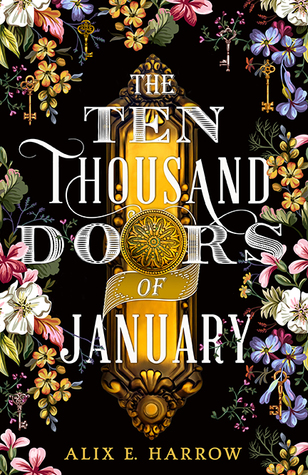
Review | The Ten Thousand Doors of January, Alix E. Harrow

43517459._SY475_Imagine a world where Doors in random locations can transport you to another place, another time. Imagine being a seventeen year old girl whose father has disappeared and left behind only a notebook with a story that seems fantastical but turns out to be true. Imagine being that girl, being Black in the early 1900s, under the care of a wealthy white guardian with ties to a shady global organization that smuggles priceless artifacts around the world. And imagine searching the world for your father while being on the run from this organization. It’s a fascinating, exciting premise, and at first glance, The Ten Thousand Doors of January is exactly the kind of fantasy novel I’d eat up.

Unfortunately, I was bored for most of the book, and kept going only because I’d requested it for review. I should preface that by saying that the writing is good; Harrow has a languid, lyrical narration style that reminds me of classic children’s stories. She also has beautiful, vivid descriptions. I can imagine other readers falling under the spell of her writing and being completely captivated by this story.

I found it too slow, and too much in love with far too many details. The story begins with a meditation on the nature of Doors, and linked to that, the beauty of words and the letters that make up words. It’s a love letter of sorts to language, and it ends up fitting with what we later learn of how Doors work, but it went on far too long for me. And while I can imagine some readers being charmed by the passage that goes into detail on the aesthetics of a single letter, I just wanted to get on with the plot.

The nature of Doors opening up to other worlds and other times offers many wonderful opportunities to explore beyond the more mundane world January grew up in, but I think there were just too many diversions, and too little of a connecting thread for me. There was a section about a place where the birds release only one feather a day and it’s such a valued item that residents chase the birds for the privilege of receiving that single feather for the day. It’s a lovely passage, and fits in beautifully with the fantastical nature of the setting, but it just didn’t move me. I think it’s partly because the settings aren’t quite fantastical enough to fully take me out of reality (like Narnia might have), yet not quite grounded enough to make me care on a rational level.

I do like the way January has to figure out how to navigate the world as a Black girl within a primarily white, wealthy community. I like how the author shows the pity and condescension her guardian and his friends subject her to, all within a veneer of politeness and affection.

I also really like the story written in the book January’s father left her. I love the romance between the Black scholar and the wealthy white adventuress, and I especially love how their relationship developed over time. I found myself hooked by that story far more than by January’s, and I wish it could have gone on a bit longer than it did.

The subplot about January’s father travelling the world had promise, especially with how it linked up to the shady group of wealthy men who want to steal valuable artifacts from around the world for their own collections. We see a bit of this group with how they chase after January, but honestly, I wanted to read a lot more about their operations, and any of the various external forces who are surely trying to take them down.

Overall, Ten Thousand Doors has an intriguing premise, and will likely charm many readers, but it just wasn’t for me. I think I would have preferred a swashbuckling romance adventure from Yule the scholar’s perspective, or an international crime-busting thriller on the smuggling organization, or perhaps a more fully fantastical, magical narrative.

TW: animal cruelty (I almost DNF’d the book after that scene)

+

Thank you to Redhook Books for an e-galley of this book in exchange for an honest review.
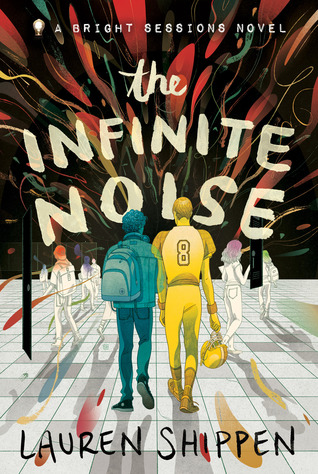
 

Review | The Infinite Noise, Lauren Shippen

43263239What if the X-Men, instead of becoming superheroes, went to therapy? That was the publisher’s hook for The Infinite Noise, and it definitely hooked me in. The X-Men franchise does a great job of showing how mutant powers can isolate people, and can cause them to experience discrimination and fear from a world that’s largely non-superpowered. Lauren Shippen ups the stakes in this novel by setting this experience within high school.

Caleb Michaels is a super empath, which means he not only senses what other people are feeling, but actually experiences the same feelings himself. That’s a tough enough condition for any human being, let alone one who is surrounded by all the heightened emotions and angst of high school. Fortunately, he comes to befriend Adam, a classmate whose presence can somehow make Caleb’s experience of his powers more manageable, and eventually the teens fall in love.

I love The Infinite Noise’s depiction of mental health. Caleb’s power means he experiences a range of very intense emotions, and it’s difficult for him to distinguish which feelings are his own from those of other people. Rather than simply becoming all angsty about it or turning vigilante as many superhero narratives go, Caleb instead sees a therapist, Dr Bright, who specializes in treating Atypicals (people like Caleb who have superpowers). While Caleb’s powers are certainly unusual, his experience of being overwhelmed by emotions is something that I think many readers may be able to relate to, and I love that Shippen shows us how a good therapist like Dr Bright helps Caleb manage his condition.

Adam also lives with depression, and because of Caleb’s empathy, we see how a depressive episode can feel, from the perspective of someone who isn’t familiar with the condition. This chapter felt very real and raw, and I love how Caleb’s response is simply to be with Adam and ride out the episode with him.

The romance between Caleb and Adam is really sweet. I love the tension created by Caleb’s reluctance to tell Adam about his powers, and by Adam’s insecurity over Caleb’s feelings for him. I love the openness and honesty in the conversations Caleb eventually has with Adam, and also in the conversation Caleb has with a girl who has an unrequited crush on him. Caleb’s responses feel remarkably mature for a high school boy, and perhaps that’s an offshoot of his power of empathy.

The Infinite Noise is the first book in the Bright Sessions series, which in turn is based on a podcast by the author. It’s this connection that ends up weakening the book for me, and possibly for other readers who haven’t listened to the podcast. There are characters and plot threads that are sprinkled throughout the story, but end up not really going anywhere, and I figure that’s because their role ties into the larger Bright Sessions universe rather than within this novel itself. For example, late in the book, Caleb and Adam meet a couple of Dr Bright’s other Atypical patients, one of whom seems really shady. The other, non-shady patient ends up befriending Caleb and Adam, and helping advise Caleb a bit on living with Atypical powers, but their role ends up being fairly minor. And the shady character all but disappears after a single scene, which is too bad because their personality seems far too intriguing for a mere cameo.

Another plot thread that turned out somewhat disappointing is the suspicious link between Adam’s parents and a villainous organization that experiments on Atypicals. There’s a lot of build up about this connection, and a lot of set up for Caleb and Adam having a forbidden romance because of it, but this plot point ended up not having as significant a payoff as I expected. Again, it felt like a seed being planted for the larger universe, and possibly a reference to a familiar villainous group from the podcast, but it falls short within a standalone.

Overall, I enjoyed The Infinite Noise, its sweet romance, and its depiction of empathy, emotions and mental health. Even the elements I thought fell flat will likely delight fans of the podcast who are more aware of their larger-scale significance.

+

Thank you to Raincoast Books for an advance reading copy of this book in exchange for an honest review.


Review | The Farm, Joanne Ramos

41398025I read The Farm expecting a Handmaid’s Tale-type dystopia. I expected a world where women are reduced to baby-making machines and must rise up against an oppressive patriarchy to regain their freedom. I was interested in the book because of the Filipina immigrant main character (Jane, a young single mother who lives in a boarding house with her baby and her cousin Ate Evelyn), but otherwise, I thought this would be yet another dystopia in a long line of the genre. Fortunately, I was proven wrong.

The Farm absolutely blew me away. It’s not so much a dystopia as it is a character study, of how the same set of circumstances can have such a wide variety of impact on the people involved. The novel delves into questions of race, income disparity, family connections, and what it means to be an immigrant far from loved ones back home. I fell in love with the characters, was fully riveted by their stories, and found it hard to put this book down. The Farm is easily one of my favourite novels of the year.

The novel revolves around Golden Oaks, a resort for women who are hired to be surrogates for wealthy families. Some of the women like to believe they’re participating in a higher calling — providing the gift of parenthood for families who cannot otherwise have children — but most of the women are simply in more desperate life circumstances and require the money. As an unemployed single mother, Jane realizes that this job could help her gain the financial stability she so desperately wants for her daughter, and jumps at the chance when Ate Evelyn suggests it. Once she’s at Golden Oaks however, Jane realizes that being away from her daughter is much harder than she imagined, even with her daughter in Ate Evelyn’s more than capable care. And she also gets caught up in events that may make keeping her job more complicated than she anticipated. Her emotions are raw and intense, and very relatable to readers who may need to make personal sacrifices to provide for loved ones.

What makes this novel so powerful however is that Ramos doesn’t just limit us to Jane’s experience. Rather, we also see the perspective of Reagan, an idealistic college graduate who wants to become independent from her wealthy family. Because Reagan is white and highly educated, she is considered a ‘premium’ host, meaning that wealthy families are willing to pay more to have her bear their child. Beyond that, she is also treated as a VIP among the hosts, and Golden Oaks director Mae Yu goes to great lengths to keep Reagan happy and feeling like she’s contributing to a greater cause. I love that Ramos delves right into the racism at Golden Oaks, and outright tells us that clients prefer white hosts, but due to financial need, there are many more Black and Latinx hosts available. Reagan, along with other ‘premium’ host Lisa, are able to get away with much more in terms of rebellious behaviour than hosts who are women of colour can. I also find it telling that Jane’s relative lack of power at Golden Oaks isn’t so much a factor of race (Asian hosts are relatively high on clients’ wish lists), as it is her limited financial and social supports. So I love how Ramos explores the intersectionality of her characters’ identities.

The novel also gives us the perspective of Mae Yu, the Chinese American director of the resort, and I love that Ramos doesn’t fall into the easy way of making Mae purely a villain. She does go to great lengths to keep her hosts in line, and amongst the characters, she’s the most overt about seeing the hosts as assets more than as women (even the clients at least pretend to care about the hosts’ humanity). But we also see how hard Mae has to fight to earn her place at the mostly white and male networks of power. Her ambitions constantly come up against structural inequalities, and throughout the novel, we feel how tenuous her grasp on power is. There’s a trace of desperation and fear in even her most ruthless plans, and while she never quite becomes a ‘good guy,’ she remains a sympathetic character.

Finally, Ramos also gives us Ate Evelyn’s point of view. Of the four narrators, Ate Evelyn is perhaps the one most straddling the line between hero and villain. We see her love for her family, and we also see her willingness to cross ethical boundaries for some extra cash. We learn her backstory, about the family she left behind in the Philippines and still needs to support, and ultimately, the impression she leaves is that of a complex, flawed, and wholly sympathetic human being.

The best dystopias do highlight the human element, and in that, perhaps The Farm is a dystopia after all. But while it tackles some urgent and relevant subjects, the overall tone doesn’t have the urgent call to action that many contemporary dystopias do. Rather, The Farm invites readers to linger, to delve deep and fully experience every moment we have with these characters. The women in this novel are all wonderfully flawed and human, and also somewhat heroic in their own ways. It’s a heart-wrenching, thought-provoking, powerful novel. I highly recommend it.

+

Thank you to Penguin Random House Canada for a copy of this book in exchange for an honest review.