

Unknown's avatar

About Jaclyn

Reader, writer, bookaholic for life!

Review | Epically Earnest, by Molly Horan

EpicallyEarnestBeyond a few nominal nods to character names and social standings, Epically Earnest bears little resemblance to the Oscar Wilde play that inspired it. Algie does share the rakishness and devilish wit of Wilde’s Algernon Moncrieff, and heroine Jane does share Jack Worthing’s origin story of being an abandoned baby. But all of Wilde’s madcap plot points, particularly the hilariously incredulous notion that both heroines in his play have such a love for the name Ernest, have been stripped away.

The result is a much less biting, much more, well, earnest and sincere young adult romance. Epically Earnest is delightfully unrestrained in the adorableness of its central love stories. Jane has nursed a secret crush on her best friend Algie’s cousin Gwen for years; with high school graduation just around the corner, she’s desperate to shed her sweaty palms and dorky witticisms and muster the courage to ask Gwen to prom. Everything about Algie turns Jane’s younger cousin Cecil into a heart-eyes emoji, yet Algie is notorious for wanting nothing more than a good time. At least until a mishap at a bowling alley reveals Cecil’s courage and heroism, and while Algie continues to speak of their dates as being all about fun, it’s pretty clear there’s more heart-eye-emoji stuff going on than Algie cares to admit.

Both couples are adorable; both romances are just really sweet. With such unabashed, fluffy joy throughout, I was surprised to see the author’s narrative restraint in detailing the big, splashy climax scene in Central Park, and the grand finale scene at prom. Part of me wishes she had gone all out in those scenes as well — I wanted to enjoy every last bit of giddy cheesiness from those moments. Yet another part of me is also glad that she did pull back when describing the spectacle — rather, the scenes focused on the emotions Jane experiences, and the ways in which her connection with Gwen deepens. If this were a movie, the spectacle around Jane and Gwen would turn fuzzy, and music would swell as the cameras zoomed in to focus on the characters. As an artistic choice, it’s smart, and a move that reminds us of the humans at the heart of these moments.

Horan also expands on the subplot about Jane’s parentage. While her counterpart in Wilde’s play, Jack, turns out to have a family history that plays right into the outlandishness of Wilde’s plot, and conveniently sets up Jack’s happy ending, Horan’s heroine Jane takes a much more thoughtful and realistic journey along this front. As a baby, Jane was found in a bag abandoned at a train station. The man who found her eventually adopted her, and then married a wonderful woman, so Jane got to grow up with a loving family. Still, she sometimes can’t help but wonder about her birth family, particularly when she gains Internet fame as Bag Baby Babe.

This subplot kicks off when Algie secretly sends a sample of Jane’s spit off for DNA testing, and the results reveal a potential cousin. Jane’s dilemma about whether or not to meet this cousin is momentous, as is the question of what to do with the knowledge if and when they actually do meet. I love where Horan takes this subplot, and how wonderfully the love and support of Jane’s family plays into it. On a side note, the moment when Algie tells Jane why he sent her spit off in the first place is probably my favourite scene in the entire novel; the surprising and unexpected depth of vulnerability of Algie’s true motivations tugged at my heartstrings, and made me want to give him a big hug.

Overall, Epically Earnest is a really sweet, feel good romance. Younger readers looking forward to their own proms may enjoy it even more than I did, but overall, this was a fun, fluffy way to spend a few hours.

+

Thank you to Clarion Books for an e-galley of this book in exchange for an honest review.
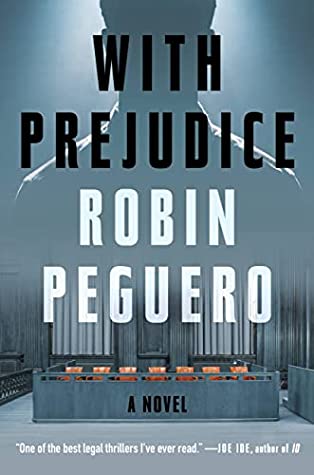
Review | With Prejudice, by Robin Peguero

WithPrejudiceWith Prejudice is a complex legal thriller about a murder trial: Gabriel Soto is accused of murdering Melina Mora. Her hair is found in his home, traces of bleach stain his floors, and a witness says she saw them arguing at a bar the evening Melina was killed. Through the trial, various bits of evidence collide with the prejudices of the people involved, and Peguero takes us into the minds and hearts of witnesses, jury members, even the judge and lawyers. Deliberately, Gabriel’s mind remains obscured until the very end, leaving us to deliberate along with the jury whether or not Gabriel is indeed guilty of this crime.

The courtroom drama was fascinating. I loved seeing Sandy and Jordan butt heads, and I especially love Sandy’s strategic choice of the soft-spoken, rumpled Nate as her second chair. I would totally read a sequel starring Nate on a case. Peguero’s background as a prosecutor is evident, with the various legal details dropped in, and the way the reasoning behind the judge’s decisions are outlined.

However, i found the story much weaker outside the courtroom. The detours into the juries’ stories was confusing and often felt unnecessary. Peguero sometimes slips into a somewhat florid narration in these scenes, and with so many side characters who matter only for a chapter or two, it takes a while to figure out what’s going on and how it relates to the story. Worse, Peguero begins these chapters with the side character’s real name, and their lives outside the trial, only revealing them to be juror number one or whatnot after the detour into their past is over, which often leaves me wondering for most of the chapter why on earth I should care about this random person. These bits of their past are interesting insofar as they show their biases, but a late reveal in the novel makes so much of this part of it moot for the purposes of the main plot. Peguero also switches between the juror’s name and their number throughout the chapters, which just adds to the confusion.

The side stories about the lawyers and the judges are also underdeveloped. Sandy’s relationship with a reporter is interesting, but then it’s mostly shunted aside for the trial. Jordan’s depiction as a vain pretty-boy with a gorgeous wife holds promise, but we never (or maybe only briefly?) meet this wife or his family. And the second chairs — Nate, whom I found most fascinating as the quiet man who’s often underestimated, and Jordan’s second chair, a woman fresh out of law school who makes an intriguingly rookie mistake while examining a witness– aren’t even given back stories at all. The detective, Sterling, probably gets the most nuanced back story, if only because his biases are a bit harder to tease out, and when revealed, turn out to have complex reasons behind them. But in the mass of mini-glimpses into many characters’ lives, Sterling’s back story feels frustratingly underdeveloped.

Still, the courtroom drama kept me hooked, and I was ready to call this a fun, if a bit scattered at times, book. But I absolutely hated the ending, and the major reveal at around the 75% mark that led up to it. I’ll allow that the ending is (unfortunately) realistic, witnesses and evidence being as they are. I’ll also allow that Peguero set up the twist solidly — looking back, there’s no reason why things couldn’t have unfolded in that way, and Peguero used quite a few clever techniques to keep it under wraps. But as someone who was super invested in the trial and its outcome, I hated it. I didn’t get that thrill of “OMG I didn’t see that coming!” Rather, I felt cheated, and wish that things had turned out differently.

+

Thanks to HBG Canada for an e-galley in exchange for an honest review.

Review | The Change, by Kirsten Miller

TheChangeCoverThe Change is a fun, fast-paced, feminist revenge fantasy starring a trio of powerful middle-aged women. The three protagonists all came into their powers after menopause, and in a market filled with feminist fiction often starring younger women, how absolutely incredible is it to add this title to that list?!

The three protagonists are a delightful trifecta of women who’d kept quiet and ‘good’ for far too long. Nessa, a widow and former nurse, heard her first spirit when she was twelve; now that her daughters are away at college and menopause has begun, she begins to hear the voices again. Jo, a former high-powered executive with a playwright husband who supports her career, has opened up a women’s only gym called Furious Fitness, for women who want to burn off their rage through exercise. Her hot flashes turn out to be fuel for super strength, channelled through her hands. And Harriet, a former advertising director, lets her inner wild woman out when her husband leaves her for a younger woman; her neat suburban home becomes overgrown with plants, and women in the neighbourhood soon know to go to her for help with all sorts of situations.

Nessa, with her gentle nature and her subplot romance with a police detective, is the one I related to and enjoyed reading about the most. But Harriet’s experiences in advertising, where her most useful skill was getting her great ideas through by making her less talented but more powerful male colleagues think they’d come up with the ideas themselves, hit hard. One of my favourite scenes is when a former colleague begs her to lift the curse she’d put that prevented him from coming up with great ideas, and she tells him, truthfully, that there’s no curse; the great ideas were never his in the first place. He doesn’t believe her, and in the midst of the more supernatural plot points, that moment feels incredibly realistic.

Nessa, Harriet, and Jo team up when they discover the dead body of a teenage girl on a beach, and the ghosts of two other teenage girls by the water, and realize there’s a serial killer on the loose who preys on young girls. The killer’s identity is revealed fairly early on, and he is brought to justice long before the book is over, which then opens up the floor to the more important questions Miller and her characters want us to contemplate: who else is complicit in crimes such as these, and how are systems and structures set up to support these crimes going on unchecked for so long?

As a rage-fuelled revenge fantasy, The Change is both deeply satisfying and deliberately discomfiting. There were moments when I found myself thinking that Harriet, the enforcer of the trio, had gone a tad too far, that there are surely gentler ways to get her point across. And when Nessa is confronted with a choice between her police detective boyfriend’s offer of support within legal forms of justice, and Jo and Harriet’s invitation to explore quicker, more effective, yet more violent means to justice, I found myself wanting her to choose her boyfriend — not because I cared so much about the law, but because the boyfriend’s appeal to pacifism appealed to me.

The Change prompts me to reflect on my response — as women, we’re so conditioned to be gentle and soft, yet when so many young women are treated so brutally, killed, and discarded like garbage, where do we draw the line and declare that enough is enough? More importantly, how loud and forcefully are we willing to make that declaration? For Nessa, Jo, and Harriet, they’ve reached their tipping point, and taken a big, confident stride right over that line. And their story invites other women to do the same.

+

Thank you to Harper Collins Canada for an advance reading copy of this book in exchange for an honest review.