Unknown's avatar

About Jaclyn

Reader, writer, bookaholic for life!

Blog Tour and Giveaway: How The Law of Dreams and The O’Briens are linked, Guest post by author Peter Behrens

Peter Behrens (c) Ryan Goodrich

The Law of Dreams and The O’Briens are connected. The first novel is a story from my great-great grandfather’s generation; the other is from my grandfather’s era. They are both “family stories” though fictionalized: based on family history, family stories, family myth. The character Joe in The O’Briens is based on my grandfather. The character Fergus from The Law of Dreams is based on my great-great grandfather.

My grandfather “Joe” was 17 when “Fergus” died; I was 17 when my grandfather died (that’s how close we are to the Irish Famine — we can almost reach across to touch hands of that generation). I had to make up a lot of Fergus’ story because the facts of his journey were lost: all I knew was the bare outlines of geography and history and emigration.

In The O’Briens, Fergus is never named, but he is referred to on one of the early pages as Joe’s grandfather who had “an appetite for geography and change” and whose life and death is shrouded in mystery . . . he’d been a “buffalo hunter in Ruperts Land;” a horse trader; he may or may not have been murdered in Texas, or drowned at Cape Horn.

Ireland is also a connection between these two novels. Fergus, in TheLaw of Dreams, comes out of Ireland. Joe is the grandson of the Famine refugee, and has very little sentimental feeling for Ireland. In fact, he even tells his brother Grattan, who wants to return to fight in the Irish war of independence, that he, Joe, “doesn’t give a rat’s ass for Ireland.” Yet the family remains very Irish in some of its ways: it’s vestigal Catholicism; Frankie’s belief in the “second sight” — the ability to see into the future — that she shares with her “Black Irish” father.

Note: Just a reminder, Anansi has been kind enough to give me a copy of The O’Briens to give away. To enter your name in the draw, just leave a comment on this post, or on yesterday’s post telling me where your family is from and where in the world you would settle if you had the choice. Please also leave your email address, so we can contact you if you win. I’ll pick a random winner on June 13th.


Blog Tour and Giveaway: The O’Briens, Peter Behrens

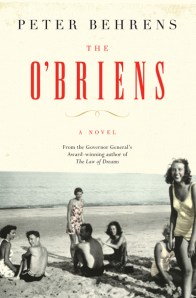
The O’Briens by Peter Behrens is a sprawling family saga that follows the life of Joe O’Brien. Chronicling Joe’s life from his childhood protecting his siblings from an abusive stepfather Joe’s business building a section of the railroad to his children going off to fight in World War II, The O’Briens also depicts a  slice of Canadian history. I haven’t read Behrens’ first novel, The Law of Dreams, and at first I was afraid I wouldn’t be able to understand this novel, but I found that O’Briens works wonderfully as a stand-alone as well.

Joe is a fascinating character, and I enjoyed watching him grow from a protective older brother to a scarred father. Like his own father, Joe has a thirst for travel, and I love how this restlessness was later inherited by Joe’s son Mike. In a novel about exploring North America and eventually settling down with a family, the O’Brien wanderlust is an apt family trait. The best parts of O’Briens are where Behrens really delves into very raw emotions, to the point that the situation can make the reader uncomfortable. The section, for example, where Joe leads his siblings in dealing with their stepfather is rather disturbing, mostly because the persons involved are young children, but I love seeing Joe’s struggle to be the father figure for his siblings and his desire to force them to grow up as well so they can survive even without him. I love the scene where Iseult has to give birth without Joe around, a terrifying episode, and Behrens captures the emotions wonderfully.

I also love the little quirks that define characters. Iseult’s obsession with photography for example, reminds me of my own mother, who loved taking pictures, though thankfully not to the extent Iseult does. The part about Iseult stopping to take a photo of her crying child before running over to see if first aid is required could have come off as gimmicky, but Behrens has set it up so well beforehand that the extent of her obsession feels natural.

Behrens’ descriptions are poetic, and I really liked some of the phrases. About stained glass windows, Behrens writes, “Rich shards of colour broke through those exuberant windows, and exotic scents — silver polish, English tobacco, China tea — drifted through the chiaroscuro rooms.” At times, I would’ve preferred a bit more subtlety in the way he depicts emotions: “Iseult felt her lungs deflate, withering as grief closed in. […] As [the phone receiver] dangled on its wire, she got slowly down on hands and needs, touched her forehead to the Tabriz carpet, then rolled over and lay on her side on the mottled wool, gasping and wheezing…” While I actually liked the image of lungs withering with grief, I found the scene getting somewhat melodramatic as it went on. What I did like, however, was that Behrens then immediately balances it out with humour, having the housekeeper Cordelia walk in and trip over Iseult’s body.

I liked the novel best when it was focused on Joe growing up. I wished it had shown more of his siblings other than Grattan — with the priest character so prominent in the first chapter, I was interested in seeing how the siblings who entered the religious life dealt with it — but I can understand Joe being completely separated from them. I didn’t find the chapters with Joe’s children as compelling, with the major exception of the part about Mike running away from home. The latter part of the novel, switching between Joe’s three children, felt somewhat disjointed, and I would’ve preferred having a central character in the next generation at least, or even Joe himself, to have provided a focal point of view.

Overall, a good book and compelling family saga. The book’s publisher Anansi has been kind enough to provide me with a copy of the book for to give away (Canadians only, please). To enter your name in the draw, just leave a comment telling me where your family is from and where in the world you would settle if you had the choice. Please also leave your email address, so we can contact you if you win. I’ll pick a random winner on June 13th.

Peter has also been kind enough to write a guest post for my blog. Keep an eye out for it tomorrow. Leave a comment on his post for an extra entry into the contest.

The Hunchback Assignments, Arthur Slade

I’m not a big fan of the steampunk genre. I tried it once with a manga from the library, and thought it was all right, but didn’t enjoy it as much as the martial arts manga I’d also checked out. So take this review of Arthur Slade’s The Hunchback Assignments from someone unfamiliar with the genre — I love, love, love this book!

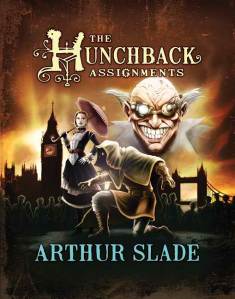
Fourteen year old Modo is a hunchbacked orphan in Victorian London, who has the ability to change his appearance. When he was a year old, he was adopted by Mr. Socrates and trained to become a secret agent. In his first assignment, he works with fellow agent Octavia Milkweed to stop a secret society who has been kidnapping children and working with Dr. Hyde to turn them feral. I have to admit, when I first heard the name Modo, I was a bit turned off by what I saw as a gimmicky similarity to the Disney movie. But when I found out that “Modo” is Latin for “formed,” I actually like the significance of the difference from the Disney name Quasimodo.

Modo is absolutely lovable. Taught from a young age that his natural form is ugly, he wears a mask to go out in public and creates a handsome knight appearance when dealing with Octavia. Modo’s crush on the beautiful Octavia is just heart-wrenching. Octavia is an intelligent, witty girl, and as she grew up an unloved orphan forced to pick pockets, she also understands how it is to not be wanted. So I think she would accept, and maybe even love, Modo in his true appearance, but because she is so beautiful, Modo is ashamed to remove his mask or his false knight’s face around her. The way he reacts whenever she shows up just makes my heart melt, and I’m not usually romantic.

The mystery about the kidnapped children, at least one of whom has been hypnotized to attack his own father, is exciting and fast-paced. Modo, while mostly innocent of the real world, is physically strong and a quick thinker. I also love how Octavia is a Buffy-esque heroine, strong enough to fight her own battles, and savvy enough to wear pants under her skirt so she can run faster. But the power of Slade’s story isn’t really in the twists and turns; it’s in the very tangible emotions he reveals in his characters, whether the heroic agents or the child victims. The ultimate solution to the mystery, while action-packed enough to imagine on the big screen, is also heartfelt, and that adds to its wallop.

Hunchback Assignments is an intriguing science-based mystery set in Victorian London. More than that, however, it’s about not fitting in, about wanting to be an even better person for love and yet being limited by something beyond your control. It’s inspirational, but not in a sappy you-can-do-anything-if-you-try way. Modo doesn’t completely overcome his appearance or learn to live with it. Rather, he finds a community of people who also don’t fit in. Everyone is an outcast, in some way, even the beautiful Octavia, and if you’ve ever felt unworthy, unloved, or just plain lacking in some way, or, heck, even if you just enjoy a good mystery with a bit of romance, definitely, definitely read this book.